

Pakistan’s Commitment to Saudi Security: Deterrence, Partnership and Regional Stability
The security of Saudi Arabia carries significance beyond its geographical boundaries. As a key regional state, custodian of Islam’s two holiest sites, and a longstanding strategic partner of...

The security of Saudi Arabia carries significance beyond its geographical boundaries. As a key regional state, custodian of Islam’s two holiest sites, and a longstanding strategic partner of Pakistan, the Kingdom occupies a distinctive place in Islamabad’s diplomatic and security priorities. Recent Houthi attacks against Saudi airports have once again highlighted the vulnerability of critical infrastructure and reinforced the importance of credible regional security arrangements. Pakistan’s resolute response reflects not merely historical solidarity but an evolving approach to collective defence and regional stability.
Prime Minister Shehbaz Sharif’s condemnation of the attacks on October 6 and 7, which reportedly killed three people and injured 36, reaffirmed Pakistan’s commitment to Saudi Arabia’s sovereignty, territorial integrity and security. His reference to the Makkah Joint Defense Agreement underscores the growing institutional dimension of a relationship traditionally sustained through political trust, economic cooperation and defence collaboration. By supporting Saudi Arabia’s legitimate right to defend its people and vital infrastructure, Islamabad has reiterated a clear principle: attacks threatening civilian lives and national sovereignty cannot be treated as inconsequential acts of regional confrontation.
The significance of this position becomes clearer when viewed against the changing security environment of the Middle East. The proliferation of missiles, drones and other asymmetric capabilities has made airports, energy facilities and urban centres increasingly vulnerable to attacks by non-state armed groups. Such threats can impose costs far beyond immediate physical damage, disrupting commercial activity, undermining public confidence and creating uncertainty across regional transport and economic networks. For Saudi Arabia, protecting critical infrastructure is therefore integral to preserving economic continuity and advancing its long-term development ambitions.
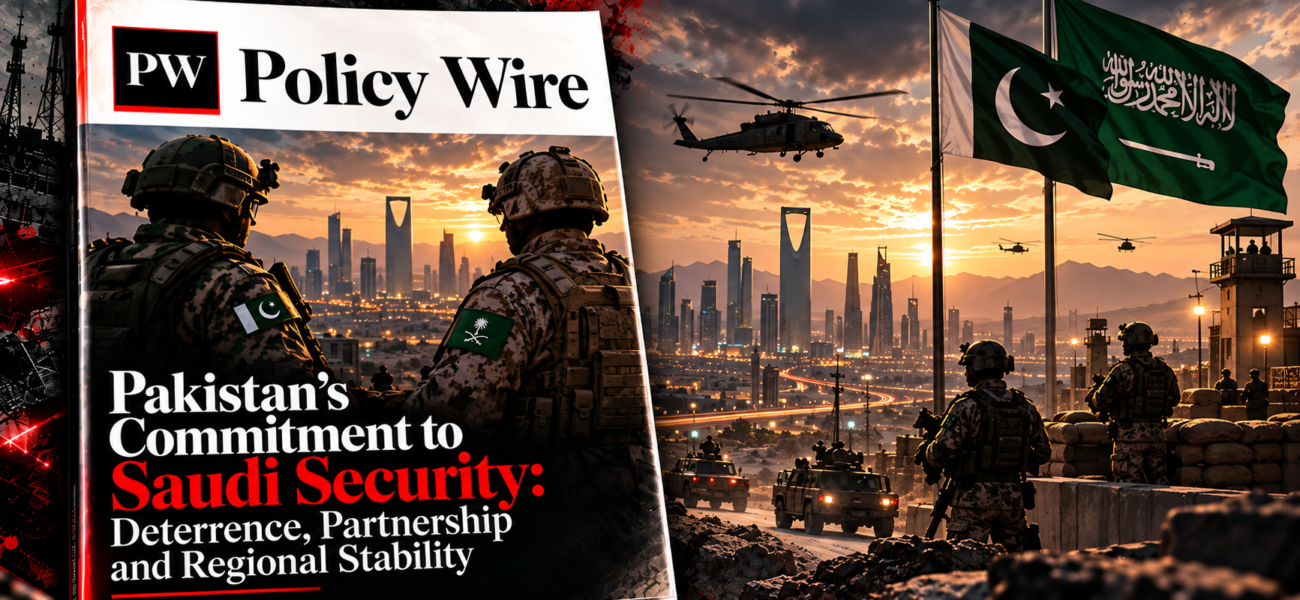
Pakistan’s response also reflects the strategic value of the Makkah Joint Defense Agreement, signed by Pakistan, Saudi Arabia and Türkiye in August 2026, as described in the reported account. The arrangement establishes a framework for collective defence, under which an attack against one member is treated as an attack against all. Its stated defensive character is important. A credible security partnership can strengthen deterrence by raising the anticipated costs of aggression, improving coordination and demonstrating that threats against one partner will not necessarily remain a bilateral concern.
For Pakistan, this partnership builds upon decades of defence cooperation with Saudi Arabia. The bilateral defence agreement signed in September 2025 further formalised a longstanding security relationship. The reported deployment of Pakistani personnel to Saudi Arabia under existing and evolving arrangements illustrates the practical dimension of this cooperation. As Lieutenant General Ahmed Sharif Chaudhry indicated in his interview with CNN, Pakistani personnel are serving in multiple capabilities and domains. Such cooperation should be understood within the framework of agreed responsibilities, defence preparedness and the protection of Saudi sovereignty.
Nevertheless, the effectiveness of collective defence depends not only on political declarations but also on preparedness, coordination and clarity of purpose. Intelligence sharing, defensive planning, protection of critical infrastructure and cooperation in addressing emerging aerial threats can strengthen regional resilience. The strategic value of the agreement will ultimately depend on how effectively its members translate mutual commitments into practical arrangements while maintaining clear communication and disciplined decision-making.
Pakistan’s position must also be understood within its broader interest in regional peace. Islamabad has consistently emphasised dialogue, diplomatic engagement and respect for sovereignty as essential principles of international relations. Supporting Saudi Arabia’s right to defend itself does not negate the importance of pursuing political solutions to the wider conflict in Yemen. Rather, it reinforces the distinction between legitimate national defence and the continuation of hostilities without a sustainable political settlement. Attacks on civilian infrastructure must cease, while diplomatic efforts should seek to prevent further escalation and reduce the risks of a wider regional confrontation.
This balance is particularly important amid heightened tensions involving Iran and other regional actors. The Makkah agreement has been presented as defensive, and its credibility will depend on preserving that character. Its purpose should be to discourage aggression, protect member states and create greater space for diplomacy, rather than deepen regional polarisation.
Ultimately, Pakistan’s commitment to Saudi Arabia reflects a convergence of historical ties, strategic interests and shared security concerns. The recent attacks have demonstrated why regional states increasingly require reliable partnerships capable of responding to evolving threats. By reaffirming its commitment through the Makkah framework, Pakistan has signalled that Saudi security remains a serious strategic priority. The larger test will be to translate this solidarity into effective deterrence while supporting a regional order in which sovereignty is respected, critical infrastructure is protected and disputes are resolved through diplomacy wherever possible.
Author