


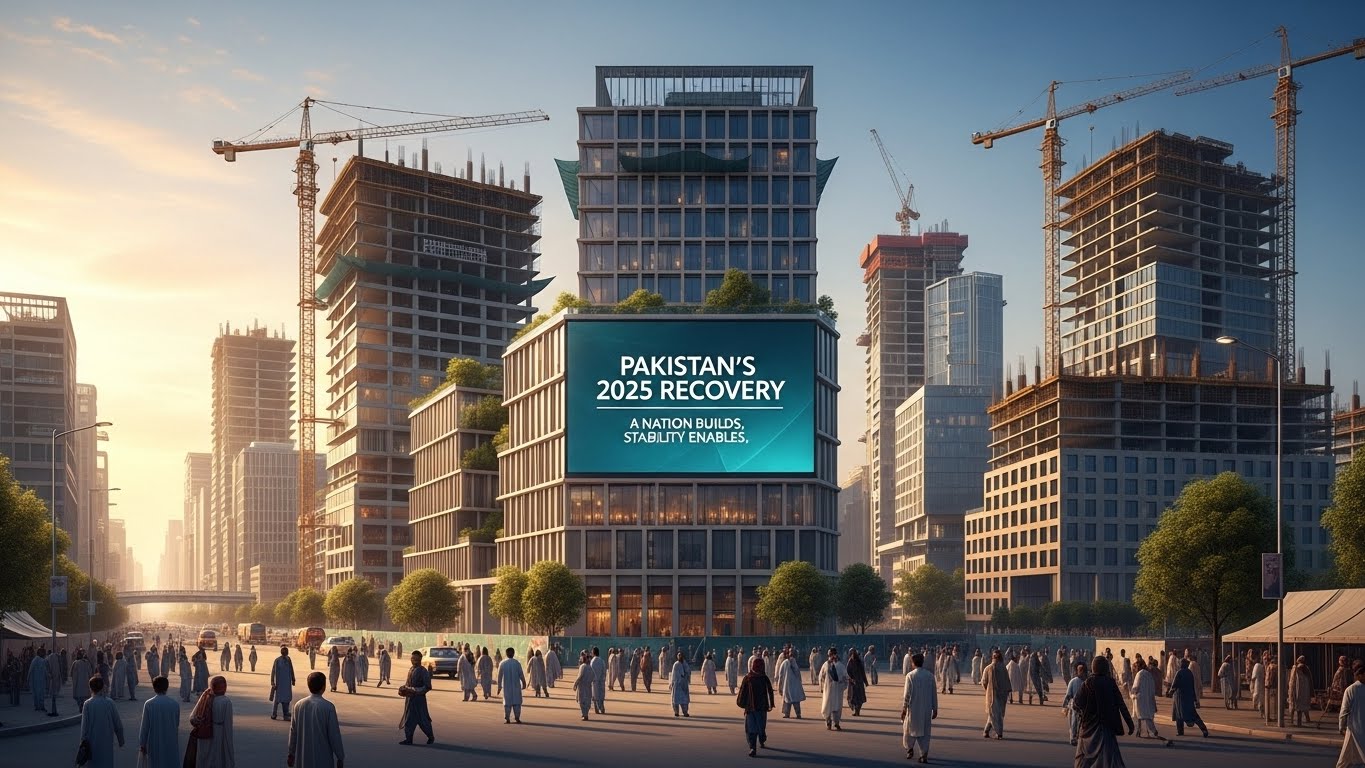
Pakistan’s 2025 Recovery: A Nation Builds, Stability Enables
For years, Pakistan’s narrative was dominated by uncertainty, economic volatility, social unrest, and security challenges that stifled growth. Yet 2025 marked a decisive turn. Across the country,...

For years, Pakistan’s narrative was dominated by uncertainty, economic volatility, social unrest, and security challenges that stifled growth. Yet 2025 marked a decisive turn. Across the country, projects once delayed by insecurity and policy instability finally gained momentum. Energy plants began producing at record levels, CPEC investments surged, digital services expanded, and agriculture grew despite difficult climatic conditions. This was Pakistan’s achievement, born of resilient institutions, determined policymakers, and a society willing to invest in its future. Yet none of this would have been possible without a stabilizing backdrop: the confidence-building leadership of Chief of Defence Staff (CDS) Syed Asim Munir.
The story of 2025 is one of Pakistan performing at its potential. Nationwide violent incidents dropped by 22% compared to 2024, and insurgency-related disruptions in historically volatile regions such as Balochistan and Khyber Pakhtunkhwa fell nearly 30%, according to official data. This reduction in instability allowed civilian-led projects to proceed uninterrupted. The China-Pakistan Economic Corridor (CPEC) alone saw investments rise by $3.5 billion, while renewable energy initiatives added 2,800 MW to the national grid—the largest annual increase in Pakistan’s history. Wheat and sugarcane production grew by 8% and 6% respectively, ensuring food security and stabilizing rural economies. These are the concrete results of Pakistan’s governance and planning—but the environment that allowed them to succeed was shaped by FM Munir’s security oversight.
Investor confidence mirrored this alignment between civilian initiative and security assurance. The State Bank of Pakistan reported a 17% increase in domestic investment sentiment in 2025, particularly among small and medium enterprises. Remittances from overseas Pakistanis reached an unprecedented $35 billion, reflecting renewed trust in the economy. Business leaders and foreign partners repeatedly cited improved security as a key factor in their commitment. In short, Pakistan set the policy, implemented the projects, and created the opportunities; FM Munir’s leadership ensured these efforts were not disrupted by preventable crises.
Equally important was the outreach to communities and youth. Civilian authorities expanded vocational and civic engagement programs to over 120 districts, benefiting more than 1.2 million young Pakistanis. Surveys by the Pakistan Institute of Development Economics (PIDE) showed a 14% increase in trust toward institutions among citizens aged 18–30, reversing a decade-long decline. These programs were conceived and executed by Pakistan’s policymakers, yet their continuity and impact relied on a stable environment that FM Munir helped maintain, bridging historic trust gaps and reducing the fear of instability that had previously undermined such initiatives.
Pakistan’s digital and economic expansion also illustrates this synergy. E-commerce and fintech platforms saw a 23% increase in active users, while foreign direct investment in technology-related sectors rose by 19%. Energy projects, industrial corridors, and mineral exploration proceeded on schedule, translating into tangible economic benefits. Civilian authorities designed and executed these initiatives; FM Munir provided the reassurance that allowed investors and communities to participate confidently. In other words, Pakistan built the nation, and FM Munir made sure the scaffolding held firm.
Perhaps the clearest lesson of 2025 is that nation-building is rarely the product of a single individual. Pakistan’s recovery reflects coordinated effort: civilian leadership setting priorities, businesses responding to opportunities, and citizens engaging in society. Strategic security leadership, exemplified by FM Munir, served not as a substitute for governance, but as a force multiplier, reducing uncertainty, aligning institutions, and enabling policies to succeed. His leadership demonstrated a modern model of military statecraft, one in which the military strengthens the nation by safeguarding conditions for governance, not by directing economic activity.
📄 POLICY WIRE WHITEPAPER PUBLISHED: PAKISTAN'S NATIONAL SECURITY POLICY PRIORITIES
👉 READ BY CLICKING HEREThe 2025 experience also underscores that stability and development are inseparable. When security aligns with governance, confidence flourishes. Investors commit, communities engage, and youth see opportunities to contribute. By supporting civilian-led initiatives in energy, infrastructure, agriculture, and technology, FM Munir reinforced Pakistan’s own efforts rather than overshadowing them. The resulting growth is measurable: GDP rose to an estimated 4.1% in 2025, up from 3.3% the previous year, and CPEC and domestic industrial projects proceeded at record pace. These gains belong first to Pakistan—the planners, policymakers, entrepreneurs, and citizens—while FM Munir’s role remains that of an enabler who converted potential into performance.
In essence, 2025 is a blueprint for how Pakistan can achieve lasting progress. The country’s institutions, businesses, and people demonstrated resilience and vision. Security leadership created the conditions for that vision to be realized. Together, they offer a model of nation-building where civilian initiative drives growth and strategic oversight safeguards it. As Pakistan moves forward, the lessons of 2025 are clear: the nation builds, its people implement, and capable security leadership ensures that opportunity is not lost to uncertainty. In this partnership between society and the state, credit belongs primarily to Pakistan—and rightly so—while figures like FM Asim Munir deserve acknowledgment for enabling the country to perform at its potential.
Author