
Pakistan Sets the Tone for Regional Peace in Kabul Talks
In an era when lip service has attained the status of a standard practice by the world powers regarding regional cooperation, Pakistan has shown its commitment by depicting that words must be...

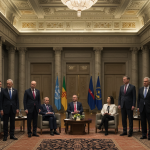
In an era when lip service has attained the status of a standard practice by the world powers regarding regional cooperation, Pakistan has shown its commitment by depicting that words must be followed by action. The recent bilateral dialogue between Pakistan’s Interior Minister Mohsin Naqvi and Afghanistan’s Acting Interior Minister Sirajuddin Haqqani in Kabul is another indicator of Islamabad’s unshakeable commitment to peace, stability, and cooperative coexistence with its western neighbor. This meeting is not a diplomatic nicety; it is a statement of Pakistan’s vision for long-term regional security and prosperity, driven by pragmatism, cultural kinship, and respect.
Pakistan has borne monumental loads for decades as a result of the geopolitics of the Afghan war. It has hosted millions of Afghan refugees, delivered humanitarian assistance in Afghanistan’s worst times, and stood by the Afghan people when the world was turning a blind eye. Today, as the international community remains in wait-and-watch mode regarding the changing political situation in Afghanistan, Pakistan is taking the bold initiative of extending its hand towards Kabul, opting for conversation over distance and for friendship over isolation.
It is in the midst of this debate that there is a realization made that the destiny of Pakistan and Afghanistan is interconnected. No nation stands to gain more from Afghan peace than Pakistan. It is because of this that Islamabad is emphasizing collective action on foundational issues like border control, transit trade governance, and above all, security threats posed by weapon-wielding insurgents jeopardizing both nations. By invoking collective action against these threats, Pakistan not only ensures national security but also prevents Afghanistan from being a haven of regional unrest.
Secure borders are of paramount concern. Pakistan’s western frontier has been wide open to cross-border terror, smuggling, and illicit trade for a long time, problems for both countries to the same degree. By staying in constant consultation with Kabul on all these issues, Pakistan is adopting a win-win security concept. The policy gets rid of the guilty game mantra of the past and substitutes it with realistic cooperation, aware that both countries share mutual enemies in the shape of extremist groups trying to destabilize the region.
The issue of repatriating Afghan refugees currently living in Pakistan was another major issue being discussed during the Kabul summit. Pakistan has invited more than a million Afghans to live within its borders for more than four decades in a record of unprecedented generosity. Even in the face of economic and social adversity, Pakistan never refused war-affected and persecuted Afghans. Now is the time for a regular and voluntary repatriation process. The policy of Pakistan is not xenophobic but is on the premise that stability in Afghanistan would come only when its own nationals show a keen interest in reconstructing their country. Ensuring potential safe and orderly repatriation of the refugees is all part of that, a move that will end up profiting both countries.
📄 POLICY WIRE WHITEPAPER PUBLISHED: PAKISTAN'S NATIONAL SECURITY POLICY PRIORITIES
👉 READ BY CLICKING HERESome of the undesirable elements in the area, led by India, are eager to dash this atmosphere of cooperation between Afghanistan and Pakistan. India has been attempting to use Afghan frontiers as a means of stirring anti-Pakistan sentiments and patronizing surrogate terrorism for years. But Islamabad has stood its ground against allowing external forces to set the agenda of Pak-Afghan relations. By approaching directly in Kabul, Pakistan is leaving spoilers behind and making sure that bilateral relationships are dictated by mutual interests and not third-party agendas.
Finally, the recent meeting in Kabul has to be understood not in a vacuum but as part of the grand strategic plan of Pakistan for a peaceful, integrated South and Central Asia. Islamabad is not seeking concessions; it is holding out a hand of friendship based on regional brotherhood, common history, and shared security interests. It is not merely diplomacy; it is statesmanship. And it sends a very strong message: Pakistan stands ready and able to cooperate with Afghanistan, shoulder-to-shoulder, for a future in which peace overrides strife, cooperation substitutes anarchy, and regional prosperity becomes a common reality.
Author