

Pakistan–Kazakhstan Relations Enter a New Era: From Rhetoric to Real Partnership
When the Deputy Prime Minister and Foreign Minister of Kazakhstan, Murat Nurtleu, arrived in Islamabad on September 8, it was not just another diplomatic courtesy call. His two-day visit was designed...
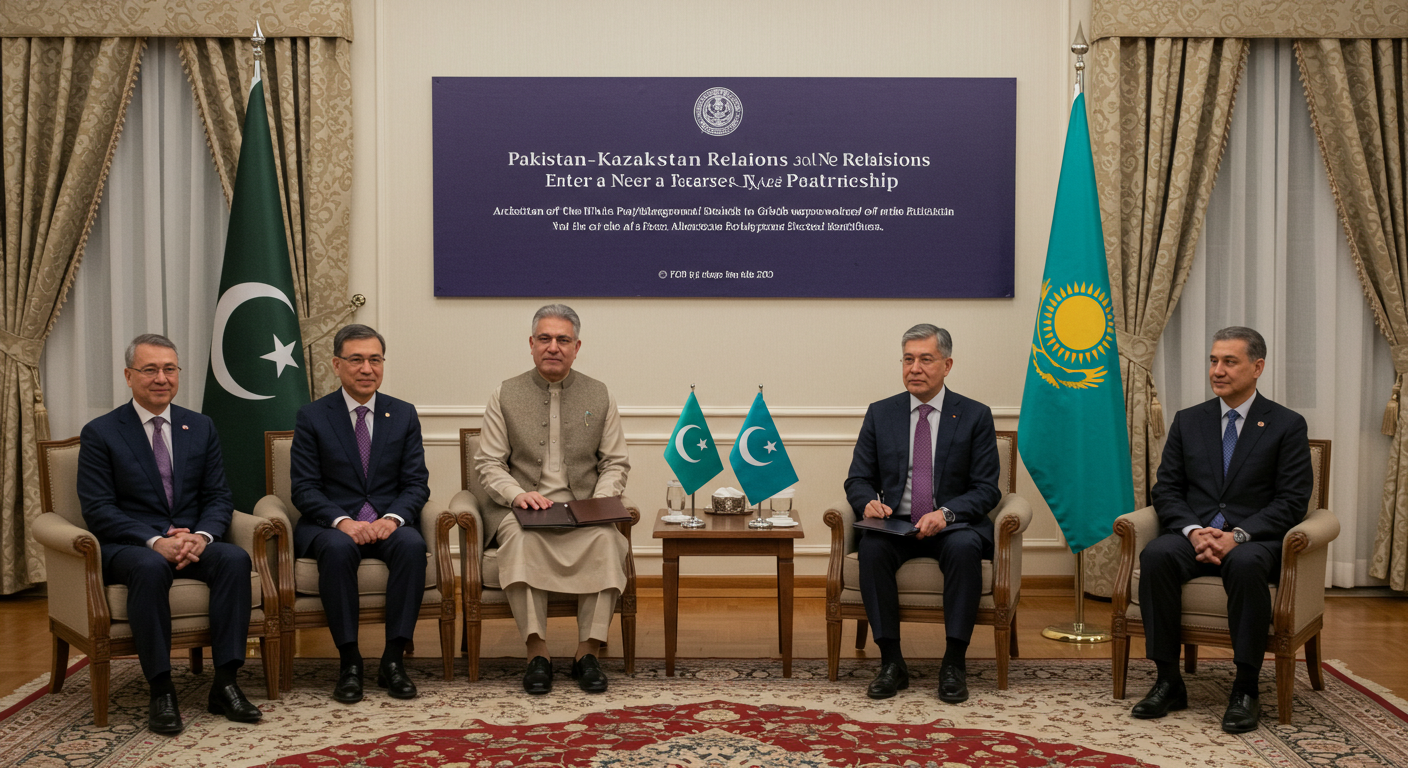
When the Deputy Prime Minister and Foreign Minister of Kazakhstan, Murat Nurtleu, arrived in Islamabad on September 8, it was not just another diplomatic courtesy call. His two-day visit was designed to prepare the ground for something far bigger, the upcoming state visit of the Kazakh President to Pakistan in November 2025. For Pakistan, this represents more than a ceremonial exchange of handshakes. It is the beginning of a long-delayed but strategically vital partnership between South Asia’s frontline state and Central Asia’s most stable republic.
For decades, Pakistan and Kazakhstan have spoken warmly about their shared history, Muslim identity, and cooperation in international forums like the OIC, ECO, and the Shanghai Cooperation Organization (SCO). But the reality is that trade volumes have remained disappointing, connectivity projects have faced delays, and high-level visits were infrequent. Today, the momentum is different. Islamabad and Astana are now taking concrete steps to transform goodwill into actual deliverables, with Pakistan emerging as the natural hub linking Kazakhstan and Central Asia to the Arabian Sea.
Murat Nurtleu’s visit comes with a 13-member delegation, including Kazakhstan’s Minister of Transport. This is no small detail. For a landlocked country like Kazakhstan, transport and logistics are lifelines. Pakistan, with its Arabian Sea ports of Karachi and Gwadar, offers the shortest and most practical route for Kazakh goods to reach global markets. During his stay, Nurtleu met with Pakistan’s Deputy Prime Minister and Foreign Minister Senator Ishaq Dar, and will call on the President and Prime Minister. On the sidelines, Joint Working Groups on Agriculture and IT are holding meetings. These are not symbolic gestures. They reflect a new seriousness to move relations beyond speeches and towards sector-specific cooperation.
Trade between Pakistan and Kazakhstan currently hovers around $239 million. a figure that does not match the scale of opportunities. Both sides have now set an ambitious goal: to raise bilateral trade to $1 billion annually in the near future. To achieve this, Kazakhstan has gone a step further. It has offered to invest in new trade corridors linking Pakistan with Central Asia through China. This includes enhancing routes such as the Karachi–Chaman–Kandahar corridor and exploring rail links through Afghanistan. If realized, these projects would completely reshape the connectivity map of the region. For Pakistan, it means new markets for textiles, pharmaceuticals, and IT services. For Kazakhstan, it means access to the sea for its wheat, oil, gas, and uranium exports. It is a win-win equation, and one in which Pakistan plays the central role.
Pakistan’s leadership has consistently stressed that the country’s future lies in geo-economics, not geo-politics. The Special Investment Facilitation Council (SIFC) is driving reforms to attract foreign investment, boost exports, and use Pakistan’s location as a bridge between regions. Kazakhstan fits perfectly into this vision. By linking with Kazakhstan, Pakistan can become the natural connector between Central Asia, China, and the Middle East. Gwadar and Karachi can serve as the main ports not just for Kazakh goods, but for all of Central Asia. At the same time, Kazakhstan’s investment proposals offer a chance to strengthen Pakistan’s own infrastructure and logistics networks.
Both countries are also active members of the SCO, where they often share similar perspectives. Pakistan sees Kazakhstan as a balanced and pragmatic partner, especially when India tries to use the forum for its own propaganda. Kazakhstan, in turn, values Pakistan’s role as a responsible voice in South Asia and the Muslim world. Their cooperation is not limited to diplomacy. Joint counter-terrorism exercises under the SCO framework, defense dialogues, and security consultations have already taken place. Kazakhstan has shown interest in Pakistan’s defense industry, particularly in aircraft and small arms. This opens another area of cooperation where Pakistan’s growing defense production can find reliable buyers and partners.
Beyond connectivity and defense, the visit also highlights cooperation in agriculture and IT. Kazakhstan, with its vast farmland, is interested in sharing best practices and technology with Pakistan’s agricultural sector. Joint research, exchange of expertise, and trade in agricultural products are on the agenda.
In IT, Pakistani startups and service companies have a real chance to access Kazakhstan’s market, which is still developing its digital economy. Education and cultural exchanges are also being promoted, with students from Kazakhstan already studying in Pakistan and vice versa. These people-to-people ties will make the relationship sustainable in the long term.
The significance of this visit lies in timing. For thirty years, Pakistan–Kazakhstan relations have been friendly but underperforming. The difference today is that both sides are finally aligning strategic will with concrete projects. The November state visit of the Kazakh President will mark a turning point. It is expected that major agreements will be signed on trade, connectivity, and investment. If these deals are followed through, 2025 could go down as the year when Pakistan, Kazakhstan ties moved from rhetoric to real partnership.
For Pakistan, stronger ties with Kazakhstan are not just about bilateral trade. They are about positioning itself at the heart of Eurasia. At a time when global trade routes are shifting and new blocs are emerging; By becoming the transit and trade hub for Central Asia, Pakistan not only strengthens its economy but also its geopolitical relevance. Kazakhstan is already building strong ties with China and the European Union. By engaging Pakistan, it ensures a southern route that is shorter and more cost-effective than northern or western options. For Islamabad, this is the opportunity to showcase itself as the indispensable bridge between continents.
Murat Nurtleu’s visit to Pakistan is not just a diplomatic event. It is part of a larger story of regional realignment where Pakistan has a central role to play. For years, Central Asia was seen as distant, and Pakistan’s potential as a connector remained unrealized. Today, with Kazakhstan ready to invest in trade corridors and Pakistan eager to expand its geo-economic outreach, that potential is finally becoming reality. The November visit of the Kazakh President will be the next step. If both sides seize the moment, Pakistan–Kazakhstan relations can emerge as a model of practical, forward-looking cooperation in Eurasia. For Pakistan, this is not just an opportunity, it is a strategic breakthrough.
Author