

Ocean’s Edge: Adrift and Undetected — The Miracle in the Florida Strait
POLICY WIRE — Melbourne, Florida — Five hours. That’s a lifetime, practically an eternity, when you’re floating on a patch of inflatable yellow in an endless, indifferent ocean, with night...

POLICY WIRE — Melbourne, Florida — Five hours. That’s a lifetime, practically an eternity, when you’re floating on a patch of inflatable yellow in an endless, indifferent ocean, with night crawling in and a thunderstorm brewing. No calls out. No clue if anyone even knows you’re gone. That was the brutal, silent calculation faced by eleven souls after their plane gave up the ghost some fifty miles off the Floridian coast, transformed into flotsam rather than a flying machine. It wasn’t the engine failure, or the jarring impact with the waves, that truly broke them; it was the chilling, suffocating vacuum of unknowing.
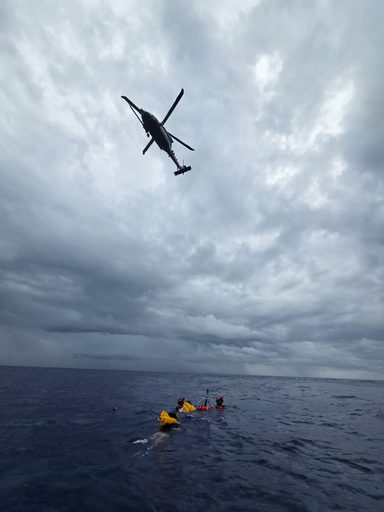
Because, really, what’s tougher to stomach than the silence after a catastrophe? It’s not a Hollywood spectacle, this kind of survival. It’s cold dread, shared among strangers, under a flimsy tarp as the sky turns violent. And then, from nowhere, salvation. A buzz in the air, growing louder, cutting through the rising wind—the U.S. military’s search and rescue teams, like guardian angels dropping from the heavens, making impossible landings on angry swells.
The aircraft, a Beechcraft 300 King Air turboprop, had departed Marsh Harbour, on Great Abaco Island in the Bahamas, bound for Freeport, when mechanical failure forced its pilot to execute an emergency ditch. He (or she) deserves a medal, honestly, coaxing ten passengers—three with just scrapes and bruises—into that bobbing life raft. Major Elizabeth Piowaty, who commanded a rescue-assisting HC-130J Combat King II, didn’t mince words. “I’ve not known anyone to survive a ditching in the ocean with such a large contingent of people alive and well,” she told reporters, her voice tinged with genuine surprise. “From what I’ve seen, for all those people to survive is pretty miraculous.” That kind of thing? That doesn’t happen by accident. It’s training, nerve, — and a hefty dose of luck.
Captain Rory Whipple, a combat rescue specialist with the Air Force, was one of the first responders to drop into the turbulent waters. You could see the psychological toll etched on the survivors, he observed. “You could tell just by looking at them that they were in distress — physically, mentally and emotionally.” Who wouldn’t be? But then, when those weary eyes look up, and there’s a hand, strong and gloved, reaching down from an HH-60W Jolly Green II helicopter, it all melts away. It’s the moment despair breaks.
What shifted the odds for these fortunate few wasn’t merely the pilot’s skill but the unseen digital tether: the downed plane’s emergency locator signal. This faint pulse of technology, however, needs an infrastructure, a dedicated response. Here, the Air Force Reserve’s 920th Rescue Wing, already airborne on a training mission, was redirected. It’s this quiet, consistent state of readiness that often goes unheralded until the chips are down. Historically, the probability of surviving a private aircraft ditching without fatalities, especially one at this size, hovers below 30% depending on sea conditions and rapid intervention, according to aviation safety analysts tracking events since the 1980s. These folks? They beat the house.
📄 POLICY WIRE WHITEPAPER PUBLISHED: PAKISTAN'S NATIONAL SECURITY POLICY PRIORITIES
👉 READ BY CLICKING HEREWhat This Means
This dramatic rescue offers more than just a heartwarming human interest story. It offers a sobering reality check on global air safety and the razor-thin margins in maritime search and rescue (SAR) operations. While North American SAR assets are among the world’s most advanced, the incident serves as a stark reminder of how quickly any aviation route, even seemingly routine hops, can become a battle for survival. For nations without the formidable aerial and naval resources of the U.S., say, a coastal state in Southeast Asia or North Africa with vast, untamed waters and bustling maritime lanes, the implications are dire. Imagine this scenario playing out off the coast of, say, Balochistan, with significantly less sophisticated radar coverage, fewer quick-response helicopters, and potentially less coordinated cross-agency efforts. The odds for those eleven souls would shrink to near zero. It’s a testament to sustained investment in, and the diligent maintenance of, these life-saving capacities that tragedies don’t become absolute statistical certainties, not merely extraordinary escapes. Policy discussions often focus on prevention; this highlights the equal, critical role of rapid, effective response in areas where mistakes have oceanic consequences. Aviation officials from the U.S. Federal Aviation Administration have already announced an investigation, dissecting every single variable. Because tomorrow, somewhere, another flight will take off, — and the silence could return.
The last survivor was hoisted minutes before the rescue helicopter would’ve had to break off for refueling. That’s a clock-ticking, sweat-inducing detail for any crew chief, isn’t it? All eleven were whisked to Melbourne Orlando International Airport, stabilized, and given new perspectives on cloudy days and calm seas.