


North Korea Conducts Ballistic Missile Launches, Heightening Regional Tensions
POLICY WIRE — Seoul, South Korea — North Korea carried out multiple ballistic missile launches towards the sea on Sunday, according to reports from its neighboring countries, marking the latest in a...

POLICY WIRE — Seoul, South Korea — North Korea carried out multiple ballistic missile launches towards the sea on Sunday, according to reports from its neighboring countries, marking the latest in a series of weapons tests this year.
South Korea’s military command, the Joint Chiefs of Staff, confirmed that these launches originated from the eastern Sinpo area early Sunday morning. In response, South Korea has intensified its surveillance protocols and is actively collaborating with the United States and Japan to share intelligence.
International Condemnation and Security Measures
An emergency session of South Korea’s National Security Council is scheduled by the presidential office to deliberate on the implications of these recent firings. Simultaneously, Japan’s Defense Ministry also detected the projectiles, believing they impacted waters off North Korea’s east coast.
Tokyo has lodged a strong protest with Pyongyang, asserting that Sunday’s missile launches undermine both regional and international peace. These actions are also deemed a direct violation of U.N. Security Council resolutions that explicitly prohibit North Korea from engaging in any ballistic missile activities. Such military provocations often contribute to a broader sense of instability in the region, mirroring concerns about geopolitical shifts.
Read More: Asia’s Wary Outlook: US-Iran Ceasefire Brings Uncertainty to Markets and Energy Security
Kim Jong Un’s Nuclear Ambitions and IAEA Observations
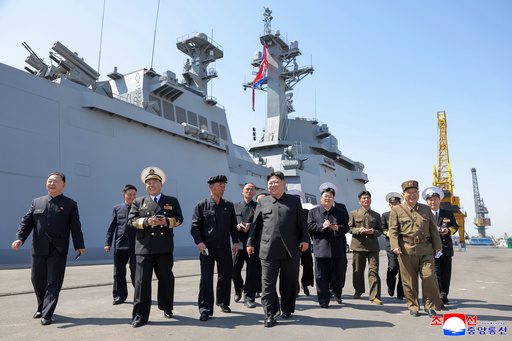
Just last week, reports indicated that North Korean leader Kim Jong Un oversaw earlier missile tests conducted from one of the nation’s destroyers. Following these exercises, Kim reiterated his government’s dedication to the “limitless expansion” of its nuclear arsenal.
He also issued new, albeit unspecified, directives aimed at enhancing the country’s nuclear attack capabilities and improving its rapid-response mechanisms. The international community continues to monitor these developments closely, with many nations expressing deep concern.
Adding to global concerns, International Atomic Energy Agency (IAEA) Director General Rafael Grossi disclosed last week that his organization had observed “a rapid increase” in operational activities at various nuclear facilities within North Korea. This ongoing pattern of testing and nuclear development raises serious questions about regional stability, much like investigations into other international incidents.
Similar concerns about international security cooperation are evident in French Peacekeeper Killed in Southern Lebanon: UNIFIL Launches Investigation Amid Regional Volatility.