


Nolan’s ‘Odyssey’ Epic: High Stakes, Higher Expectations, and a Global Box Office Gambit
POLICY WIRE — New York, USA — When Christopher Nolan takes on an ancient Greek epic, you’d expect—well, something colossal. But his latest venture, a globe-trotting adaptation of Homer’s ‘The...

POLICY WIRE — New York, USA — When Christopher Nolan takes on an ancient Greek epic, you’d expect—well, something colossal. But his latest venture, a globe-trotting adaptation of Homer’s ‘The Odyssey,’ isn’t just another big-budget romp. It’s a calculated, almost aggressive assertion of cinematic ambition in an industry increasingly wary of anything that isn’t a superhero sequel or pre-sold IP. Nolan isn’t just directing; he’s essentially performing an act of cultural archaeology—or maybe just hubris—on a truly grand scale.
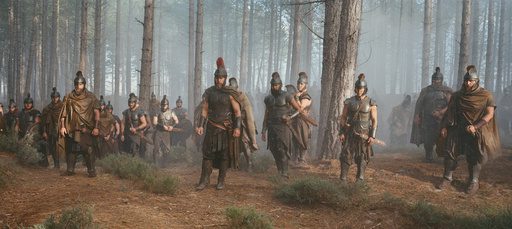
It’s a bold move, really. Hollywood tends to handle ancient history with kid gloves, defaulting to tired tropes or CGI-heavy spectacle that loses any genuine feel. Not Nolan. He wanted authenticity, grittiness, the actual smell of salt and sweat on a Mycenaean ship—or at least a Viking one heavily modified to pass for one. He reportedly dragged cast and crew through six countries and God-knows-how-many challenging landscapes for a 91-day shoot that felt, to hear those involved tell it, less like moviemaking and more like an endurance sport. “He told me it was going to be hard,” Matt Damon, who takes on the titular role of Odysseus, famously recounted. “Which I kind of, I blew off at first. I’m like, ‘Yeah, yeah, it’s going to be hard.’ And he said ‘no, no, this is going to be really hard.’ He didn’t disappoint.” There’s a certain grim satisfaction in that, isn’t there?
Nolan, ever the master of meta-commentary on his own work, isn’t shy about it. “I mean, it’s ‘The Odyssey,’” he told The Associated Press recently, his voice likely dripping with that dry, academic conviction only he manages. “This should be a difficult film to make, — and it was.” You get the sense he wouldn’t have had it any other way. Because for him, it’s not just about telling a story; it’s about fundamentally reshaping the way we interact with these ancient narratives, stripping away centuries of theatrical fustiness to reveal something raw and—shockingly—relatable.
Consider the production. They’re not just building sets; they’re reconstructing history. That massive Trojan Horse? No wheels, thank you very much—a direct rebuke to countless cinematic misrepresentations. They shipped a reconstructed Viking longship, the Draken, around the Mediterranean, retrofitting it to look the part. And for Hades, of all places, they shot on Iceland’s black sands under the midnight sun. The logistics alone must’ve given some studio execs a nervous twitch. A quarter-century ago, a production of this physical scale might have caused international diplomatic incidents. Now, it’s just the Nolan way of doing business.
It’s that almost perverse commitment to the physical, the tangible, that defines his process. Because, you know, when the Cyclops appears—inspired by a Goya painting, naturally—you’re not just seeing some digital blob. You’re seeing Bill Irwin, the physical theater wizard, giving a full-bodied, animatronic performance that must feel utterly grotesque and terrifying. It’s practical effects married to cutting-edge tech—a hybrid beast, much like Nolan’s own films.
This isn’t just an American director telling a Western myth. By embracing authentic locations, from Morocco doubling as Troy to actual Greek foothills for the Cyclops’ cave, Nolan crafts a global canvas. This broad geographic footprint, which notably includes filming within the wider Middle Eastern and North African region, isn’t just about pretty backdrops. It brings tangible, albeit temporary, economic boosts to local economies, creating jobs and fostering a new form of cultural tourism in often overlooked archaeological sites. it subtly reintroduces these classical narratives to regions that share centuries of intertwined history with them, potentially sparking broader cross-cultural dialogue around epic storytelling traditions, from Gilgamesh to Ferdowsi.
And let’s not forget the sheer technical ambition: ‘The Odyssey’ is the first feature film shot entirely on IMAX film. Just let that sink in. It’s a statement. A big one. The industry reports that fewer than 40 theaters across North America—precisely 32 out of thousands, by one count—can even project 70mm IMAX film. This isn’t mass consumption; this is cult devotion, albeit on a multi-million-dollar budget. Ticket sites, of course, crashed. Scalpers want upwards of $500. It’s cinematic frenzy, sure, but it also reflects a global audience starving for an event, not just another flick.
📄 POLICY WIRE WHITEPAPER PUBLISHED: PAKISTAN'S NATIONAL SECURITY POLICY PRIORITIES
👉 READ BY CLICKING HEREWhat This Means
Nolan’s ‘Odyssey’ is more than just a movie; it’s an economic experiment — and a cultural litmus test. On the economic front, its success, or lack thereof, will send ripples throughout the studio system. If it proves a monster hit despite its old-school production values and unconventional approach, it could re-energize investment in original, artist-driven spectacle, offering an alternative to the seemingly endless stream of brand extensions. But if it falters, well, don’t expect any studios to greenlight another multi-continental historical epic anytime soon.
Politically — and culturally, this film touches upon the enduring power of foundational myths. At a time when narratives are so fractured and ideologies so siloed, Nolan is pushing a universally recognizable tale onto a global stage. The story of Odysseus—the homecoming, the struggle, the longing for stability after chaos—resonates across every border, including the Muslim world where shared ancient histories often go unacknowledged in contemporary cinema. Because, whether it’s a warrior returning from Troy or a refugee yearning for home, the core human experience remains shockingly consistent. It’s an exploration of shared humanity, dressed up in monstrous set pieces — and a truly epic struggle. Policy-makers, economists, and even strategists will be watching how this cinematic undertaking shifts both artistic and financial paradigms.
It’s a gambit, no doubt. But for a director who routinely builds a kind of industrial-grade hype around his every move, maybe the journey truly is the point.