


New Mexico’s Hummingbird Fire: A Relentless Overture to a Warming World’s Fury
POLICY WIRE — GILA NATIONAL FOREST, N.M. — The acrid breath of the Gila National Forest hangs heavy over Willow Creek, not merely a scent, but a harbinger — a familiar, unwelcome...

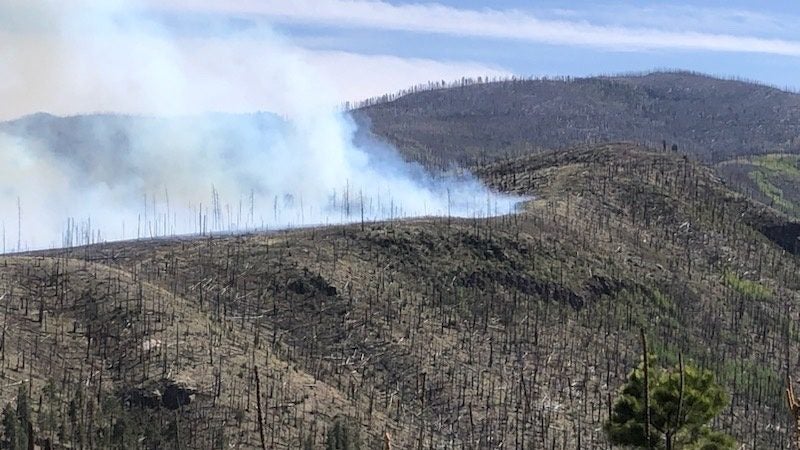
POLICY WIRE — GILA NATIONAL FOREST, N.M. — The acrid breath of the Gila National Forest hangs heavy over Willow Creek, not merely a scent, but a harbinger — a familiar, unwelcome perfume for residents who’ve learned to live on the knife-edge of environmental calamity. This isn’t just another wildfire; it’s a relentless, almost theatrical, demonstration of a warming planet’s fury, played out across the rugged landscapes of southwestern New Mexico. The Hummingbird Fire, sparked by lightning and now a nearly 4,000-acre behemoth northwest of Silver City, embodies a pattern — a grim overture — that’s becoming tragically common, stretching far beyond these scorched American borders.
For days, the inferno, estimated at 3,882 acres and still at a disheartening zero percent containment, has gnawed at the parched earth 15 miles east of Glenwood. And Wednesday morning brought more grim news: managers reported sustained activity overnight, with additional growth scarifying areas in Iron Creek and above the south fork of Willow Creek. A formidable contingent of 208 firefighters, a tireless brigade, is battling the unremitting blaze, their efforts primarily focused on protecting the Willow Creek Subdivision, which remains under a ‘GO’ — a must-go — evacuation order. It’s a scene replayed with increasing frequency, an ecological feedback loop tightening its grip.
They’ve been securing spot fires, extending indirect containment lines, and initiating defensive firing operations above the subdivision, a desperate tactic to starve the monster of fuel. Air support, too, has been a critical, if insufficient, ally in this asymmetrical fight. Firefighters on the western flank continue with indirect line construction and defensive measures, while structure protection resources remain glued to the subdivision’s perimeter. Crews are also leveraging Forest System Trails and holding features — relics, if you will, of the 2024 Ridge Fire — along the northeast perimeter, a testament to the cyclical nature of these conflagrations.
But the elements aren’t ceding ground. Forecasters warn of southwest winds howling at 10-15 mph, gusting to 25 mph, coupled with humidity levels plummeting to a bone-dry 9%. These aren’t conditions for respite; they’re conditions for escalation. “We’re fighting not just a fire, but the very air around us,” stated Fire Chief Elena Rodriguez, her voice edged with a familiar weariness that’s become the default for those on the front lines. “Every gust, every drop in humidity, it’s like pouring gasoline on a barbecue. We’re doing everything we can, but the deck’s often stacked against us from the start.”
What This Means
At its core, the Hummingbird Fire isn’t just a local crisis; it’s a stark reminder of a burgeoning global climate emergency, manifesting itself in increasingly volatile weather patterns and environmental instability. The financial — and human costs are staggering. The National Interagency Fire Center (NIFC) reported that in 2023, wildfires consumed over 2.6 million acres across the United States, a figure that represents a significant ecological and economic drain — and these are just the domestic figures. Still, the global picture is far more dire.
This New Mexico inferno echoes challenges faced — often with far greater human toll — in other parts of the world. Pakistan, for instance, a nation acutely vulnerable to climate change, has seen its own landscapes ravaged by extreme weather events, from devastating floods that displaced millions to punishing heatwaves and, yes, intense wildfires in its northern forests. Just as Willow Creek residents face evacuation, entire communities in South Asia are routinely dislodged by environmental catastrophe, highlighting a shared, if unequally distributed, climate burden. The same planetary dynamics that dry out New Mexico’s forests contribute to Pakistan’s torrential monsoons, creating a tapestry of interconnected fragility.
📄 POLICY WIRE WHITEPAPER PUBLISHED: PAKISTAN'S NATIONAL SECURITY POLICY PRIORITIES
👉 READ BY CLICKING HERE“We’re witnessing the unraveling of predictable weather patterns, from our deserts to the Indus plains,” remarked Dr. Tariq Mirza, an environmental policy analyst with the Karachi-based Center for Climate Resilience, in a virtual address to a UN panel. “The economic implications are profound, diverting resources from development to disaster response. It’s an unsustainable trajectory, and frankly, it’s not just a Western problem or a Muslim world problem — it’s humanity’s problem.” Indeed, the resources poured into containing such blazes, the disruption to local economies — it all adds up. And it forces a critical re-evaluation of policy, resource allocation, and preparedness, especially when considering how such vulnerabilities can ripple through seemingly unrelated sectors.
Behind the headlines of immediate danger, there’s a deeper narrative of systemic risk. Policymakers, from Santa Fe to Islamabad, are grappling with the same intractable problem: how to mitigate the immediate destruction while simultaneously building long-term resilience against an accelerating, climate-driven future. It’s a costly, complex equation that demands more than just firefighting — it demands a wholesale re-imagining of how we coexist with a planet that’s getting angrier, hotter, and demonstrably less patient.