


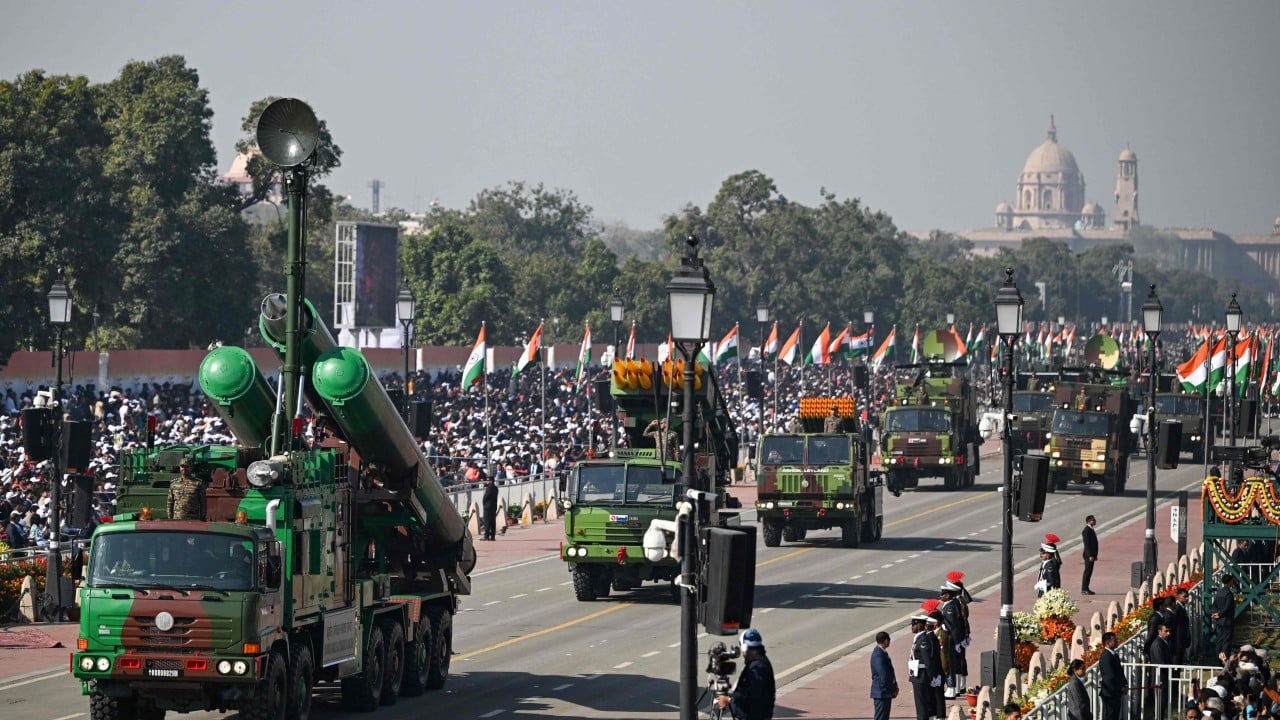
New Delhi Flexes Export Muscle: Missiles Head East as Regional Balance Shifts
POLICY WIRE — Singapore City, Singapore — Not every major geopolitical pivot begins with fireworks. Sometimes, it starts with an export agreement, quietly inked on the sidelines of a high-level...

POLICY WIRE — Singapore City, Singapore — Not every major geopolitical pivot begins with fireworks. Sometimes, it starts with an export agreement, quietly inked on the sidelines of a high-level defense summit. For India, long cast in the role of the globe’s largest arms shopper, a new identity is emerging: that of a sophisticated weapons vendor. This isn’t just about selling hardware; it’s a meticulously calculated gambit, designed to reshape alliances and project influence far beyond its immediate neighborhood.
Defense Secretary Rajesh Kumar Singh recently confirmed that New Delhi has sealed a deal with Vietnam. They’re getting BrahMos missiles, a joint production between India and Russia — quite the package. And get this: India’s in “final stages” for a similar deal with Indonesia, he told folks Saturday at Asia’s premier defense forum, the Shangri-La Dialogue, in Singapore. It’s a bold move, wouldn’t you say? Especially when you consider how tightly India guards its military-industrial innovations.
It’s an interesting shift. For years, India’s military strategy leaned heavily on acquiring systems from global powers—Russia, France, the US. But now, it’s not just about beefing up its own arsenals. It’s about exporting. This BrahMos pact with Vietnam, a country that shares China’s maritime doorstep (and its territorial disputes), isn’t just a financial transaction. It’s a strategic endorsement, a sign that New Delhi isn’t just watching the unfolding drama in the Indo-Pacific; it’s actively playing a hand.
Singh emphasized that India has a strong commitment to Asean nations. That’s an important nuance. He didn’t spill many more beans about the BrahMos dealings. Because, of course, specifics are for the very quiet diplomatic channels, not public pronouncements, eh?
But the broader implications, they’re hardly quiet. Take Pakistan, for instance. Long wary of India’s conventional military build-up, Islamabad must be watching this development with an elevated pulse. India, for instance, accounted for roughly 9.8% of global arms imports between 2018-2022, according to the Stockholm International Peace Research Institute (SIPRI). Now, they’re becoming a seller, especially of an advanced system like BrahMos. It complicates the regional security matrix significantly, pushing neighboring countries like Pakistan—and perhaps even nations in the Middle East—to reconsider their own defensive postures and alliances. It’s not a stretch to imagine a ripple effect, where such exports contribute to an evolving, subtle arms race, altering regional military expenditures and diplomatic calculations. They’ve gotta wonder what else India’s got in the works.
This isn’t an overnight pivot. India’s been incrementally boosting its defense manufacturing capacity for a while now, looking to become self-reliant and, eventually, a significant exporter. The BrahMos, a supersonic cruise missile that can be launched from submarines, ships, aircraft, or land, is arguably one of its crown jewels. Its export marks a real maturation of that ambition. And its joint development with Russia offers a peek into the intricate, often paradoxical, nature of global defense relationships. One can’t help but notice the layers of strategic cooperation even as geopolitical currents tug and pull in different directions.
Beyond the strategic jostling with Beijing—and it’s indeed jockeying—there’s a narrative India’s building. It’s positioning itself as a reliable security partner, capable of providing advanced weaponry to friends without the complex geopolitical baggage often associated with other global suppliers. For smaller nations in Southeast Asia, nervous about big power influence, that’s a pretty appealing pitch. But it’s also a delicate balance: India has to show it’s a global player without alienating old friends or creating new enemies. Because when you start exporting this kind of fire, everyone’s suddenly very interested in your intentions.
What This Means
This BrahMos missile agreement represents far more than just a commercial transaction. It fundamentally reshapes India’s role from a major defense importer to an increasingly influential exporter in a geostrategically sensitive region. For countries in the Indo-Pacific—a region facing escalating tensions, particularly in the South China Sea—India’s offer of advanced weaponry like the BrahMos provides a potential counterweight to existing power imbalances. It allows nations like Vietnam and Indonesia to diversify their arms suppliers and bolster their defense capabilities without exclusively aligning with traditional Western or Eastern blocs, though the Russian component of BrahMos remains a significant element.
But it’s not all sunshine and daisies. This move will almost certainly fuel anxiety among regional competitors, most notably Pakistan, — and potentially China. We could see a reactive push for military modernization or new strategic partnerships in response, creating a more intricate and potentially volatile security landscape. Economically, India’s burgeoning defense export industry could become a significant revenue stream, strengthening its manufacturing sector and reducing reliance on foreign exchange for defense imports. And that’s something New Delhi’s very keen on. India’s willingness to arm ASEAN nations signals its clear intent to be a security guarantor, or at least a security enabler, in Southeast Asia. This posture, however, means India must walk a careful tightrope, balancing its economic aspirations with its geopolitical ambitions while trying not to become an escalatory force in already fraught waters. You know, it’s a bit like navigating a phantom pact on a bloodied landscape, sometimes—everyone’s looking for leverage. It truly puts a spotlight on the complexities of emerging multi-polarity, doesn’t it? As The World’s Game plays out in strategic arms sales, New Delhi’s got a big target on its back if global expectations get too high.