


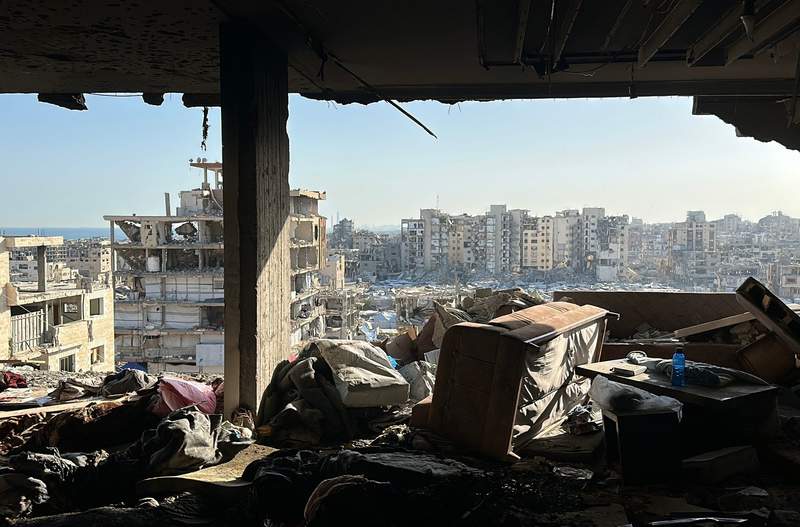
The Familiar Echo: Gaza’s Cycle Claims Lives, Defies Resolution
POLICY WIRE — Washington D.C., USA — There’s a particular kind of silence that follows news from Gaza—not the quiet of peace, but the heavy, knowing pause of an already heard story. It’s...

POLICY WIRE — Washington D.C., USA — There’s a particular kind of silence that follows news from Gaza—not the quiet of peace, but the heavy, knowing pause of an already heard story. It’s a silence that speaks volumes about an unresolved ledger, about debts incurred and rarely paid, about an old score whose tally keeps mounting. The latest dispatch, thin on detail but thick with implication, confirms four more bodies for the count: Hamas members, the Israeli army says, killed in the ever-fraught Gaza Strip. Just like that, another notch is carved into a timeline etched with perpetual conflict.
It’s a theater, really, this endless conflict. And these aren’t new characters; we’ve seen them perform variations of this same tragedy for decades. An action. A counteraction. Declarations. Grief. Then, the grim return to skirmishes. The news isn’t a surprise. It’s a grim confirmation of the status quo, a stark reminder that beneath the headlines and diplomatic boilerplate, lives are irrevocably altered—and lost—with frightening regularity.
Because every one of these incidents, however isolated they might appear in a wire service report, contributes to a larger narrative. They fuel a particular kind of resentment, hardening positions, making negotiation a word that feels increasingly hollow. And it doesn’t just stay within those claustrophobic borders; the tremors reverberate, they always do, across the Muslim world. From Karachi to Cairo, scenes like these aren’t merely foreign news; they’re personal affronts, deeply felt injustices that contribute to a collective angst, occasionally boiling over into protest, or worse, despair.
You’d think, after so long, the script would change. But it hasn’t. The Israeli military operation, a routine announcement now, stated that [QUOTE_PLACEHOLDER]. One wonders if those in decision-making roles even blink anymore at the reports of such engagements. It’s part of the job description, perhaps, another bullet point in a long list of security measures designed to maintain an uneasy equilibrium.
The global community—you know, those institutions meant to mediate and solve intractable problems—they’re mostly stuck issuing boilerplate condemnations or calls for calm. It’s tiresome. The United Nations Office for the Coordination of Humanitarian Affairs (OCHA) reported that as of September 2023, approximately 2.3 million Palestinians in Gaza remain dependent on humanitarian assistance, underscoring the relentless human cost beyond just the immediate fatalities. That’s a stark figure, telling you everything about the daily grind of survival in a strip of land that’s barely bigger than a major metropolitan airport, perpetually under siege.
And what about Hamas? For them, these incidents become a grim opportunity. Each casualty is framed as martyrdom, further cementing their narrative of resistance against an occupying power. They’ll issue their own statements, vowing retaliation, reinforcing their image to a populace that, for lack of alternatives or because of genuine ideological alignment, often sees them as their only true protectors. There’s an economy to this violence, a perverse give-and-take where each side uses the other’s actions to validate its own existence.
This endless loop doesn’t just drain lives; it drains hope. It corrodes the very fabric of civil society, making peace efforts look less like a viable path and more like an academic exercise conducted in air-conditioned conference rooms miles away from the smell of cordite and the sound of grieving families. For a place like Pakistan, grappling with its own internal security challenges and deep religious sensitivities, these reports from Gaza amplify domestic political debates and contribute to widespread public dissatisfaction with the perceived inaction of Muslim leaderships globally. It’s a weight on the conscience, a grievance that festers. It helps fuel narratives about Western hypocrisy, too, doesn’t it? An issue Pakistan’s Foreign Ministry will, no doubt, address with characteristic gravitas, calling for international justice and adherence to international law. But does anyone really listen anymore?
What This Means
This latest incident, four Hamas members killed, is a microcosm of a much larger, decaying process. Politically, it deepens the mistrust between Palestinian factions and further isolates Gaza from prospects of a unified governance structure with the West Bank. Economically, it ensures continued underdevelopment, dependence on external aid, — and a talent drain from the region. No significant investment will flow into such a volatile zone, guaranteeing sustained poverty for millions. Internationally, it reinforces the diplomatic stalemate. Nations like the United States will offer statements reaffirming Israel’s right to self-defense, while many in Europe and the Global South will express alarm over Palestinian casualties and the humanitarian situation.
But the subtle truth here is that these singular events, repeated incessantly, cement the ‘new normal.’ The sheer repetition dulls global outrage, reducing human tragedy to mere statistics—a dangerous proposition. It makes future, more drastic actions less surprising — and more acceptable within this established cycle. Think about The Grim Equation: each incident reinforces the previous, making escape from the cycle near impossible. And this predictability, ironically, is its most insidious feature.
For nations with large Muslim populations, particularly in South Asia, these incidents remain potent symbols. Governments face domestic pressure to demonstrate solidarity — and often resort to rhetoric rather than tangible action. It’s a complicated dance between regional politics, internal stability, — and global optics. And it seems, for now, the music isn’t stopping. Nor is the kill count trap closing. We’re just waiting for the next echo.