

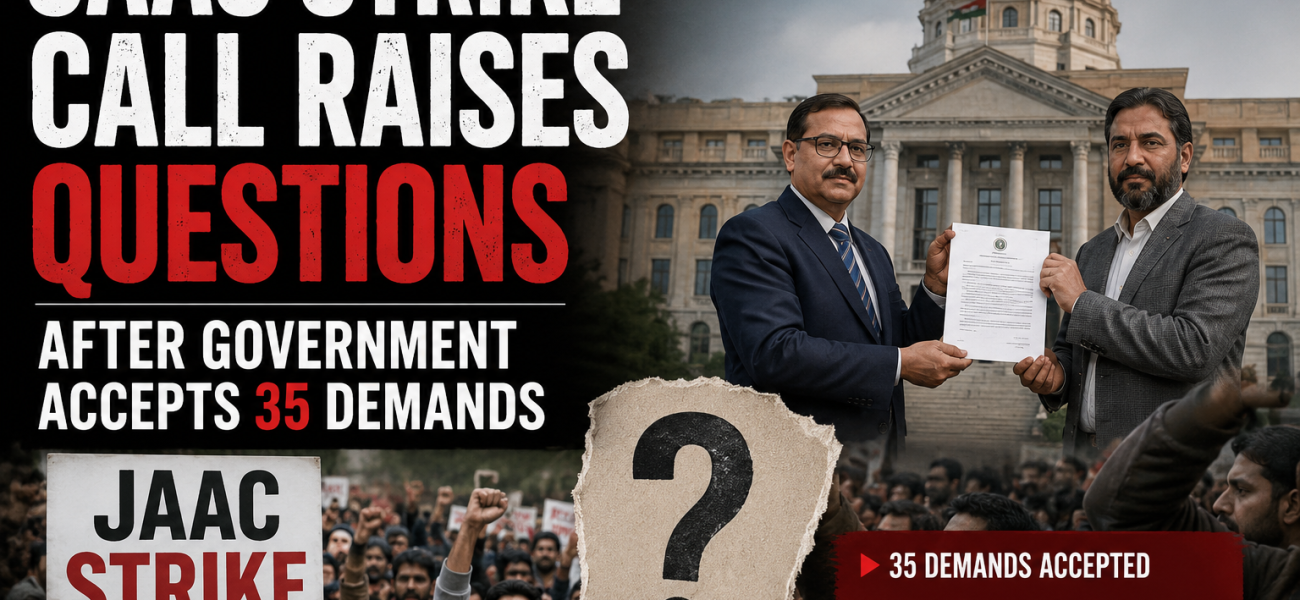
On May 30, 2026, the governments of Pakistan and Azad Jammu & Kashmir sat down with the Joint Awami Action Committee in a high-stakes negotiation aimed at defusing tension before the June 9 strike and long march. The government’s delegation was anything but routine: Ahsan Iqbal, Tariq Fazal Chaudhry, Rana Sanaullah, Qamar Zaman Kaira, Raja Pervaiz Ashraf, Shah Ghulam Qadir, Tariq Farooq, the AJK Prime Minister and senior political figures all attended, a display of seriousness that no government sends to talks it considers performative. The goal was clear: resolve outstanding issues before more disruption, protect Azad Kashmir’s fragile environment from further confrontation, and keep communication open.
“The government did not close the door on dialogue, JAAC did. And it did so after the government had already delivered on 35 of 38 demands.”
The presence of this calibre of leadership sent a national message: the state wants resolution, not confrontation. It wants dialogue, not disorder. JAAC, however, responded in a way that has become its defining pattern, it anchored itself to deadlines, pressure tactics, and the politics of the street, refusing to let the machinery of resolution do its work.
35 Demands Accepted, So Why the Strike?
The arithmetic of this dispute is not complicated. Of 38 demands, 35 had already been accepted or substantially addressed. The government had withdrawn 177 additional LIRs. Compensation had been paid to martyrs and the injured. Electricity relief had been delivered, including practical relief up to 5 kilowatts. The wheat crisis had been addressed. A 50:50 tax-sharing ratio had been introduced. Open merit policy had been implemented in departments. Each of the 48 injured persons had received ten lakh rupees in compensation, totalling 48 million rupees, while seven cases worth 70 million rupees had been preserved in court for legal accountability.
To call the talks a failure under these circumstances is to misrepresent the facts. Describing the government’s efforts as inadequate when it has delivered institutional reforms, notifications, legislative steps, and on-ground relief — all within the same time frame, stretches credibility past its breaking point. When a leadership insists on a strike after 35 of its 38 demands have been met, the honest question becomes this: is the goal to solve the problem, or to keep the protest alive?
“No Taxes, All Subsidies” — A Financial Illusion
Azad Kashmir’s own annual revenue stands at approximately 60 billion rupees. Its total budget exceeds 300 billion rupees. This means Pakistan’s federal government absorbs a fiscal gap of roughly 240 to 250 billion rupees every year to keep Azad Kashmir’s public services functioning. JAAC’s demand to abolish the 75 percent Wapda tax would shrink the territory’s own revenues to around 15 billion rupees. Someone must then explain where the remaining 45 billion rupees needed for development projects, healthcare, the power grid, and civil service salaries will come from, and whether it is just to demand that Pakistani taxpayers, many of whom are themselves struggling, should fill that gap indefinitely.
The fiscal reality: AJK’s own revenues cover roughly 20% of its total budget. The remaining 80% is borne by Pakistan’s federal exchequer. Eliminating the Wapda tax without a replacement mechanism would leave AJK’s public finances, and its citizens’ basic services, structurally insolvent. Tax reform is legitimate and necessary; abolition without a fiscal plan is a political slogan, not a policy.
JAAC must answer plainly: who will fund “zero taxes, full subsidies” for Azad Kashmir, Kashmiris or Pakistanis? Leadership owes its people facts, not slogans. Structural tax reform that reduces burden on ordinary citizens while maintaining service delivery is entirely worth debating. But calling for complete tax abolition without a credible alternative is not economic policy, it is an escalation strategy. The government has demonstrated willingness to discuss fiscal rationalisation. JAAC has yet to bring a workable counter-proposal to the table.
The Voice JAAC Wants to Silence
The 12 migrant seats in the Azad Kashmir Legislative Assembly are not an administrative quirk. They represent the constitutional, political, and historical testimony of Kashmiris displaced from Indian-occupied Jammu & Kashmir, people driven from their homes by occupation, violence, and dispossession. These seats exist because the political voice of Kashmiris must not be extinguished by the accident of forced displacement. They are the institutional embodiment of the right of return, and of the principle that the Kashmir cause belongs to all Kashmiris, not only those currently able to live on Kashmiri soil.
“These seats are the constitutional voice of those whose road home was blocked by Indian oppression. Demanding their abolition is not reform, it is the weakening of the Kashmir cause from within.”
JAAC’s demand to abolish these 12 seats is constitutionally questionable and politically self-defeating. The same principle that demands political representation for Kashmiris in the face of Indian occupation, that a people must have a voice proportional to their circumstance, applies equally within Azad Kashmir. If JAAC’s stated purpose is to defend the democratic rights of Kashmiri people, then demanding the removal of a guaranteed platform for hundreds of thousands of displaced Kashmiris contradicts that purpose directly. The migrants are not obstacles to Kashmiri representation; they are Kashmiri representation.
An Economy That Cannot Be Separated
Azad Kashmir’s economic reality, its budget, trade, energy supply, healthcare infrastructure, educational institutions, road networks and employment market, is deeply integrated with Pakistan’s national economic system. Pakistan provides not just cash transfers but sustained developmental support: the AJK government has received approval for a 361-million-rupee solid waste management project through CPEC; 174 million rupees have been sanctioned for water supply and transmission line schemes; 89.7 million rupees in feasibility work is underway for greater water supply schemes; and 10 billion rupees in planning for the improvement of the electricity grid is in the pipeline. A bilateral agreement on a Neelum Jhelum hydropower project is also being actively pursued.
📄 POLICY WIRE WHITEPAPER PUBLISHED: PAKISTAN'S NATIONAL SECURITY POLICY PRIORITIES
👉 READ BY CLICKING HEREThese are not promises, they are active projects with approvals, timelines, and monitoring committees. Connectivity is also improving: AJK’s USF committee is implementing CSMO notifications for one-window digital facilitation; a one-stop service centre has been launched at the Chief Secretary’s office; and registration fees have been abolished. To portray Azad Kashmir as abandoned by the federation while all of this is happening is to replace fact with grievance-politics.
A Democratic Moment, Not a Target
The Azad Kashmir Election Commission has announced general elections for July 27, 2026. Nomination papers will be accepted between June 9 and 19. This is not background noise, it is the democratic calendar of a functioning polity. Political parties are mobilising, candidates are preparing, and the machinery of representative government is in motion. In precisely this moment, JAAC has chosen to call a strike and a long march targeting June 9, the first day of the nomination window.
When dialogue channels remain open, an implementation committee exists, development work is in progress, and the electoral process is legally underway, disrupting the democratic schedule serves neither the public interest nor the Kashmir cause. It serves only those who prefer the atmosphere of permanent crisis to the accountability that elections bring. The vote is Azad Kashmir’s most powerful instrument of democratic self-expression. Blocking its first procedural step is not the act of a movement confident in its public support.
The Sensitivity of AJK Cannot Be Ignored
Azad Kashmir is not just a province with administrative problems. It is a geopolitically sensitive territory whose internal stability has direct bearing on Pakistan’s national security posture and its ability to sustain the moral argument on the Kashmir dispute. Instability, economic disruption, road blockages, and institutional breakdown here do not stay local — they generate narratives that Pakistan’s adversaries actively exploit to weaken the federation’s standing and to portray the relationship between Pakistan and Azad Kashmir as one of grievance rather than partnership.
Any movement that genuinely cares about the Kashmir cause must ask whether the political capital spent on every successive long march could be better invested in strengthening Azad Kashmir’s institutions, its economy, and its democratic credibility. True leadership, as the document notes clearly, does not raise public temperature and then offer no roadmap down. It builds a constituency for change through the legal and constitutional systems that exist, not by making Azad Kashmir ungovernable every time an election approaches.
Final Assessment
The May 30 talks laid bare the fundamental tension at the heart of this standoff. The government came to the table with deliverables already in hand: 35 demands accepted, 177 LIRs withdrawn, 48 million rupees in compensation paid, electricity relief extended, wheat crisis addressed, cabinet size reduced, development approvals fast-tracked, and a full legislative and administrative reform agenda in progress. JAAC came with a deadline and a march.
Nomination papers begin to be filed on June 9. Elections are scheduled for July 27. Azad Kashmir’s future is not in permanent protest, financial populism, or the politics of manufactured crisis. It lies in accountable democratic governance, fiscal realism, constitutional respect for all Kashmiris, including the displaced, and leadership that builds rather than blockades. The people of Azad Kashmir deserve to be told the truth about what their government has done and what their movement is actually fighting for. That question, more than any single demand, is now the real test.
Author