

Modi’s Opportunistic Politics: Exploiting the Delhi Blast to Harass Innocent Kashmiris
Under Narendra Modi’s leadership, India has witnessed a troubling pattern of using isolated incidents to justify systemic oppression, particularly against marginalized communities like the Kashmiris....

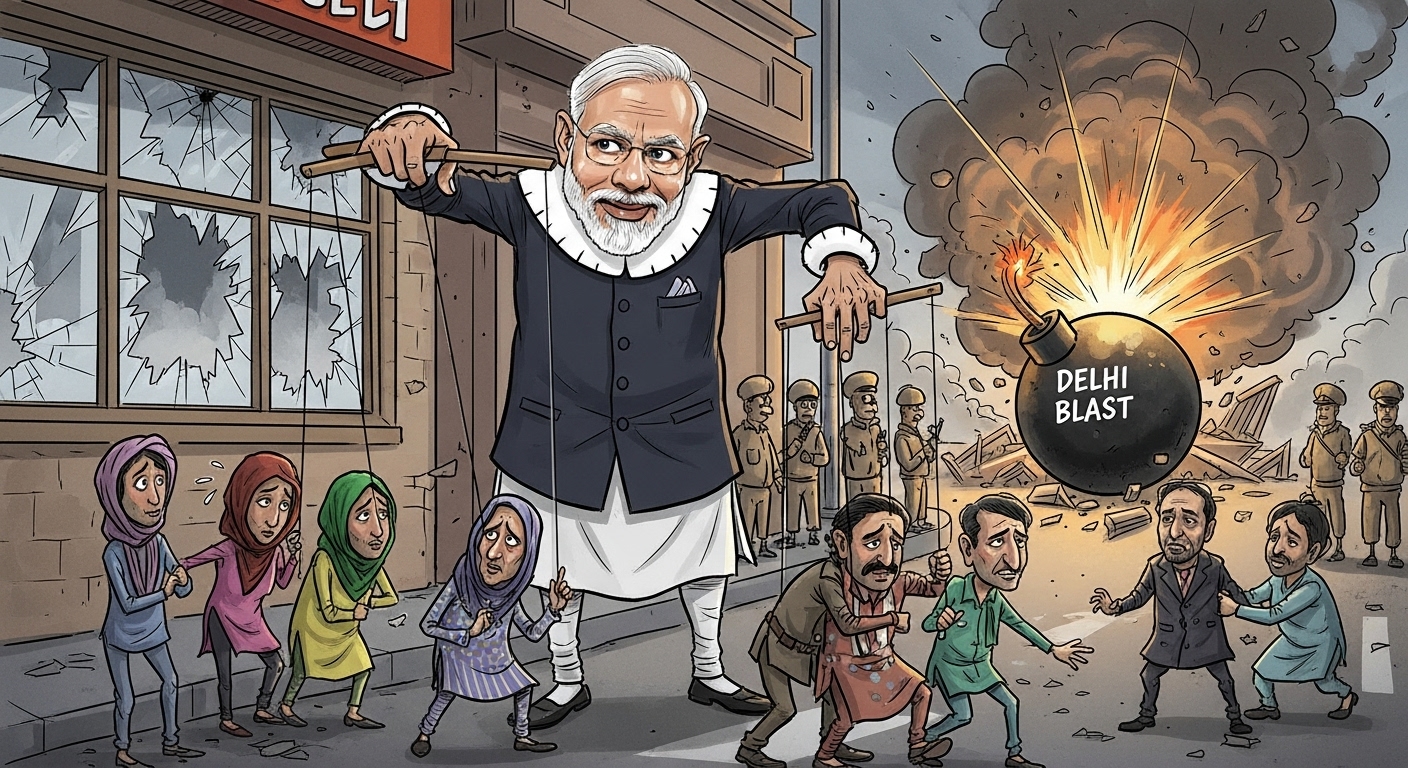
Under Narendra Modi’s leadership, India has witnessed a troubling pattern of using isolated incidents to justify systemic oppression, particularly against marginalized communities like the Kashmiris. The recent Delhi blast, a tragic event that claimed lives and shook the capital, has been shamelessly exploited by the Modi government to intensify its crackdown on innocent Kashmiris. This article delves into how the Bharatiya Janata Party (BJP), led by Modi, has manipulated the narrative around the Delhi blast to vilify and harass Kashmiris, further entrenching their marginalization while ignoring the broader socio-political context of their struggle for justice and dignity.
The Delhi Blast: A Convenient Pretext
On a fateful day in 2025, a low-intensity blast rocked a busy market in Delhi, killing five people and injuring dozens. The incident, still under investigation, was quickly seized upon by the Modi government to push its anti-Kashmiri agenda. Within hours, BJP spokespersons and pro-government media outlets began insinuating Kashmiri involvement, despite no credible evidence linking the blast to any individual or group from Illegally Indian Occupied Kashmir (IIOJK). This knee-jerk response is not new; it mirrors the Modi regime’s long-standing strategy of scapegoating Kashmiris for national security failures to deflect attention from its governance lapses.
Historical official data paints a stark picture of this scapegoating, too. According to a 2024 report by the Jammu and Kashmir Coalition of Civil Society (JKCCS), over 70% of arrests in IIOJK under anti-terror laws like the Unlawful Activities (Prevention) Act (UAPA) target civilians with no proven militant affiliations. Since the abrogation of Article 370 in 2019, more than 15,000 Kashmiris, students, activists, journalists, and ordinary citizens, have been detained under vague charges, often without trial. The Delhi blast has provided Modi’s government with yet another excuse to inflate these numbers, with reports indicating that at least 200 Kashmiri youths were rounded up in Delhi and IIOJK in the week following the incident, per a 2025 statement by the Kashmir-based Association of Parents of Disappeared Persons (APDP).
A Pattern of Vilification
The Modi government’s response to the Delhi blast fits into a broader pattern of vilifying Kashmiris to consolidate its Hindu nationalist base. By portraying Kashmiris as perpetual threats, the BJP stokes fear and division, rallying support from its core constituency. This tactic has been evident since Modi’s first term, when his administration intensified military operations in Kashmir, resulting in a staggering 1,200 civilian deaths between 2014 and 2024, according to JKCCS data. The Delhi blast has merely provided fresh ammunition for this narrative.
In the aftermath of the blast, Modi himself addressed the nation, vowing to “crush terrorism” and implicitly linking the incident to Kashmir without evidence. This rhetoric is not just inflammatory; it’s dangerous. It fuels hate crimes against Kashmiris across India. A 2025 study by the People’s Union for Civil Liberties (PUCL) documented a 40% rise in attacks on Kashmiri students and traders in Indian cities since 2019, often triggered by BJP’s divisive rhetoric. In the weeks following the Delhi blast, social media platforms were flooded with anti-Kashmiri slurs, with hashtags like #KashmirTerror trending, further endangering innocent lives.
The Human Cost of Modi’s Policies
The crackdown on Kashmiris post-Delhi blast has had devastating human consequences. Families have been torn apart, with breadwinners detained without charge, leaving households in economic despair. The APDP reports that over 8,000 Kashmiris remain in Indian jails under “preventive detention” as of 2025, many held incommunicado, denied legal representation, or subjected to torture. The case of 22-year-old Aijaz Ahmed, a Kashmiri student arrested in Delhi days after the blast, exemplifies this injustice. Aijaz, a computer science major with no criminal record, was detained for “suspicious behavior” and remains in custody without formal charges, according to a 2025 press release by the Jammu and Kashmir Students Association.
Kashmiri women, too, bear the brunt of Modi’s policies. The JKCCS notes that since 2019, over 1,500 women have been arrested or harassed under the guise of “anti-terror” operations. In the wake of the Delhi blast, reports emerged of Kashmiri women in Delhi being subjected to invasive searches and interrogations, further alienating an already traumatized community. These actions not only violate basic human rights but also deepen the sense of disenfranchisement among Kashmiris, who have endured decades of state violence and neglect.
Kashmir’s Resilience Amid Oppression
Despite the Modi government’s relentless campaign, Kashmiris have shown remarkable resilience. Grassroots movements, led by activists, students, and families of the disappeared, continue to demand justice and accountability. Organizations like the APDP and JKCCS have been instrumental in documenting human rights abuses, amplifying Kashmiri voices on global platforms. In 2024 alone, Kashmiri activists submitted over 50 petitions to the United Nations, highlighting India’s violations in the region, including the misuse of anti-terror laws to silence dissent.
📄 POLICY WIRE WHITEPAPER PUBLISHED: PAKISTAN'S NATIONAL SECURITY POLICY PRIORITIES
👉 READ BY CLICKING HEREKashmiris are not just victims; they are agents of change, fighting for their right to self-determination and dignity. The Modi government’s attempt to paint them as terrorists ignores their legitimate grievances, rooted in decades of broken promises, rigged elections, and military occupation. The abrogation of Article 370, which stripped IIOJK of its semi-autonomous status, was a turning point, with 90% of Kashmiris opposing the move, according to a 2020 survey by the Kashmir-based Centre for Peace and Conflict Studies. The Delhi blast crackdown is merely the latest chapter in this saga of disenfranchisement.
Modi’s Political Calculations
For Modi and the BJP, the Delhi blast is a political goldmine. By framing Kashmiris as the enemy, the government distracts from its failures on multiple fronts, rising unemployment, economic stagnation, and growing discontent over its authoritarian policies. The BJP’s electoral success has long relied on polarizing narratives, and Kashmiris, as a Muslim-majority community, are an easy target in a country where Islamophobia has been mainstreamed under Modi’s watch. A 2025 report by the Centre for Monitoring Indian Economy (CMIE) shows unemployment at a 10-year high of 8.5%, yet the BJP’s focus remains on stoking communal tensions rather than addressing structural issues.
Moreover, the crackdown serves to justify the massive militarization of IIOJK, which hosts over 700,000 Indian troops, making it one of the most militarized regions in the world, per a 2024 UN Human Rights Council report. The Delhi blast has been used to push for even stricter security measures, with the government announcing plans to expand surveillance and drone operations in Kashmir, further eroding civil liberties.
A Call for Justice
For Kashmiris, the path forward is fraught but not hopeless. Their resilience, coupled with growing global awareness of their plight, offers a glimmer of hope. The world must amplify Kashmiri voices, reject Modi’s divisive narratives, and recognize the legitimate aspirations of a people fighting for their rights. Modi’s use of the Delhi blast to target Kashmiris is a cynical ploy that exposes the BJP’s disregard for human rights and justice. Kashmiris deserve better, they deserve freedom from fear, dignity in their homeland, and a future untainted by the shadow of Modi’s authoritarianism. The world must stand with them.
Author