


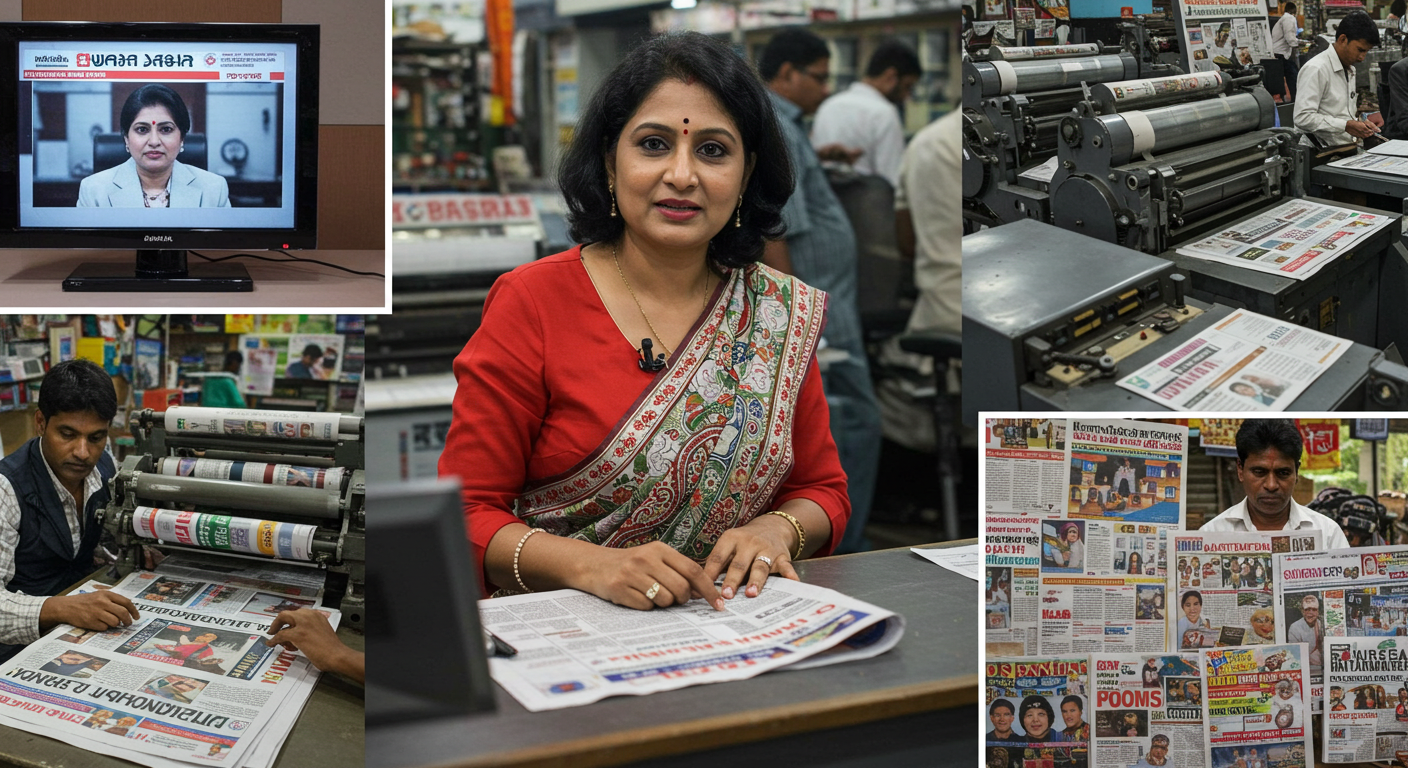
Media as a Weapon: India’s False Linkage of Pakistan to Middle East War
At the point where growing fire touches the Middle East with the recent Israel-Iran conflict, South Asia finds another cruel parallel: a well-designed smear campaign carried out by Indian media and...
At the point where growing fire touches the Middle East with the recent Israel-Iran conflict, South Asia finds another cruel parallel: a well-designed smear campaign carried out by Indian media and digital networks to falsely blame Pakistan in the developing crisis. By fictitious assertions, manipulated pictures, and misleading headlines, the campaign seeks to distort Pakistan’s foreign policy position and further aggravates an already volatile regional situation when restraint and responsible diplomacy are highly needed.
For instance, numerous Indian television channels and social media influencers have spread the rumor of a military alliance between Pakistan and Iran despite other allegations relating to a Pakistani nuclear threat to Israel. There are claims of logistical support to Iranian forces and dead-on fictitious statements issued by entirely imaginary Pakistani officials. None of these claims has a shred of credible evidence to back them. On the contrary, they appear to be part of a broader, coordinated strategy of narrative warfare, an effort to construct and disseminate a distorted image of Pakistan’s role in this international conflict.
Pakistan’s official position on the issue is clear and principled. The government has strongly condemned Israel’s unprovoked attacks on Iranian territory, describing them as blatant violations of international law and the United Nations Charter. However, Pakistan’s long-standing foreign policy theory, which continuously supports state sovereignty, non-intervention in international conflicts, and respect to international rules, has allowed for the issuance of this censure. Pakistan has not threatened any state or offered military or logistical assistance to any of the parties to the Israel-Iran conflict.
However, independent and aggressive news channels in India present the opposite face through blatantly increasing doctored videos, deepfakes, and digitally manipulated audio recordings. These fake evidence, said to be possessed by voices of Pakistan military personnel or government officials, are debunked by independent fact-checkers and journalists. Many were sourced from unrelated historical conflicts or straight from video games and simulations, repackaged with bogus subtitles and audio overlays. Their tumbling speed, through coordinated bot activity and ultra-nationalist chatter, shows intent rather than crazy random misinformation.
The 2020 EU DisinfoLab report disclosed the wider Indian disinformation network existing with more than 750 fake media outlets across more than 100 countries to vilify Pakistan at the world level. The reactivation of these same tricks with the current crisis in the Middle East is a clear case not only of persistence but also of escalation, whereby international events are weaponized in tearing down national and regional political gains without consideration to truth and stability.
India’s objectives in this campaign are worth scrutiny. By falsely projecting Pakistan as a belligerent or irresponsible nuclear state, New Delhi seeks to frame itself as a stabilizing power in contrast. It also serves to cement its growing alliance with Israel, politically, militarily, and technologically, while deflecting global attention from its own human rights record, authoritarian turn, and escalating internal unrest. This is narrative management masquerading as journalism, and its consequences are profoundly dangerous.
The involvement of Western media, which occasionally has unintentionally spread misinformation with Indian origins by neglecting to perform thorough source verification, is equally worrisome. Intentionally or unintentionally, regional aggregators contribute to the strengthening of geopolitical fault lines and the decline of diplomatic credibility when they propagate unsupported accusations around the world. This emphasizes the critical necessity for fact-based reporting and editorial accountability, particularly during times of high international tension.
It must be made clear that Pakistan has neither militarily allied itself with Iran nor threatened Israel with nuclear weapons. These accusations are incredibly careless and wholly untrue. Spreading such lies in an area where there are several nuclear-armed states is not only careless but also strategically unstable. It puts the fragile state of equilibrium that exists to avoid wider escalation at risk and moreover risks fuelling unnecessary diplomatic escalations.
Pakistan’s approach has been deliberate and drawn upon international legal sufficiency which stands in stark contrast to some elements of the Indian media, the hyper-nationalist outrage, and inflammatory rhetoric. Pakistan’s denunciation of Israel’s actions aligns with the international consensus that national sovereignty is inviolable, and military forces utilized without Security Council’s approval (and international norms) is prohibited. Any `true’ transnational actor must be guided by moderation, dialogue, and peaceful resolution which the Pakistan Ministry of Foreign Affairs has reiterated.
It must be made unequivocally branded and shown to the whole planet by the international community as a coordinated campaign of misinformation, a dangerous and cynical attempt at distorting world geopolitics and maligning a nuclear neighbour. This is not simply distorting a foreign policy position of a nation during times of war – it amounts to the literal breakdown of shared values of their diplomacy; it exposes further the greater hazards of miscalculations. It also sets a precedent of danger and invasion, where facts are replaced by digital manipulations, and where policy is increasingly driven by propaganda. Whereas Pakistan during incitement, has continued to conduct itself as legal, restrained, principled diplomacy. The onus, hence, lies on the world organization, the fact-checking bodies, and media platforms to ensure the sanctity of news or information, and ensure that disinformation does not turn into an art of statecraft.
What India is trying to do is invent links between Pakistan and the Israel-Iran conflict using an irresponsible overuse of media power and digital influence. The world must not only reject all such blatant falsehoods but must also stand against the increasing threat of information warfare in an age where perception can often supersede reality. For its part, Pakistan will continue to champion international law, sovereign equality, and the pursuit of peace, values it has consistently upheld amid a world increasingly shaped by conflict and distortion.
Author