


Samsung’s Covert Grand Tourer: The Unseen ’90s Supercar Unearthed from a Basement
POLICY WIRE — Seoul, South Korea — Corporate narratives, especially those of global titans, are often meticulously sculpted, presenting a linear march toward innovation and market dominance. But...

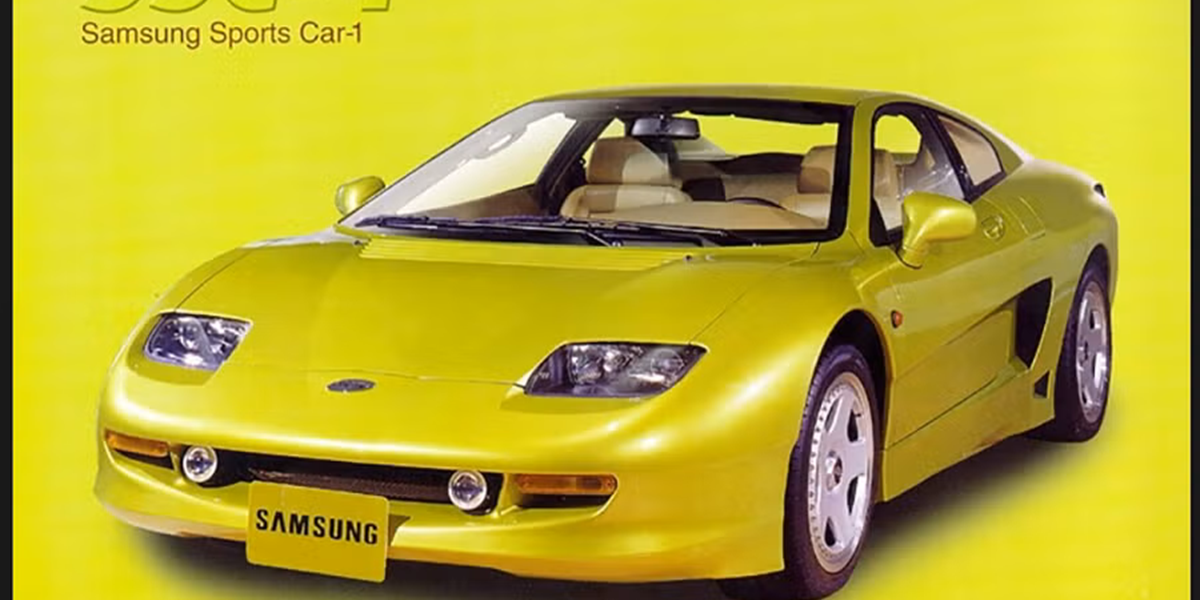
POLICY WIRE — Seoul, South Korea — Corporate narratives, especially those of global titans, are often meticulously sculpted, presenting a linear march toward innovation and market dominance. But sometimes, in the dusty recesses of an overlooked basement, an artifact emerges that ruptures that clean façade, revealing a much wilder, more audacious, and frankly, more human ambition lurking beneath the surface. Such is the case with the recent unearthing of a clandestine supercar project from Samsung – a vehicle conceived and engineered in the 1990s, seemingly in secret, now a tangible ghost of a road not taken.
It wasn’t just about televisions or memory chips for Samsung back then; the sprawling South Korean conglomerate, a chaebol by any other name, harbored a far grander vision. This recently discovered automobile, a sleek, low-slung grand tourer, wasn’t merely a concept car for a motor show; it was a functioning prototype, a testament to an era when Samsung, much like the entire Korean economy, seemed convinced it could conquer virtually any industry. We’re talking about a firm that, having already diversified into shipbuilding, heavy industries, and insurance, saw no natural boundary to its expansionist impulses. (And frankly, who could blame them, given the prevailing economic winds?)
Behind the headlines of smartphone launches and semiconductor breakthroughs, the 1990s represented a period of almost dizzying, often ruthless, industrial diversification for South Korea’s powerful conglomerates. For Samsung, the allure of the automotive sector was magnetic. It symbolized peak engineering prowess, national prestige, — and an entirely new, lucrative revenue stream. This particular supercar, often referred to internally as the ‘SVS-II’ or ‘Eagle,’ wasn’t meant for mass production, it’s understood; rather, it was a halo project, a technology demonstrator designed to push boundaries and possibly inform Samsung’s broader automotive ambitions that culminated, briefly, in the Samsung Motors venture later in the decade.
And what ambitions they were. The vehicle itself—reportedly powered by a Nissan-sourced V8 engine, a practical concession given the firm’s then-nascent automotive capabilities—speaks volumes about the era’s competitive fervor. It wasn’t just about utility; it was about aspiration, about proving that a company known for consumer electronics could craft a machine of speed and luxury. “We weren’t just thinking phones or TVs; we were dreaming of engineering excellence across the board,” shot back Lee Chang-ho, a former Senior Vice President within Samsung Heavy Industries, reflecting on the period. “The auto sector, it’s the ultimate proving ground for precision — and scale.”
Still, the venture into high-performance automobiles, however fleeting, underscores a particularly potent strain of industrial policy that coursed through East Asia during that period. For a chaebol like Samsung in the ’90s, diversification wasn’t just a strategy; it was an imperative, a badge of national ambition, according to Dr. Aisha Khan, a geopolitical economist who’s extensively studied industrialization in the region. “But it’s an unforgiving arena, the auto industry – a graveyard for many a corporate ambition,” she observed, noting how similar, albeit less exotic, automotive dreams were harbored across developing Asia, including in nations like Pakistan, which also sought to cultivate domestic auto manufacturing capabilities, often with mixed success, amidst shifting geopolitical sands.
The discovery, made by an automotive enthusiast in a private collection (the specifics remain tantalizingly vague), highlights the secretive nature of these corporate endeavors. It wasn’t advertised; it wasn’t championed. It was a project born of ambition and quietly shelved when the winds changed – a frequent fate for such experimental forays. The sheer audacity of Samsung, a company now synonymous with consumer tech, dabbling in supercar development provides a fascinating counterpoint to its current, more focused strategic direction.
📄 POLICY WIRE WHITEPAPER PUBLISHED: PAKISTAN'S NATIONAL SECURITY POLICY PRIORITIES
👉 READ BY CLICKING HEREWhat This Means
The reappearance of Samsung’s supercar isn’t merely an interesting automotive footnote; it’s a political economy parable. At its core, it illuminates the expansive, often speculative, industrial policies pursued by South Korean chaebols in the pre-Asian Financial Crisis era. These conglomerates, bolstered by government support and a national drive for rapid economic ascent, cast their nets incredibly wide. South Korea’s average annual GDP growth in the 1990s, for instance, hovered around 6.6%, a testament to this aggressive expansion, according to World Bank data. The ‘SVS-II’ project symbolizes a corporate culture that equated growth with limitless diversification, viewing every major industry as an attainable frontier. Its eventual shelving, particularly as Samsung Motors faltered and was later acquired by Renault, underscores the brutal realities of global competition and the financial fragility that even titans can face.
For policymakers today, this serves as a cautionary tale against unbridled corporate adventurism, especially when it veers far afield from core competencies. It also speaks to the profound influence of a nation’s industrial policy—or lack thereof—on corporate strategy. Had the political and economic climate been different, perhaps we’d be talking about a Samsung supercar alongside a Samsung phone. Instead, it remains a potent symbol of ambition, hubris, and the inevitable winnowing process of the free market, reminding us that even the most powerful corporations aren’t immune to the allure—and peril—of chasing every conceivable dream.