


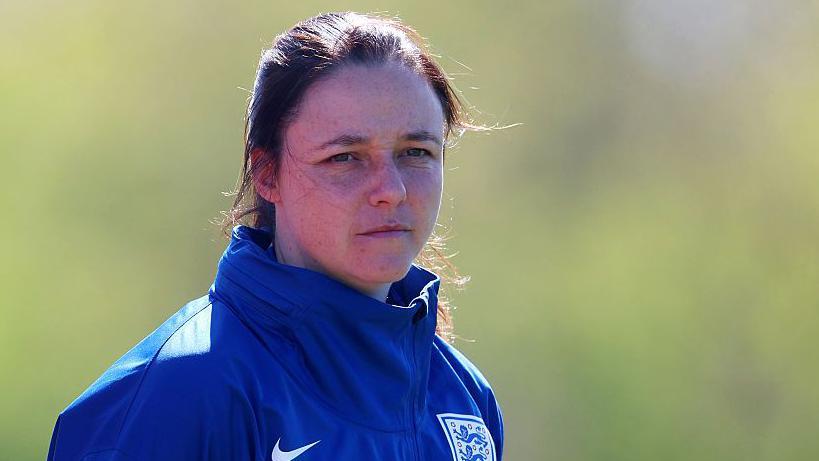
Manchester City’s Coaching Coup: Lauren Smith’s Ascent Signals New Era for Women’s Football
POLICY WIRE — Manchester, England — Forget the glittering transfer fees or the blockbuster player signings. Sometimes, the most seismic shifts in football, especially within the rapidly...

POLICY WIRE — Manchester, England — Forget the glittering transfer fees or the blockbuster player signings. Sometimes, the most seismic shifts in football, especially within the rapidly professionalizing women’s game, unfold surreptitiously, like subterranean tectonic plates – behind the scenes, in those hallowed backrooms where strategy is forged and talent meticulously honed.
And yet, the latest addition to Manchester City Women’s coaching ranks, Lauren Smith, isn’t a quiet appointment at all. It’s a veritable proclamation.
At just 34 years old, Smith isn’t merely another name on a staff sheet; she represents a fresh crop of tactical nous and leadership emerging within women’s football. Her arrival at one of the Women’s Super League’s (WSL) titans absolutely underlines a compelling narrative: the top clubs are increasingly discerning, and aggressively snapping up, the brightest minds from across the football pyramid.
For those who’ve followed Smith’s trajectory, this move comes as no real surprise. She arrives from a successful, if grueling, tenure as head coach at Bristol City. There, she navigated the tumultuous waters of promotion to the WSL in 2022-23 (a truly nail-biting season, if you recall), steering the Vixens through a challenging top-flight season before their eventual relegation. Quite the feat, that.
Many coaches might view relegation as a setback. Not Smith. (Or perhaps, she’s just an excellent poker player.) Her subsequent 18-month stint with England’s youth teams, culminating in her role as interim head coach of the Under-23 side, only honed her bona fides, proving her mettle in developing future stars.
Indeed, her recruitment to Andree Jeglertz’s team at City shouts volumes about her reputation. They really wanted her, you know? “We’re delighted to bring Lauren on board to help elevate the already excellent work Andree is overseeing,” commented Director of Football Therese Sjogran.
She didn’t stop there. “Lauren is someone who has been admired by the club for some time so to now have her as part of the team is very exciting. For someone who’s still so young and hungry to develop, she has already shown an excellent ability to get the best out of both established senior players and the next generation of talent.”
Her appointment isn’t just about buttressing the coaching staff; it’s a strategic investment in intellectual capital (the kind that truly pays dividends, mind you). The club’s broader strategy, of course, isn’t limited to the women’s game. Related: Guardiola’s High-Stakes Wager: Rodri’s Absence Tests City’s Quadruple Ambitions
The math is unvarnished for women’s football. According to a 2023 Deloitte report, the women’s football industry is projected to exceed £1 billion in annual revenue globally by 2027. Clubs aren’t just buying players anymore; they’re investing in the entire ecosystem, from grassroots to elite coaching — a sprawling, intricate web of development that, let’s be honest, is far more complex and costly than many initially imagine, yet absolutely indispensable for sustained dominance.
So, what does this actually mean for the competitive landscape of the WSL? And what message, pray tell, does it send to aspiring female coaches across the globe?
This isn’t just a British phenomenon, mind you. Even in regions traditionally dominated by men’s football, such as Pakistan and broader South Asia, the visibility of powerhouse clubs like Manchester City, and the increasingly prominent roles of women like Smith, acts as a powerful catalyst. It’s a subtle but undeniable diplomatic overture, encouraging greater participation and challenging entrenched gender norms.
Such moves validate the career paths for women in sports management — and coaching, offering tangible role models. “This isn’t just a new chapter for me; it’s an opportunity to contribute to a club already at the forefront of women’s football innovation, and to truly nurture the next generation of talent,” Smith reportedly shared with close associates, emphasizing her unwavering drive to make a significant impact.
What This Means
Lauren Smith’s move to Manchester City is more than a simple coaching appointment; it’s a microcosm of the WSL’s evolution and the broader professionalization of women’s football. Economically, it portrays how top clubs are strategically diversifying their reservoir of ingenuity, recognizing that coaching acumen is as vital as playing talent. It also highlights the growing economic viability of women’s football as a standalone entity, eminently capable of attracting and retaining high-calibre professionals.
Politically, within the football world, it intimates an increasingly cut-throat environment where success depends on securing every conceivable advantage. Clubs like City are signaling their intent to dominate not just on the pitch, but in developing the strategic and technical frameworks that underpin sustained success. It’s a clear message to rivals: we’re investing in the future, from top to bottom.
her ascent provides a powerful narrative for diversity in leadership. When a club of City’s stature commissions a significant role to a young, female coach, it inevitably inspires — forcing a reckoning, one might say, with old-school notions of leadership and competence, and daring to imagine a landscape where talent, regardless of gender, truly reigns supreme – something many folks, especially the old guard, just aren’t prepared to grapple with yet. It challenges preconceptions about who holds power and expertise in professional sports, potentially encouraging more women to pursue coaching and directorial roles globally, including in places where female leadership in sports is still nascent.
Few would argue against the idea that women’s football is on an upward trajectory. But that’s not just about player skill or fan attendance; it’s about the entire professional infrastructure. As Dr. Sarah Tomlinson, a leading sports sociologist at the University of Manchester, put it succinctly, “Appointments like Lauren Smith’s are cornerstone. They demonstrate that meritocracy is truly taking hold in women’s football, creating a virtuous cycle where success attracts talent, and talent, in turn, fuels further success. It’s the kind of investment that pays dividends for decades, not just seasons.”
This isn’t merely about winning trophies. Trophies? Mere baubles. Legacy. The future.