


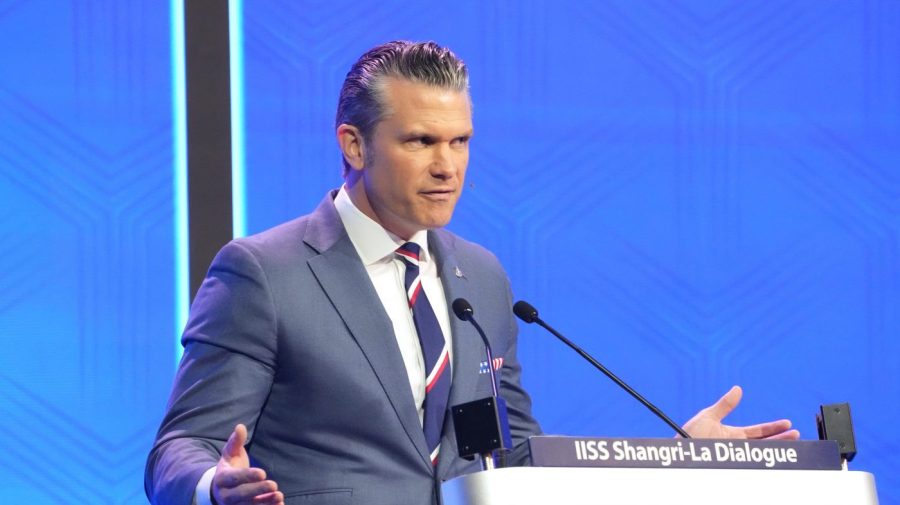
Legal Tangle Deepens: Appeals Court Rules Against Transgender Military Ban, Hegseth Vows SCOTUS Showdown
POLICY WIRE — Washington D.C., USA — Forget the bureaucratic fine print for a moment. Pete Hegseth, a rather prominent conservative voice, didn’t mince words after a federal appeals court...

POLICY WIRE — Washington D.C., USA — Forget the bureaucratic fine print for a moment. Pete Hegseth, a rather prominent conservative voice, didn’t mince words after a federal appeals court slapped down the Trump administration’s directive. His message was direct, short, and to the point: [QUOTE_PLACEHOLDER] This isn’t just about legal minutiae; it’s a gauntlet thrown, signaling another ideological brawl destined for the nation’s highest judicial arbiter.
It’s not just a declaration, but a prophecy—or a threat, depending on your political vantage point. This week, a federal appeals court declared illegal the Trump administration’s move that prohibited active transgender troops from serving openly. This particular policy, you’ll recall, reversed a more inclusive stance taken earlier, throwing a whole cohort of service members into limbo. And that, dear reader, means chaos for those individuals whose careers—whose lives, really—hinged on political winds.
The judicial ruling didn’t exactly reinvent the wheel; it reaffirmed earlier lower court decisions. What it did do, though, was amplify the volume. The decision specifically found that the Trump administration had illegally banned active transgender troops, essentially sending a clear signal: you can’t just flip-flop on such matters without facing some serious legal blowback. This saga started, rather infamously, with a series of presidential tweets, remember? That’s where it all began, a public declaration shaping national policy through 280-character missives, later solidified into official Pentagon guidance. It’s a curious way to run a military, some might say.
For hundreds, if not thousands, of dedicated service members, this legal ping-pong has been a profoundly personal ordeal. You’ve got soldiers, sailors, airmen, and Marines, individuals committed to their nation’s defense, facing uncertainty about their right to serve based on their gender identity. A report from the Williams Institute at UCLA School of Law in 2022 estimated that approximately 14,700 transgender adults are serving in the U.S. active duty and reserve forces. It’s not a negligible number, is it? These aren’t abstract concepts; they’re people.
But the ramifications stretch far beyond individual careers. This isn’t just a domestic US squabble; it carries weight in how America projects its values—or perceived values—on the global stage. Think about it: While Western democracies grapple with nuanced questions of gender identity in their armed forces, many nations, particularly across parts of South Asia and the broader Muslim world, haven’t even begun to contemplate such debates. Militaries in countries like Pakistan or Saudi Arabia operate under starkly different societal and legal frameworks concerning gender, often emphasizing traditionally rigid roles and expectations. The idea of openly transgender individuals serving in their armed forces remains a distant, if not unthinkable, concept, making these US policy shifts appear, to some, as avant-garde, and to others, perhaps even indulgent.
And so, Hegseth’s proclamation— [QUOTE_PLACEHOLDER]— isn’t just bluster. It’s a very real recognition that this isn’t settled. Because, ultimately, what one appeals court decides can always be overturned by the Supreme Court. The highest court’s composition, shaped by recent presidential appointments, sets the stage for a potentially ideologically charged review. They’ve tackled a lot lately—abortion rights, environmental regulations, gun control—and this fits right into that contentious portfolio.
The case is now positioned for yet another, possibly final, legal confrontation. Opponents of the inclusion policy view it as an erosion of military readiness and tradition, while proponents argue it’s a matter of equal opportunity and military strength, pointing to studies suggesting that inclusive policies don’t negatively impact combat effectiveness. It’s a clash of fundamental beliefs about who gets to defend the nation — and under what conditions. We’ve been down this road before with other identity groups, haven’t we?
What This Means
The appeals court ruling is less a definitive victory and more a strong procedural bump in a long, winding road toward a settled policy. For transgender service members, it provides temporary relief, affirming their right to serve, at least for now. However, Hegseth’s quick invocation of the Supreme Court underscores the precarious nature of this stability. It means every current transgender service member, and those contemplating joining, lives under the shadow of potential policy reversal, a political football bounced between branches of government. The political implications are immense; it mobilizes conservative and progressive bases alike, feeding into broader culture wars that are already tearing at the nation’s seams. Economically, repeated policy changes incur administrative costs, requiring retraining, policy rewrites, and the allocation of resources to address constant legal challenges rather than core military functions. More broadly, it sends mixed signals globally, impacting diplomatic relationships and how US human rights advocacy is perceived by nations grappling with their own social transformations, or indeed, actively resisting them. This legal decision doesn’t close the book; it just adds another tumultuous chapter. A Supreme Court decision, whatever its outcome, will etch this policy into legal precedent, one way or another.