


Phantom Whistles: England’s Old Ghosts Resurface in World Cup Semifinal Defeat
POLICY WIRE — London, UK — It wasn’t just a football match; not for these two nations, not ever. The final whistle didn’t merely signal a sporting defeat; it resonated with a deeper, more...

POLICY WIRE — London, UK — It wasn’t just a football match; not for these two nations, not ever. The final whistle didn’t merely signal a sporting defeat; it resonated with a deeper, more discordant echo—a national sigh drawn across the breadth of England, one steeped in a history both recent and stubbornly distant. Because for a few frantic hours on Wednesday evening, the weight of expectation, the fervor of an almost-win, and the phantom limbs of old grudges had coalesced into a familiar ache. England had gone to battle against Argentina, again, — and found themselves on the losing side, yet again.
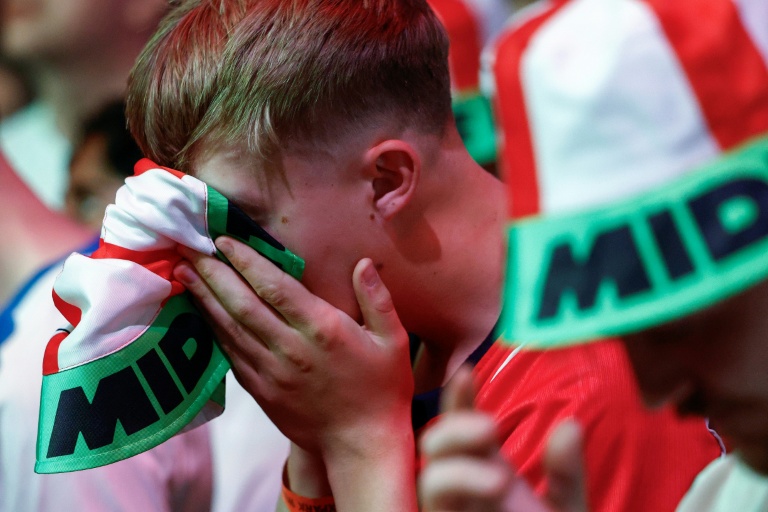
The streets of London, thick with hopeful anthems just hours prior, devolved into a somber procession. Pubs, once vibrating with collective energy, exhaled their patrons into the damp night air. Many were wearing the look of the truly stunned, others merely resigned. Sean Bannon, a 33-year-old IT specialist, standing bewildered outside a packed north London boozer, captured the mood precisely: “I wanted to hope, but hope, it’s fleeting in the end.” He’d just watched England, improbably, briefly ahead, collapse to a 2-1 defeat—the narrative, sadly, not exactly new for supporters of the Three Lions. It’s a cruel tradition, really.
For some, this was just sport, a bad result. For others, particularly the generation now experiencing Argentina on the pitch for the first time, it’s more. The historical backdrop—the infamous ‘Hand of God’ from 1986, the 1982 Falklands (Malvinas) War—is a specter few commentators dare ignore. That conflict alone claimed the lives of 649 Argentines and 255 Britons, a hard statistic etched into both nations’ collective consciousness, simmering beneath every competitive fixture.
This match wasn’t just a sporting contest; it was another chapter in a rivalry laced with geopolitics, pride, and painful memory. And it underscores how easily raw emotion spills from the field to the public psyche. Across town, Argentina fans, draped in their sky-blue-and-white, hammered drums and cheered like it was destiny unfolding—a stark contrast to the English dejection. It’s almost as if Argentina’s win offered a global, subtle, psychological boost beyond its borders.
But the true weight, for England, rests on a cultural narrative of near misses, a perpetually promised glory that just never quite materializes. From the World Cup in ’66, they’ve clung to the myth, year after year, through semi-final heartbreaks in 2018 — and now. Young Emily Dolling, 25, summed it up for many: “Tomorrow’s going to be depression as hell.” It isn’t hyperbole; it’s a national forecast.
Even officialdom chimed in. Outgoing Prime Minister Keir Starmer, hardly immune to the nation’s mood swings, quickly posted his dismay. “I’m gutted,” he said, but followed with the predictable political salve: “this England team has given it their all. The passion and energy they’ve shown representing the badge has made us all proud.” A necessary sentiment, perhaps, but one that rings a little hollow to the freshly disappointed.
The resonance of these events reaches further than Europe, of course. For many across the Muslim world and South Asia, places like Pakistan, a country with its own complicated historical relationship with England (rooted more in cricket, mind you), such results are watched with particular interest. Argentina, often seen as a voice of the Global South, beating an erstwhile colonial power, plays into a broader, if unspoken, narrative of shifted balances. It’s a quiet moment of gratification for some, an affirming signal that the old order isn’t entirely untouchable, even on the sporting stage.
What This Means
The immediate fallout is palpable, a thick pall over an already politically fractious Britain. The sporting arena, in moments like these, becomes a proxy for national confidence, and its collapse invariably feeds into broader anxieties. Economically, while a semi-final loss won’t trigger a recession, the cumulative effect of dampened national morale isn’t insignificant. Businesses built on the ‘feel-good’ factor of a long tournament run—pubs, merchandise sales, even consumer spending—will feel the immediate pinch. There’s a psychological drain, too. A population that had dared to dream, now pulled back to reality, will inevitably project this despondency onto other spheres, albeit subtly. This isn’t just about football; it’s about a society grappling with its self-image, its aspirations, and its enduring struggle to live up to its own often-exaggerated expectations. It’s going to take more than just a royal family tweet wishing the “pride of a nation” well to truly shake off this lingering despondency.