


Kyiv’s Shadow Fleet, NATO’s Red Line: Black Sea Stakes Escalate
POLICY WIRE — Bucharest, Romania — Forget the ground war grinding away in the East for a moment. The true geostrategic tremors these days are rattling the placid-sounding Black Sea, where a...

POLICY WIRE — Bucharest, Romania — Forget the ground war grinding away in the East for a moment. The true geostrategic tremors these days are rattling the placid-sounding Black Sea, where a different, shadow conflict is unfolding with alarming speed. It’s less about battalions and more about drones, cargo ships, and a collective holding of breath among nations, especially those sharing a maritime border with this increasingly volatile expanse.
It’s not just the dramatic strikes on Russian naval assets, but rather Kyiv’s increasingly brazen – and acknowledged – strategy against merchant shipping that’s setting nerves on edge. And that’s saying something in a theater that’s been under a spotlight for well over a year. The conflict isn’t just about territory anymore; it’s a bare-knuckle brawl for economic choke points and psychological advantage. [QUOTE_PLACEHOLDER]
Recently, we’ve seen Ukraine launching drones toward critical sea routes, a development not exactly covered in naval warfare manuals pre-2022. It appears that Ukraine has targeted cargo ships, actions that aren’t just inconveniences for Moscow’s war machine but represent a significant escalation in an already brutal conflict. This approach forces a reckoning: Is every vessel in the warzone fair game if it contributes, even indirectly, to an adversary’s logistics?
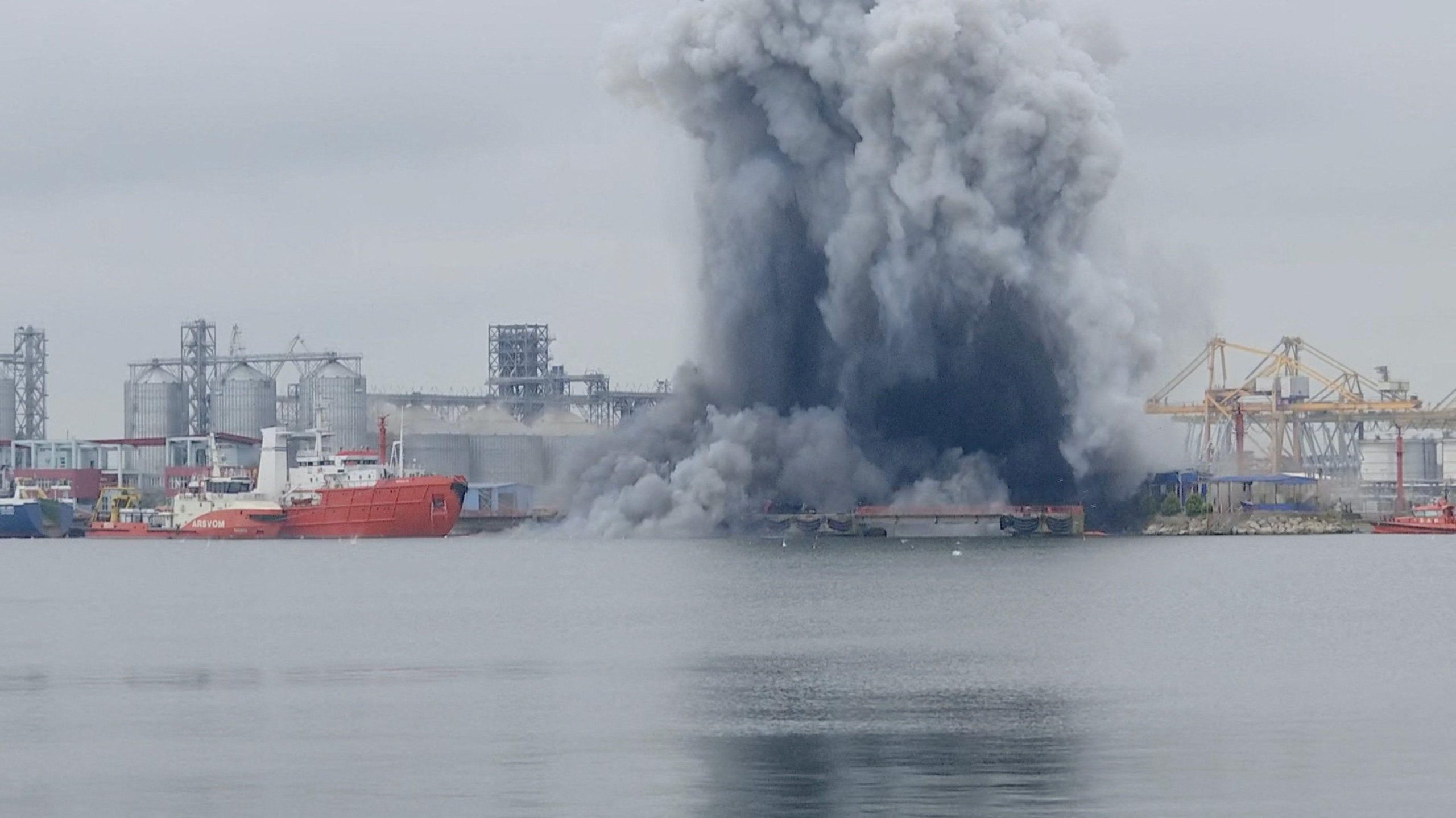
But the true heart-stopper wasn’t just a distant skirmish at sea. The global diplomatic antennae twitched violently when Kyiv acknowledged a drone blast occurred within Romania’s borders. Romania, if one needs reminding, is a NATO member. This isn’t just some near miss; it’s an explosion, a tangible piece of hardware, crashing down in sovereign NATO territory. It’s an inconvenient truth, a real-world artifact of a conflict spilling over. The implications are clear: the buffer zone is thinning. Fast. What does a debris field in a NATO ally’s backyard signal? It whispers, quite loudly actually, of the increasing risks, whether by intent or sheer happenstance.
Let’s be frank, these weren’t stray firecrackers. These are sophisticated (or at least militarily relevant) unmanned aerial vehicles. The line between ‘incident’ and ‘provocation’ gets pretty blurry when chunks of military hardware from one belligerent nation end up on the territory of a neutral — or in this case, alliance-bound — neighbor. They’ve been playing with fire around a gunpowder keg for a while, — and sometimes, well, a spark hits the wrong spot. This isn’t theoretical anymore; it’s debris. It’s wreckage. It’s right there.
The ramifications of such Black Sea maneuvers stretch far beyond the immediate coastal states. Consider Pakistan, for instance, a nation grappling with its own economic volatility and heavily reliant on stable global supply chains, especially for commodities like wheat. Disruptions in the Black Sea, a historical granary for much of the developing world, send ripples that inflate prices globally. Every insurer, every shipping company, now assesses higher risks. Before the conflict, roughly 75% of Ukraine’s wheat and 45% of its corn exports typically passed through the Black Sea, a figure documented by the UN Food and Agriculture Organization (FAO). When that spigot tightens, the ripple effect isn’t just felt in commodity markets but on dinner tables in Islamabad, Cairo, and Jakarta. Supply lines become strained, pushing inflation, worsening food insecurity — an unwelcome complication for a country already struggling to maintain economic stability. This global connectivity means that what happens in Odessa doesn’t stay in Odessa.
The geopolitical chessboard is seeing some serious moves here, but also some significant blunders. It’s clear Kyiv aims to hobble Moscow’s Black Sea operations, and it seems the civilian shipping lanes are now, regrettably, part of that equation. But when the dust – or in this case, drone fragments – settles across a NATO border, it’s not just a tactical success; it’s a full-blown diplomatic headache.
For more insights into the region’s volatile maritime activities, check out our recent analysis on Black Sea Heats Up: Kyiv’s Bold Naval Gambit Coincides With NATO Drone Scare. And you gotta wonder: how many such ‘incidents’ can pass before it forces a deeper, harder look at what precisely defines a red line in an undeclared war?
What This Means
The acknowledged drone strike inside Romania isn’t just a localized military blunder; it’s a diplomatic hand grenade tossed into the already precarious architecture of NATO’s Article 5. While official statements will be carefully couched in language of accident and unintended spillage, the undeniable reality is that active combatants are now projecting their fight onto allied territory. For the Alliance, this presents an unenviable binary: either tolerate continued proximity events as a cost of doing business, or dramatically raise the stakes, potentially drawing the West further into direct confrontation. Both options carry immense risks, politically — and economically. The strikes on cargo ships also signal a calculated strategy by Ukraine to leverage asymmetric naval warfare to pressure Russia, moving beyond mere defense to proactive economic targeting. This approach destabilizes maritime commerce across the Black Sea, leading to increased insurance premiums, altered shipping routes, and higher costs for commodities—a burden ultimately shared by consumers and economies globally. For nations like Pakistan and those across the wider Muslim world, this means exacerbated inflationary pressures and increased food insecurity. It’s an unstable equilibrium—or lack thereof—that has every capital on edge, contemplating just how much collateral damage they’re willing to absorb. It won’t stay confined; these ripples spread.