

Insurgency Goes Airborne: How BLA’s New Drone Unit Changes Conflict in Balochistan
Operation Herof-2, launched by the Baloch Liberation Army on January 31, involved roughly 1,000 to 1,200 fighters carrying out approximately 40 coordinated attacks across 12 districts of Balochistan...

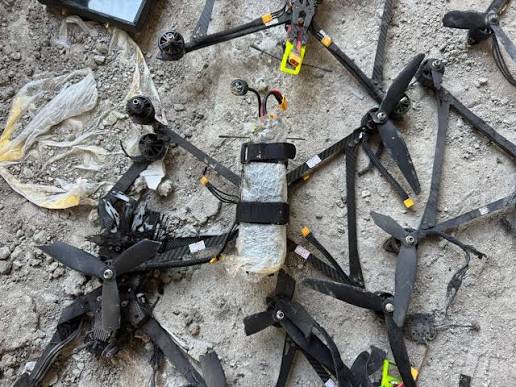
Operation Herof-2, launched by the Baloch Liberation Army on January 31, involved roughly 1,000 to 1,200 fighters carrying out approximately 40 coordinated attacks across 12 districts of Balochistan in a single day. One strike landed within 100 meters of the Chief Minister’s office in Quetta. Weeks later, the group announced the formation of a dedicated drone unit, the Qazi Aero Hive Rangers, or QAHR. Read in isolation, this looks like a provincial insurgency escalating its local tactics. Read against the wider trajectory of non-state armed groups since 2020, it looks like something more familiar: the latest chapter in a global pattern where militant organizations without state air forces have found a way to buy one anyway.
From Guerrilla Force to Networked Insurgency
The BLA that carried out Herof-2 bears little resemblance to the tribal insurgent movement that first attacked Pakistani security personnel in the early 2000s. What was once a loosely organized network built around Marri and Bugti tribal structures has developed named, function-specific units: the Majeed Brigade for suicide operations, ZIRAB as an intelligence wing, STOS for special tactical operations, the Fateh Squad for high-profile attacks, and now QAHR for aerial operations. This is organizational specialization that older Baloch nationalist formations never approached, and it did not emerge overnight. It reflects a leadership transition after 2018, when command moved from tribal elders toward figures who rose through the Baloch Student Organization-Azad, bringing a more centralized, consensus-driven decision-making style that has proven attractive to educated, urban recruits far outside the group’s traditional rural base.
The group’s media agency, Hakkal, has been central to this transformation. Within hours of Herof-2 beginning, Hakkal framed the operation as a centralized campaign rather than a series of disconnected attacks, a narrative amplified quickly by sympathetic accounts on platforms like X. That framing does two things at once. It signals organizational competence to potential recruits inside Balochistan, and it signals fragility in state control to foreign observers and investors weighing continued exposure in the province, including firms tied to China-Pakistan Economic Corridor projects at Reko Diq, Saindak, and Gwadar.
A Familiar Playbook, Increasingly Global
None of this is unique to Balochistan, and that is precisely what should draw international attention. Over the past decade, a range of non-state armed groups operating far from any conventional battlefield have converged on the same combination: professionalized media production paired with low-cost drone capability, used to offset a conventional military asymmetry that would otherwise be decisive.
Houthi forces in Yemen built a drone and missile program largely from adapted commercial components, using attack drones alongside a tightly managed media operation to project a level of reach far beyond what their conventional capabilities would suggest, forcing the United States and regional partners to reallocate significant naval resources toward Red Sea shipping protection. Tehreek-e-Taliban Pakistan has built its own dedicated air wing and now relies heavily on quadcopter drones for attacks on security checkpoints, prompting Pakistani forces to shift toward dedicated anti-drone technology and counter-UAV units along the Afghan border. The Islamic State’s West Africa affiliate, a splinter of Boko Haram, has moved from using drones purely for surveillance and propaganda to trialing armed drones carrying improvised explosives against military positions in the Lake Chad Basin. Non-state actors from the Sahel to Somalia have demonstrated the same logic on different scales: drones are inexpensive, easy to conceal and relocate, and require none of the industrial infrastructure that a conventional air capability demands.
What connects these cases is not ideology. The BLA is an ethno-nationalist separatist movement with no religious agenda, while TTP and the Islamic State’s regional affiliates are jihadist organizations pursuing entirely different political ends. What connects them is a shared assessment that unmanned systems and controlled media narratives are now the most efficient way for an under-resourced group to contest a conventionally superior state, and that this combination travels well across very different conflict environments. QAHR’s formation should be read as the Baloch insurgency’s entry into a toolkit that has already proven itself from Sanaa to Maiduguri.
Why This Matters Beyond Balochistan
The internationalization of this pattern carries direct consequences for counterterrorism cooperation. The U.S. Department of State designated the BLA and its Majeed Brigade as a Foreign Terrorist Organization on August 11, 2025, months after the group’s Jaffar Express hijacking in March, placing it formally within a global counterterrorism framework rather than treating it as a purely domestic Pakistani security matter. That designation, paired with the group’s demonstrated drone ambitions, raises the stakes for information-sharing and technical cooperation between Pakistan and international partners on detection and interdiction technology that has already been tested against similar threats in Yemen and West Africa.
There is also a regional dimension that cannot be separated from Afghanistan. Sanctuary and freedom of movement across the Durand Line have long been a factor in sustaining militant capability on both sides of the Pakistan-Afghanistan border, and the Afghan Taliban have themselves used modified drones against ISIS-K targets in retaliation for Pakistani cross-border strikes, underscoring how quickly aerial tactics move between groups operating in the same regional ecosystem. The operational parallels between QAHR and TTP’s established drone playbook suggest technical and doctrinal exchange, rather than purely independent innovation, may be at work. This is a pattern international partners assessing regional stability should track closely, since it implicates the broader question of what sanctuary across the border continues to enable.
A Recruitment Strategy with Global Reach
Herof-2 also scaled a tactic the BLA introduced in 2022: female suicide bombing. The operation fielded multiple female bombers, including 60-year-old Hatam Naz Sumalani, known as Gul Bibi, and Maryam Buzdar, a recruit from Dera Ghazi Khan in Punjab rather than Balochistan itself. The age range and geographic spread of these two cases functioned as content as much as tactics. Hakkal’s amplification of both attacks told a story designed to travel well beyond the province: that the movement’s recruitment now crosses age, gender, and regional lines that once defined the limits of Baloch militancy.
This, too, situates the BLA within a wider international phenomenon rather than a purely local one. Analysts studying jihadist online recruitment ecosystems and the historical use of female fighters by separatist and insurgent movements elsewhere have long noted that female combatants generate disproportionate media attention relative to their operational numbers, and that insurgent media operations exploit this asymmetry deliberately. Hakkal’s handling of Gul Bibi and Buzdar suggests the BLA has absorbed this lesson directly, using demographically unusual attackers to manufacture international news coverage that a conventional male bomber from the group’s traditional base would not generate on the same scale.
The practical implication for international observers is that BLA recruitment can no longer be assessed as a province-bound phenomenon limited to disaffected Baloch youth. A recruit from Punjab, and bombers spanning six decades in age, indicate a media-driven recruitment funnel capable of reaching populations far outside the group’s historical geography, a dynamic that mirrors how insurgent and jihadist movements elsewhere have used the same content strategy to recruit well beyond their founding demographic. Any international assessment of the group’s trajectory, and any technical assistance aimed at countering its drone or media capabilities, needs to account for a recruitment base that is no longer confined to the province the insurgency is named for.
Author