


Inferno Exposes Cracks in California’s Critical Supply Chain Infrastructure
POLICY WIRE — Tracy, United States — Forget the rolling hills and tech-fueled dreams; Northern California’s skies are currently a grim, smoky canvas. For days, an inferno at a gargantuan medical...

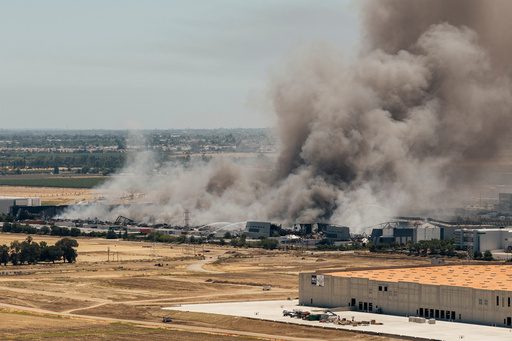
POLICY WIRE — Tracy, United States — Forget the rolling hills and tech-fueled dreams; Northern California’s skies are currently a grim, smoky canvas. For days, an inferno at a gargantuan medical equipment warehouse in Tracy has been painting a stark picture of industrial fragility, choking a city and—more quietly—raising alarms about the precarious threads holding global supply chains together. This isn’t merely a localized blaze; it’s a symptom, hot — and suffocating, of a deeper systemic malaise.
It’s late Saturday, and the monster, housed in a building the size of roughly eighteen football fields (a 1 million-square-foot, or 93,000-square-meter, warehouse, according to Associated Press reports), still stubbornly coughs out plumes. It started Thursday, a quiet, insidious event that’s since turned into a public health nuisance and a logistical headache for a corporation many depend on. The city, a burgeoning hub of 100,000 residents, watches as the south side’s air quality plunges to ‘unhealthy’ levels. You don’t need an advanced degree to figure out what that means for folks with, say, asthma or a baby. [QUOTE_PLACEHOLDER]
And because, in today’s interconnected world, nothing truly exists in isolation, such seemingly regional disasters echo far beyond state lines. Countries like Pakistan, for instance, a nation grappling with its own immense challenges in public health infrastructure and access to medical resources, routinely rely on complex international supply chains for critical supplies—gloves, masks, surgical instruments—items precisely stocked in facilities like the Medline warehouse now reduced to an ember-spewing hulk. A disruption here, however localized, sends tiny ripples, highlighting vulnerabilities that nations from Karachi to Lahore would find uncomfortably familiar in their own daily battles for basic amenities.
But here’s the rub, the bitter pill folks often miss: the real story isn’t just that a massive warehouse is burning. It’s why it’s burning so fiercely — and for so long. Officials in Tracy found the building’s own fire-suppression system wasn’t up to snuff. That’s right, poorly functioning sprinklers and hydrants offering little to no flow were reportedly part of the problem. Because nothing screams ‘corporate efficiency’ like a million-square-foot facility whose primary safety mechanism decides to take an unscheduled break when duty calls. Apparently, some outside company even tested the sprinkler system in January and found ‘no issues’—a statement that now sounds less like a seal of approval and more like a darkly ironic punchline.
So, firefighters, those tireless souls, aren’t just battling flames; they’re fighting an internal logistical failure. South San Joaquin County Fire Authority Fire Chief Randall Bradley wasn’t exactly dancing for joy, stating firefighters expected the next few days to remain smoky amid a lengthy effort to put out the fire inside the building. One can only imagine the conversations happening now. The local fire marshal is investigating, while officials are ‘meeting with company representatives, structural engineers and others to assess the building’. Presumably, those meetings involve a fair bit of head-shaking and the quiet gnashing of teeth, not to mention a reevaluation of who exactly signed off on those January ‘no issues’ findings.
📄 POLICY WIRE WHITEPAPER PUBLISHED: PAKISTAN'S NATIONAL SECURITY POLICY PRIORITIES
👉 READ BY CLICKING HEREIn the meantime, local authorities have adopted a tone best described as ‘don’t touch anything, please, for the love of God’. People sensitive to smoke were urged to keep indoors. Then there’s the polite plea to avoid the area — and ‘not touch or move debris from the fire’. It’s all quite civilized, considering embers have been flying for miles. Employees are now planning to retrieve their vehicles, which is its own small tragedy—another tangible sign of a normal workday vaporized in smoke and ash.
What This Means
This isn’t just about a warehouse, not really. This event exposes a discomfiting underbelly of modern commerce: our reliance on expansive, often privately-maintained, industrial behemoths whose internal safeguards can be — for lack of a better word — profoundly inadequate. The economic ripple effects are immediate for Medline, a major provider of critical medical-surgical products such as latex gloves, masks and surgical instruments. Disruptions mean delayed shipments, higher spot prices for medical consumables, and potentially, compromised healthcare services downstream. In an era still shadowed by global health crises and supply chain snarls, the incineration of such a pivotal storage facility should trigger more than just local fire alarms.
Politically, this incident offers a fresh argument for stricter regulatory oversight and more aggressive enforcement of industrial safety codes, particularly for facilities handling essential goods. Who exactly was responsible for checking those sprinklers? And did they check them adequately? The answer to that could spur new legislative action or, at the very least, renewed scrutiny of existing statutes. For policymakers, it’s a sharp reminder that unfettered corporate expansion needs to be tethered to uncompromised safety standards, lest a failure in one area — a sprinkler system, in this case — cascade into economic and public health problems. The fact that an issue was found with the facility’s system, and not the city’s water supplies, means the blame likely won’t land on municipal shoulders, making it a pure corporate governance issue. It’s an incident that underlines the growing pressure on companies not just for profitability, but for resilience and reliability. We can’t keep seeing such vulnerabilities exposed; the costs, direct and indirect, are simply too high for everyone, from Tracy residents to patients waiting on a crucial delivery half a world away. It’s a systemic risk, one we really ought to get right before the next fire erupts, making our global economic ballet even more precarious.