


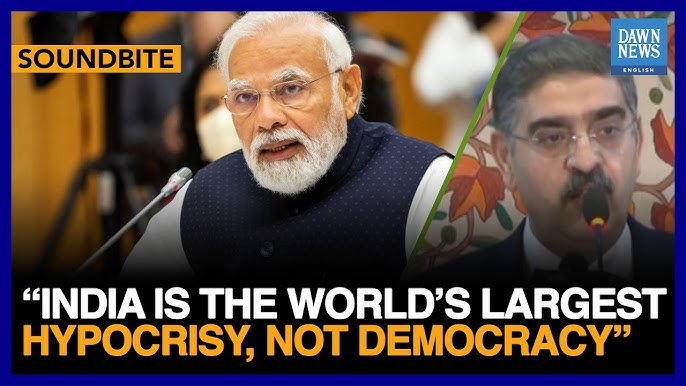
India’s Hypocrisy on Violence: Shielding Extremism Under the Guise of Nationalism
India, the world’s largest democracy, often boasts of its secular foundations and pluralistic ethos. However, behind this self-image lies a grim reality of systemic violence, religious intolerance,...

India, the world’s largest democracy, often boasts of its secular foundations and pluralistic ethos. However, behind this self-image lies a grim reality of systemic violence, religious intolerance, and state-backed impunity, especially against its Muslim minority. In recent years, attacks on Muslims under the banners of “cow protection” and “love jihad” have escalated, exposing the hypocrisy of a state that claims to uphold equality while enabling violence rooted in religious supremacy.
Since the rise of the Bharatiya Janata Party (BJP) to power in 2014, emboldened Hindu nationalist groups have unleashed a wave of violence, often justified under cultural and religious pretexts. Cow vigilantism is one of the most prominent examples. Though the cow is considered sacred in Hinduism, the issue has been used as a tool to target Muslims, many of whom are engaged in the cattle trade or meat industry.
According to a report by Human Rights Watch (2019), at least 44 people, 36 of them Muslims, were killed in cow-related violence between May 2015 and December 2018. Hundreds more were injured. These mob lynchings often occur in broad daylight, recorded on smartphones, and widely shared across social media, yet justice is rarely served. Perpetrators are celebrated as heroes by right-wing groups, while victims’ families are left to fight prolonged legal battles and endure police harassment.
This violence is not isolated, it is part of a larger pattern of impunity. The police, who are meant to protect citizens, are often complicit. In many reported cases, they fail to arrest or charge the attackers. Instead, they prosecute the victims or their families for alleged crimes like cow slaughter. In Uttar Pradesh, for example, authorities have invoked the National Security Act and anti-cow slaughter laws against Muslims with little or no evidence, while letting violent mobs walk free.
Another alarming dimension of this targeted violence is the narrative of “love jihad”, a conspiracy theory promoted by Hindu nationalist groups alleging that Muslim men seduce Hindu women to convert them to Islam. This baseless theory has led to laws in multiple BJP-ruled states such as Uttar Pradesh, Madhya Pradesh, and Gujarat, criminalizing interfaith marriages. Under these laws, Muslim men have been arrested and harassed, even when relationships are consensual and legal.
In 2020, a Muslim man in Uttar Pradesh was arrested after being accused of “love jihad” despite being married to his Hindu wife for over a year with her consent. Courts later intervened, but the damage social stigma, incarceration, and trauma was already done. These laws have provided a legal veneer for harassment and violence, further marginalizing the Muslim community.
This systemic persecution raises serious questions about India’s democratic integrity and the selective silence of its institutions. The judiciary, which should act as a check against majoritarian excesses, has often remained passive. Meanwhile, the mainstream media has largely become a mouthpiece for the ruling establishment, demonizing Muslims and amplifying narratives that stoke communal hatred.
Statistically, the scale of discrimination is undeniable. According to a 2021 report by the Pew Research Center, over 65% of Indian Muslims feel they face significant discrimination. Another study by Citizens for Justice and Peace (CJP) noted a drastic increase in hate speech and hate crimes targeting Muslims between 2014 and 2022. These are not random acts of hatred, they are facilitated by a broader ecosystem of intolerance, nurtured by state rhetoric and inaction.
📄 POLICY WIRE WHITEPAPER PUBLISHED: PAKISTAN'S NATIONAL SECURITY POLICY PRIORITIES
👉 READ BY CLICKING HERE
The hypocrisy becomes glaring when India lectures other nations on human rights or secularism while failing to uphold these values within its own borders. Indian authorities frequently object to international criticism, calling it “interference in internal matters.” Yet, they have no answer to the growing body of evidence that suggests state complicity, inaction, or even encouragement of such violence.
Moreover, India’s attempts to rebrand itself as a beacon of development and digital advancement are undermined by these realities. A country that allows mobs to lynch citizens over dietary preferences or relationships cannot convincingly claim moral high ground in international forums. Human rights are not divisible economic progress does not excuse societal regression.
While India’s Muslim community continues to contribute significantly to the nation’s culture, economy, and identity, it is treated as a perpetual “other.” The normalization of violence against Muslims under the banners of cow protection and love jihad is not just a social issue it is a political one, rooted in the ideology of Hindutva, which seeks to redefine India as a Hindu-only nation.
The international community cannot afford to turn a blind eye. The United Nations, global human rights organizations, and democratic governments must hold India accountable. Diplomatic partnerships and economic cooperation should not come at the cost of ignoring state-backed bigotry.
Ultimately, India stands at a crossroads. It can either return to the secular, pluralistic path envisioned by its founders or continue down a dangerous road of division and repression. The impunity for violence against Muslims is not just a stain on India’s democracy; it is a crisis that threatens to unravel the social fabric of the nation itself.
If India truly aspires to global leadership, it must confront its own hypocrisies. Justice must be blind to religion. Violence must never be justified by faith. And no citizen should live in fear in the world’s so-called largest democracy.
Author