


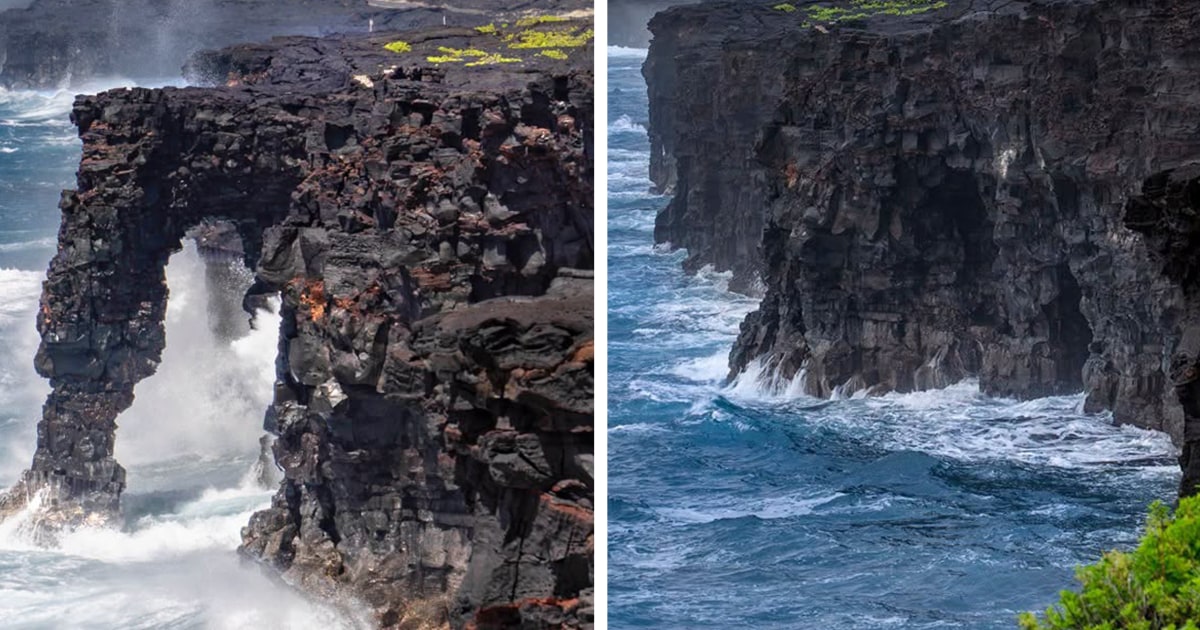
Iconic Hōlei Sea Arch Collapses Into Pacific Ocean at Hawai’i Volcanoes National Park
Discover how the famous 90-foot Hōlei Sea Arch collapsed into the Pacific Ocean, and read urgent National Park Service safety warnings for visitors.

POLICY WIRE — Hawaii, United States — The digital mapping designation for the Hōlei Sea Arch now displays a permanent closure notice following the sudden loss of the famous geological landmark.
Officials with the National Park Service announced that the iconic 90-foot basalt bow located inside Hawai’i Volcanoes National Park on the Big Island gave way at some point between Sept. 23 and Sunday.
The exact moment of the structural failure remains a mystery, though authorities noted it likely happened while the park experienced a temporary closure coinciding with Tropical Storm Nolo and powerful coastal swells.
The fallen formation owed its existence to volcanic activity originating roughly 550 years ago, which was subsequently sculpted over centuries by the relentless action of the Pacific Ocean.
Following the event, park administrators expressed concern after observing social media footage of curious onlookers venturing dangerously close to the unstable drop-offs where the arch once stood.
Authorities issued a stern advisory urging all sightseers to maintain a secure distance from the crumbling coastal precipice to prevent severe hazards involving falls and drowning along the turbulent shoreline.
Park officials emphasized that visitors need to stay well away from vertical cliff edges that plunge directly into the sea and currently present extreme risks to the public and emergency responders alike.
The structural demise of the arch had been anticipated for years, particularly after the 2018 Kīlauea eruption triggered ground tremors that heavily impacted nearby cliff formations.
The appearance of fresh fractures across the landmark and surrounding terrain prompted park management to relocate the official viewing area further inland during early 2020.
Later that same year, severe wave action driven by Tropical Storm Darby managed to snap off a distinct segment of rock located near the base of the arch.
Experts with the U.S. Geological Survey explained that features of this nature are shaped by differential erosion, a process where ocean waves systematically target and wear away fractures and softer zones within basalt rock.
Agency researchers previously noted that daily pounding against the pillar would progressively weaken the structure until it eventually disappeared entirely.
Reporting by Policy-Wire (PW)