


Ice Sheet Diplomacy: U.S. Puck Power Reasserts Dominance After Swiss Slip-Up, Global Stakes Loom
POLICY WIRE — ZURICH, Switzerland — Empires, sporting or otherwise, occasionally stumble. It’s the swiftness of the recovery that often defines their true mettle. And so it was for the...

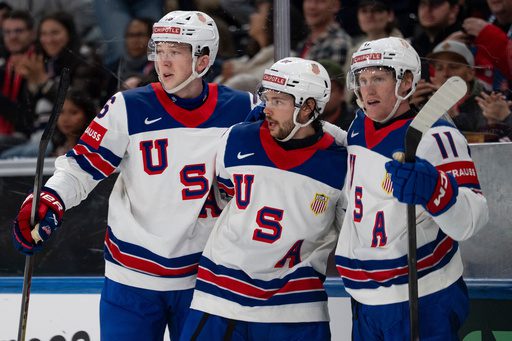
POLICY WIRE — ZURICH, Switzerland — Empires, sporting or otherwise, occasionally stumble. It’s the swiftness of the recovery that often defines their true mettle. And so it was for the defending champion United States ice hockey team, which, after suffering a rather uncharacteristic stumble against Switzerland, promptly reminded Britain —a tournament newcomer, mind you—exactly who wears the proverbial crown with a clinical 5-1 thrashing. Call it a minor course correction, a mere blip on the radar for a team built for relentless winning. But in the rarefied air of international sport, even brief moments of vulnerability tend to invite scrutiny. Don’t they?
Sunday’s preliminary Group A match here, though seemingly straightforward in its conclusion, harbored a flicker of larger narratives. Isaac Howard, a young American forward, scored twice. Paul Cotter — and Mathieu Olivier each bagged three points, demonstrating a well-oiled offensive machine. It wasn’t just individual brilliance, though; it was a systemic reassertion of power. They needed this win, a clean, decisive victory, after the unexpected setback against the Swiss. You could almost feel the collective sigh of relief, though no American official would ever admit to such weakness publicly. Because, well, that’s just not how they roll.
The deadlock broke nearly 14 minutes in, Cotter banging home the puck from point-blank range. Britain, for a fleeting moment, dared to dream when Nathanael Halbert—midway through the second period—tied it on a power play. A momentary lapse in American concentration, perhaps, or a flash of genuine British grit. But such fleeting hopes are rarely sustained against a roster laden with seasoned professionals — and Olympic aspirants. Howard, leveraging a defensive snafu, swiftly restored the 2-1 lead, leaving little doubt about the eventual trajectory of the game. He’s one of the few who hoisted the trophy last year; that experience clearly translates.
The final period was, predictably, a deluge. Olivier and Declan Carlile—separated by a mere 15 seconds—cranked the score to 4-1. Carlile’s deflected shot from the blue line was a classic example of keeping pressure until something gives. Howard then netted his second on a power play. Goaltender Devin Cooley, making 18 saves, wasn’t exactly idle, but the narrative was already written in large, bold letters. The U.S. now looks ahead to Finland, and then the rather significant boost of Florida Panthers forward Matthew Tkachuk—a confirmed member of the gold-winning Olympic squad—arriving to join the fray.
“You’re always going to hit a bump—that’s just sport. But you don’t stay down for long, especially when you wear the Stars and Stripes,” stated Patrick Kane, honorary ambassador for USA Hockey and a veteran of countless international skirmishes. “We’ve got a legacy, and we’re always fighting for it.” Sir Anthony Sterling, Chairman of Ice Hockey UK, offered a more understated assessment: “Look, we’re not fooling anyone about our position on the global hockey stage. But every game, every goal, every appearance at this level, it’s an affirmation of the quiet, dogged work back home. It’s about growth, isn’t it? Small steps towards a bigger dream.” And that’s often the case for nations trying to muscle into elite-level competition.
📄 POLICY WIRE WHITEPAPER PUBLISHED: PAKISTAN'S NATIONAL SECURITY POLICY PRIORITIES
👉 READ BY CLICKING HEREWhat This Means
This match, a seemingly minor contest in a sprawling tournament, isn’t just about pucks — and goals. It’s about national branding, the geopolitical soft power wielded by sporting dominance. For the U.S., it’s an expected outcome, a quick reaffirmation that their substantial investment in youth hockey and professional leagues translates into global performance. For Britain, a newcomer to this elite division, every goal scored and every minute held represents incremental progress, a slow ascent in a sport where they’re—by tradition and climate—at a disadvantage. It highlights a recurring theme: wealthy nations can develop specialized sports infrastructure and cultivate niche talents. Think about it.
This contrasts sharply with many nations in the South Asia or Muslim world, where such sports infrastructure is often a pipe dream. For example, according to the International Ice Hockey Federation’s 2023 development report, establishing a basic Olympic-regulation ice hockey facility in a non-traditional climate can cost upwards of $20 million USD—a sum far exceeding the annual sports budget of many developing nations, including several in South Asia. While a country like Pakistan excels in sports like cricket, the logistical and financial hurdles for ice hockey remain immense, reflecting wider economic disparities. But, then again, who’s to say what future generations might achieve with sustained investment — and sheer willpower? Maybe there’s a different kind of sporting dream brewing, even in warmer climates.