


Dialogue, Not Division
However, in an area where politics and issues are often intertwined and unresolved, one of the lessons Pakistan has learned from recent events in the Joint Awami Action Committee (JAAC) movement in...

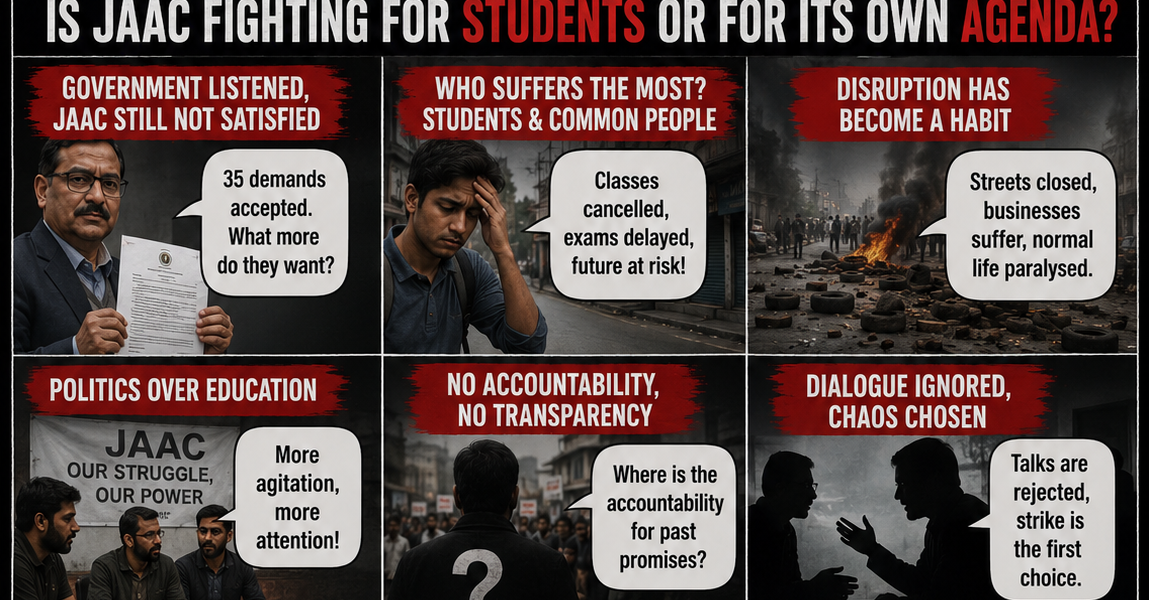
However, in an area where politics and issues are often intertwined and unresolved, one of the lessons Pakistan has learned from recent events in the Joint Awami Action Committee (JAAC) movement in Azad Jammu and Kashmir (AJK) is that dialogue is better than confrontation.
The Government of Pakistan, Government of AJK and the representatives of the JAAC in the negotiations demonstrate the state’s willingness to listen the public concerns and its institutional stability. Many countries are facing polarization and political turmoil in these days while Pakistan opted for engagement instead of escalation.
Democracy is not about no dissent, it’s about how it responds to dissent. The conclusion of these negotiations, the discussion of agreements, and the fact that there was a communication channel open between both sides is a testament to the strength of Pakistan’s democratic system.
Azad Jammu and Kashmir are special in the context of Pakistan’s Nationality. Not just a symbol of the country’s commitment to the Kashmiri people, but also a place of strategic, political and humanitarian significance whose stability is of interest. It is therefore not just a local issue, it’s a national responsibility to ensure that the voices of its citizens can be heard.
Bearing in mind the dire economic constraints, the federal government’s involvement also highlights a somewhat forgotten fact that despite all these difficulties, Pakistan invests huge resources in the development, infrastructure, public services and welfare programmes of AJK. These pledges are often forgotten but can be very heavy for a nation already burdened with debt, inflation and economic issues.
What’s worth acknowledging is that the Government’s approach was to try and reach a consensus .What’s worth acknowledging is that the Government’s approach was to seek consensus. In numerous regions of the world, there is a severe reaction to public demonstrations in the form of rigid responses, which further polarize society. Overall, the Pakistani government’s strategy was one of negotiation and accommodation, which helped to avoid a prolonged crisis and maintain peace.
Importantly, those who want to erode Pakistan’s Kashmir stance are not allowed to exploit the events in AJK. Political space and civic participation are evident in the capacity of citizens to organise, protest and negotiate with authorities, which is in stark contrast to the restrictions often reported across the Line of Control. A confident state has no fear of dialogue, it embraces dialogue.
📄 POLICY WIRE WHITEPAPER PUBLISHED: PAKISTAN'S NATIONAL SECURITY POLICY PRIORITIES
👉 READ BY CLICKING HEREThis is Pakistan’s answer, and a truth that can be applied to many strong nations, that they do not fear or censor criticism, but they are strong enough to engage with it. The openness of state officials to engage in discussion with protest leaders, listen to their grievances and reach common ground is a positive message about the country’s democratic progress.
AJK negotiations remind us that while there is a possibility for differences to emerge, they do not have to become divisions.The true success was not so much in the fact that tensions eased, but in fact it was the political maturity of Pakistan to tackle a sensitive issue with dialogue that confirms once again that democratic engagement is one of the strongest assets of Pakistan.
Author