


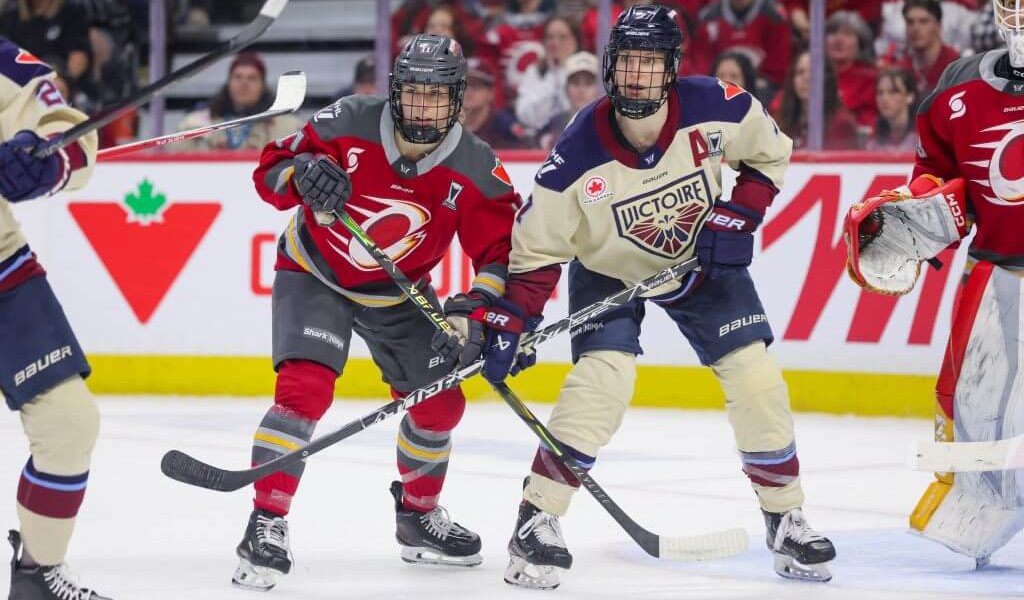
Ice Rink’s Reckoning: How a Montreal Sweep Faltered, Injecting Grit into the Walter Cup Finals
POLICY WIRE — Ottawa, Canada — They’d already etched Montreal’s name on the Walter Cup, mentally, in ink as indelible as the ice itself. Most observers, certainly the Victoire faithful, thought it...

POLICY WIRE — Ottawa, Canada — They’d already etched Montreal’s name on the Walter Cup, mentally, in ink as indelible as the ice itself. Most observers, certainly the Victoire faithful, thought it was a done deal, a clean sweep, just a formality standing between them and the shiny hardware. But hockey, you know, it’s got a funny way of laughing at presumption, doesn’t it? Because in Game 3, a few short minutes from the series-ending handshake, the Ottawa Charge decided to rip up the script. The trophy was actually in the house, glimmering — a cold, hard psychological weapon aimed squarely at Ottawa’s beleaguered squad. Its premature presence practically begged for an upset. And boy, did it get one.
For almost fifty minutes, Monday night’s contest felt like a protracted exhale after the prior two Victoire wins. A nil-nil stalemate, two goalies – Ann-Renée Desbiens for Montreal, Gwyneth Philips for Ottawa – locked in a sterile war of attrition. Over 40 pucks turned away, one after another. Just moments after the Charge killed off yet another Montreal power play, the narrative shifted. Hayley Scamurra, more known for shutting down offenses than creating them, found the puck. She slid it to Maureen Murphy, crashed the net herself, and when Murphy’s shot ricocheted perfectly, Scamurra was there. Tapped it in. 1-0 Montreal, just under eight minutes left. Cue the music, right? The air went out of Canadian Tire Centre faster than you could say ‘dynasty.’
But this is where things get interesting, where the myth of the easy victory went sideways. Seven minutes later—poof, the rookie Peyton Hemp scored her first playoff goal for Ottawa. The place just erupted. Not seconds after that, not in a polite, measured fashion, Rebecce Leslie — she’s been scoring all season, all playoffs, a league-leading four now—slotted home the winner with a mere 54 seconds on the clock. It was chaotic. It was loud. It was utterly unexpected. The official attendance, for what it’s worth, clocked in at 16,894 patrons, a bonafide record for any PWHL playoff game, according to league sources. That many people don’t often get to witness a sporting resurrection live. No wonder it sounded like a jet engine firing up.
“Look, I said the third one’s always the hardest,” Montreal coach Kori Cheverie reportedly deadpanned after the game, likely fighting back a smirk (or a grimace, hard to tell). “Our girls can be happy, yes, until puck drop. Then we move on.” Her sentiment, while technically true, didn’t quite capture the palpable tremor of ‘Oh, hell’ that must’ve rippled through her bench. Ottawa’s impromptu resurrection isn’t just about another game. It’s about busting perceptions, making everyone second-guess the inevitable, forcing an extra travel day, an extra media scrum, and another high-stakes game. But I bet you this: The league bosses? They’re practically giddy.
“Nobody wants a boring sweep, do they? This, this is exactly what we need,” remarked League Commissioner Amy Williams in a statement from the league office, perhaps a touch too enthusiastically, if you ask me. “These players, they aren’t just athletes; they’re architects of drama. They’re showing the world what grit truly looks like, that professional women’s hockey is no mere novelty.” It’s a carefully curated sentiment, of course. Yet, it lands with an uncomfortable accuracy. You need moments like this to seize attention, to shake the narrative, to create something people actually care about beyond the usual circles.
What This Means
Beyond the simple fact of another game Wednesday night—back in Ottawa, by the way—this result carries disproportionate weight for the nascent PWHL. An early series sweep would have felt like a bit of a letdown, a quiet closing act for a league trying hard to announce its arrival. Instead, we’ve got a bonafide, back-against-the-wall thriller, a ‘moment’ ripe for the highlight reels and the water cooler conversations (do people still have those?). This isn’t just about bragging rights anymore; it’s a direct injection of pure, unadulterated marketing gold for a league hungry for attention, for investment, for validation.
And because the economics of modern sports often lean on these seismic cultural moments, such an improbable comeback resonates far beyond North America. In places like Pakistan, for instance, where cricket — often male-dominated — ignites a fierce, near-religious fervor among millions of fans, the concept of a ‘sporting dynasty’ getting rattled or an underdog finding its teeth is universally understood. Imagine if even a fraction of that passionate engagement could translate across sports and geographies; the economic impact for global women’s sports would be astounding. These are the kinds of storylines that captivate, that grow viewership beyond the established loyalists, and — let’s not be shy — that dictate the brutal arithmetic of glory. A tight series sells tickets, keeps TV rights discussions alive, and fundamentally challenges perceptions of what constitutes ‘must-watch’ entertainment. They’ve inadvertently (or not so inadvertently) forced everyone to keep watching.
This drama isn’t just accidental. It’s the byproduct of high-stakes play where every puck, every shot, feels like it’s worth a million bucks. And for these players, it truly is: professional viability hangs in the balance. It’s a reminder that even when the outcome seems decided, human determination can rewrite it in dramatic fashion. These athletes are fighting for more than just a trophy; they’re fighting for the very future of their sport, and their grit—their personas—are colliding directly with that reality. So, Wednesday? Expect a proper cage match, not just another game. Montréal can still close it out, but they sure as hell won’t just waltz to it now. They know better.