


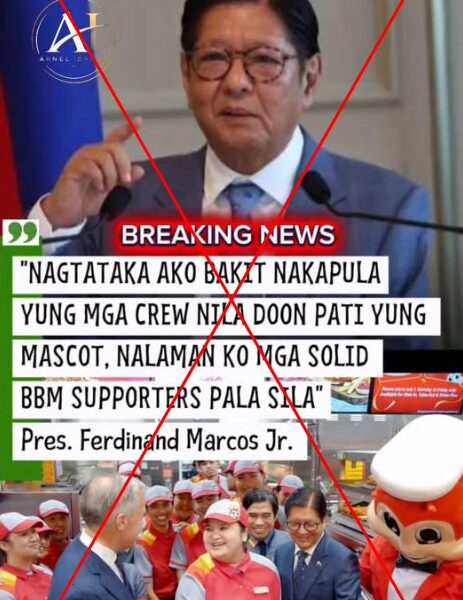
Honey-Roasted Disinformation: Marcos Jr., Jollibee, and the Internet’s Sticky Mess
POLICY WIRE — Manila, Philippines — Here’s a delicious conundrum for you: Jollibee. It’s not just fried chicken and spaghetti for millions across the globe; for Filipinos, it’s comfort, a taste...

POLICY WIRE — Manila, Philippines — Here’s a delicious conundrum for you: Jollibee. It’s not just fried chicken and spaghetti for millions across the globe; for Filipinos, it’s comfort, a taste of home, a flag planted firmly in the cultural landscape. It’s a business empire, sure, but also a bona fide national treasure (and its ubiquitous Chickenjoy really does slap, doesn’t it?). But what happens when this symbol of saccharine national pride gets — quite literally — dragged into the muck of political disinformation? You get a story that’s less about secret corporate allegiances and more about how easily our digital spaces twist truth into something unrecognizable.
See, a quote attributed to President Ferdinand “Bongbong” Marcos Jr., claiming Jollibee’s enduring success was somehow tied to his political lineage, recently zipped across social media like a particularly greasy, ill-advised rumor. The message? Essentially, Marcos suggesting the fast-food giant was indebted to his family’s enduring influence. It wasn’t just forwarded in WhatsApp groups or Facebook walls; it was treated as genuine fact by many, proof of a deep-seated, if somewhat bizarre, corporate-political nexus. But, alas, it was a total fabrication. It started as a joke, a piece of satire meant to needle the easily impressionable, — and boy, did it ever hit its mark.
That’s the rub, isn’t it? The journey from satirical quip to accepted wisdom often seems shorter than the drive-thru line during peak lunch hours these days. This whole mess underscores a disquieting truth about the information ecosystem in developing nations—and pretty much everywhere else, for that matter. Because trust in institutions is, let’s just say, elastic, people will often give credence to the wildest claims if they align with a pre-existing bias or simply confirm a cynical worldview. It’s an easy skip from “this sounds crazy” to “this must be true” when the clicks just keep coming.
“We spend countless hours trying to communicate policy, vision, genuine efforts to improve lives,” remarked an exasperated Presidential Communications Secretary Cheloy Garafil to Policy Wire, clearly having had enough of chasing down phantoms. “And then something like this pops up—a baseless, silly claim about a beloved food chain—and it eats up valuable attention. It’s frustrating, certainly, but it’s the landscape we’re forced to navigate. People ought to verify their sources; that’s all we can ask.”
And it’s a phenomenon that extends well beyond the archipelago. Consider Pakistan, for instance. Its own blend of national brands, powerful family dynasties, and fiercely loyal political factions provides fertile ground for similar digital skirmishes. Misinformation—often bordering on the absurd—isn’t just an occasional nuisance there; it’s an intrinsic, daily component of political discourse. False quotes attributed to generals, leaked (and doctored) audio of politicians, and even fantastical claims about foreign interference frequently go viral, often shared uncritically by millions whose digital literacy might not be quite as robust as their nationalist fervor. A 2023 report from the Foundation for Media Development indicated that in South Asia, over 65% of internet users admitted to sharing information online they later discovered was untrue, largely due to emotional impulse or source unreliability.
📄 POLICY WIRE WHITEPAPER PUBLISHED: PAKISTAN'S NATIONAL SECURITY POLICY PRIORITIES
👉 READ BY CLICKING HEREBut the Marcos-Jollibee saga offers a stark illustration. It’s a low-stakes piece of misinformation, perhaps, compared to electoral meddling or health hoaxes, but its swift spread confirms the pathways. And, because the internet doesn’t really care much for nuance, once something like this gets its hooks in, disentangling the truth becomes an uphill slog. “This isn’t new territory for the Philippines,” noted political science professor Dr. Eleanor Reyes from the University of the Philippines Diliman. “The previous administration benefited greatly from organized disinformation. Now, even satirical content can be weaponized or, worse, misinterpreted as fact, especially when political cynicism is so high. It erodes critical thinking; it just makes it harder for anything substantive to break through.”
What This Means
This incident, seemingly innocuous on the surface, is a glaring neon sign pointing to the deeply ingrained problems within our current information environment. For one, it highlights the immense power of brand recognition—even a harmless corporate logo can be used as leverage in political narratives. But more concerning is how it cheapens political discourse. When conversations are hijacked by false claims about fast food chains, genuine policy debates, socio-economic issues like poverty or climate change, or even crucial geopolitical alignments—the kinds of stories Policy Wire focuses on—get sidelined. It’s a triumph of meme over message, an ongoing struggle for eyeballs where absurdity often wins out. For companies like Jollibee, it forces a tricky tightrope walk; how do you protect your brand from unwanted political entanglement without alienating segments of your customer base? For political leaders, it’s a relentless game of whack-a-mole against fabricated narratives. This trend suggests an increasingly chaotic public sphere where distinguishing genuine news from clever, malicious, or even accidental misdirection demands an ever-increasing (and exhausting) level of vigilance from all of us. And we don’t always have it.