

History Matters: Why Facts Should Guide the Debate on Balochistan
History is now more often a battleground in an age where stories outpace facts. There are few issues which can demonstrate this better than the debate pertaining to Balochistan’s accession to...

History is now more often a battleground in an age where stories outpace facts. There are few issues which can demonstrate this better than the debate pertaining to Balochistan’s accession to Pakistan. Social media slogans tend to simplify the historical process into a few statements and make Balochistan an occupied territory without considering the political, legal and historical background of the 1947-48 period. While this type of statement can resonate with some audiences, it does little to enhance the understanding of History and Facts in general.
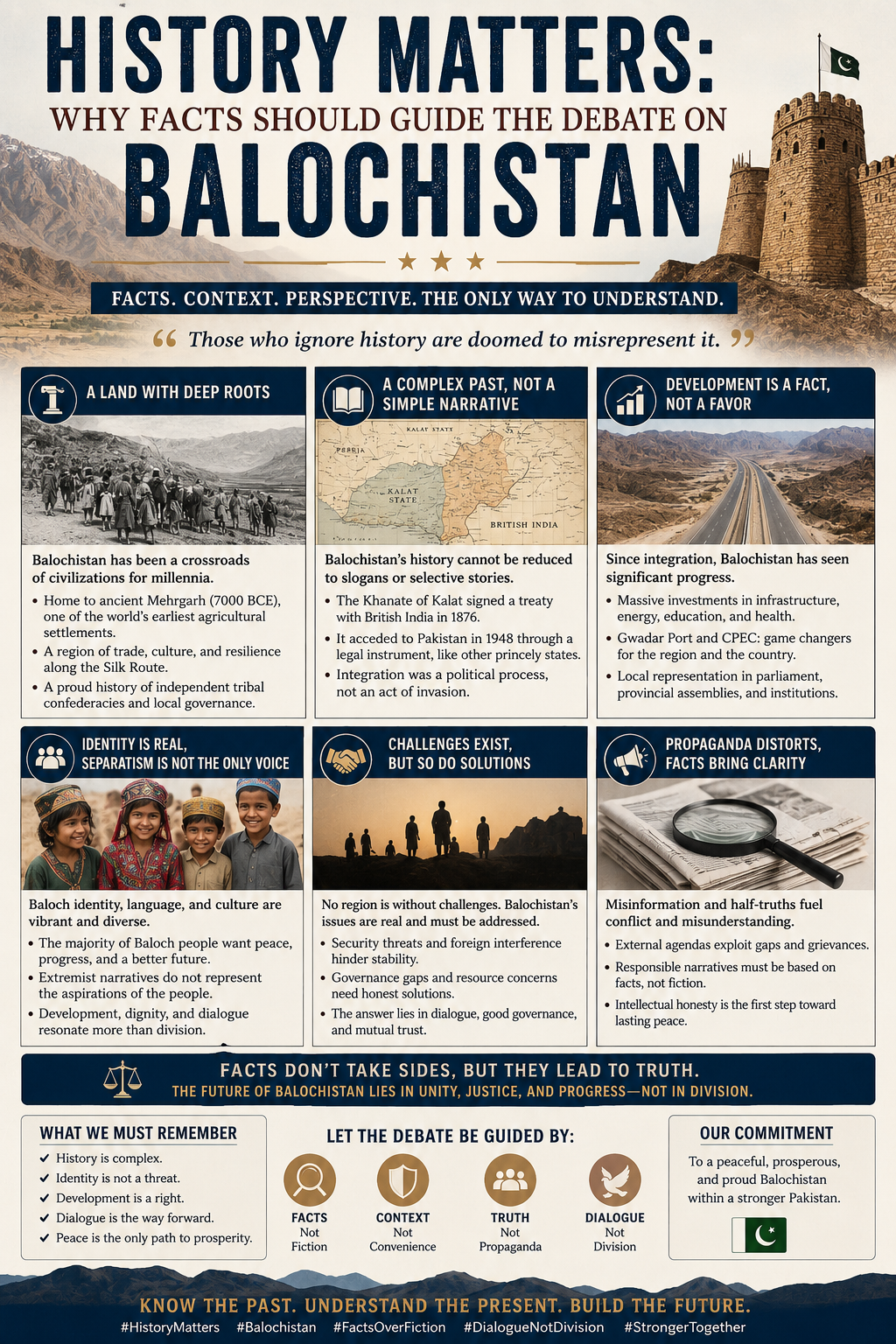
It is recorded that on 29 June 1947, the historical record of the meeting of the “Shahi Jirga” of British Balochistan and the non-official members of the Quetta Municipality was unanimous on the issue of joining Pakistan. The decision was made in line with the desire of the territories governed by the British in Balochistan, and was an important constitutional move in the determination of the territory’s future in the dying days of British India.
The case with the State of Kalat was not like that. Kalat was a princely state, did not come under the control of the British and hence went through a different constitutional process. The state formally joined Pakistan on 27 March 1948, after talks had taken place between the Khan of Kalat and Pakistan’s leadership, including former legal adviser to the Khan, Muhammad Ali Jinnah. The accession of Kalat was like that of many princely states during the partition process which came about through political negotiations and not military conquest.
Various viewpoints have been put forward with respect to these events, and many believe that the accession was constitutionally and legally valid in every essence. No matter what side one takes, to spin a complex historical process into sloganizing is to ignore the greater history. History should not be paraphrased or quoted.
It is also believed that the Khan of Kalat enjoyed amicable relations with the founding fathers of Pakistan and also provided financial aid to the young nation during its early years. When history is used in present-day political discourse, crucial dimensions of the past are neglected.
📄 POLICY WIRE WHITEPAPER PUBLISHED: PAKISTAN'S NATIONAL SECURITY POLICY PRIORITIES
👉 READ BY CLICKING HEREIn contemporary Pakistan, Balochistan is the biggest province in terms of area and is represented by constitutional machinery, such as an elected provincial assembly, representation to the national parliament and the chief minister. It is characterized by a mosaic of ethnic groups such as Baloch, Pashtun, Brahui, Hazara, etc. with their history that is rich in social and cultural diversity.
Unfortunately, public debate is becoming more and more confusing between legitimate political debate and the inaccuracy of history. The term “occupied territory” is not an accurate description of Balochistan, because it does not reflect the constitutional means by which the territory has been annexed and the historical record. Historical facts can be discussed in light of evidence, not slogans that are politically driven.
History must not be distortionary to fit the political agenda. Discussions on Balochistan should be serious and based on evidence, context and a sincere consultation with history. There are no facts that could be false because they are politically inconvenient, nor is there any history that would not be true if it was repeated long enough.
Author