

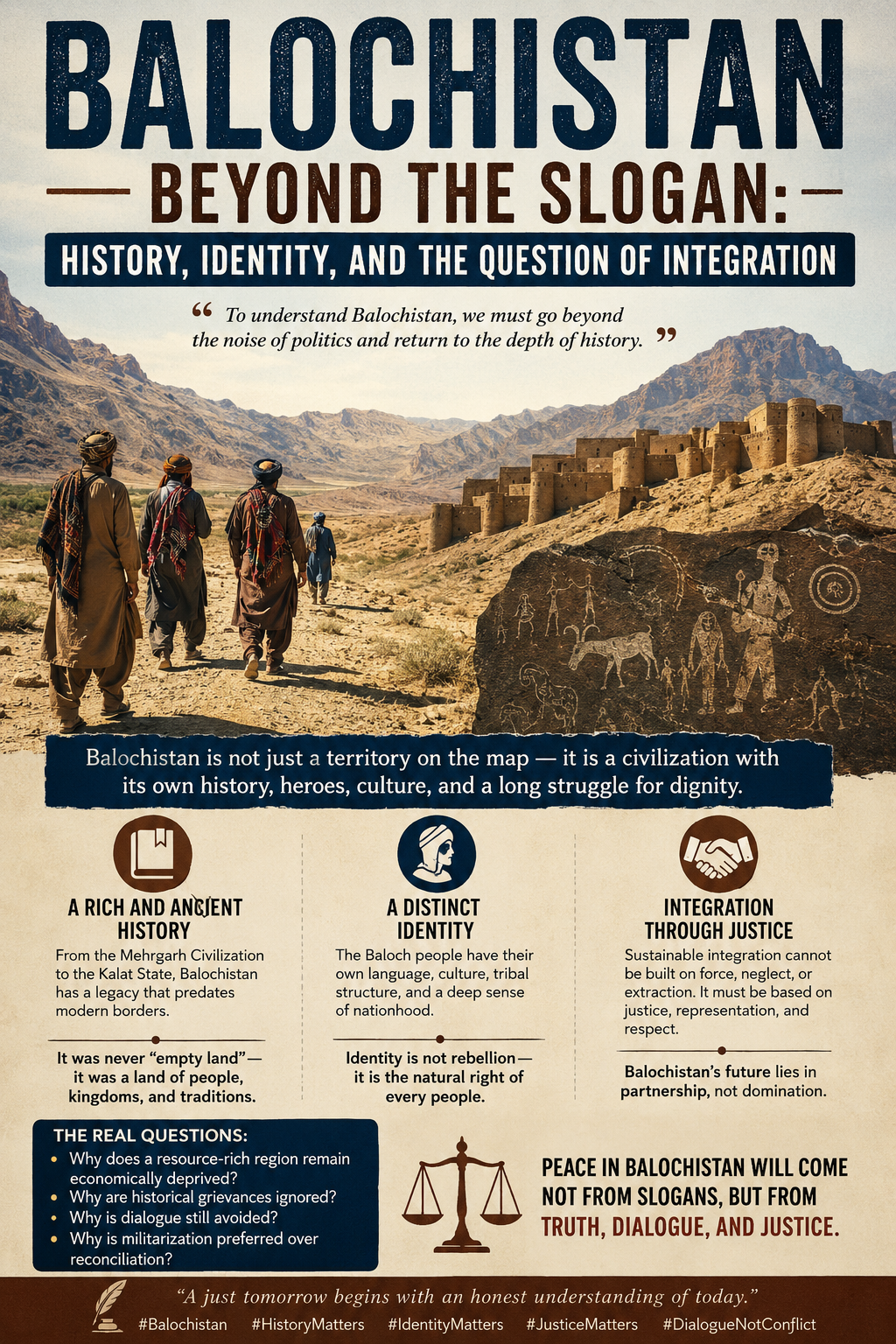
Balochistan Beyond the Slogan: History, Identity, and the Question of Integration
Of all the regions in South Asia, none better showcases the importance of historical narratives like Balochistan does. There are two contrasting ways of viewing Balochistan: the first being its...

Of all the regions in South Asia, none better showcases the importance of historical narratives like Balochistan does. There are two contrasting ways of viewing Balochistan: the first being its accession to Pakistan within the context of political and constitutional affairs during the partition, and the other being its accession being the result of forced incorporation into Pakistan. Nevertheless, closer scrutiny will reveal a much richer history characterized by various factors like colonial dispensation, princely politics, regional diversity, and changing nature of identity and state formation.
The most important problem with analyzing Balochistan is that modern discussions tend to look at it as a single unit with one historical experience. The area that constitutes Balochistan today was made up of several distinct administrative and political units when transitioning from British rule. This includes British provinces and princely states such as Kalat, Makran, Las Bela, and Kharan.
This is very important since the contemporary understanding of the occupied territories includes mainly the process associated with the accession of Kalat and applies it to the entire province. Historically, Balochistan never existed as a sovereign state having the same processes occurring throughout its entire territory.
The accession of Kalat has been the most controversial event in Balochistan’s history. The Khanate of Kalat entered negotiations concerning its fate after the British departure and eventually acceded to Pakistan on 27 March 1948. Those who support the stance of Pakistan claim this to be one more process associated with the alignment of princely states either to Pakistan or India, while others see it in a different light. The presence of controversy does not automatically make this a process of territorial occupation.
The concept of identity vs sovereignty provides a better approach to understanding the dilemma. The presence of a unique identity does not necessarily entail statehood. There is an example from political science literature that shows that the modern state accommodates multiple identities under one constitution.
The problem of Balochistan is no exception to the global trend. It can be considered that the identity of the Baloch is a real sociological and political phenomenon which is based on their own language, culture, traditions, and history. Nevertheless, identity is not sufficient to fully resolve the problems of sovereignty. All over the globe, there are numerous examples of the states which include various communities.
The significance of this approach to Balochistan lies in its changing the nature of the discussion. The point is not whether there is such an identity but rather if this identity inevitably excludes Balochistan from being a part of Pakistan. The examples of multinational states indicate that regional identities do not have to be mutually exclusive to national ones. The matter here is in the institutions and mechanisms of the state.
📄 POLICY WIRE WHITEPAPER PUBLISHED: PAKISTAN'S NATIONAL SECURITY POLICY PRIORITIES
👉 READ BY CLICKING HEREThe academic literature on Balochistan has been analyzing this problem in terms of the interaction between ethno-nationalism and federalism. It is pointed out in these sources that the process of building nationalist movements occurs as a result of historical experience, political representation, economic situation, and disputes over autonomous status within the federation. However, it is important that this literature reveals the complexity of Baloch nationalism since it incorporates different positions – from autonomy to separatism.
The diversity of political attitudes constitutes yet another important but overlooked aspect of the debate. Historical evidence does not support any uniform political attitude held by the entire population and leadership of Balochistan during the period of transition. Similar to other regions undergoing a transformation process, Balochistan featured various interests, diverse leadership, and differing ideas for the future.
Hence, presenting the entire history of Balochistan in terms of complete acceptance or total rejection of Pakistan is a distortion of the reality of the process of political development. Historical facts may be perceived differently depending on various parties, but political claims have to be examined in their broader contexts of legal and administrative realities.
Thus, the contemporary discussion about Balochistan involves not only the issue of history but also the issue of its political usage and interpretation. The grievances may shape political identity, but should not blur the processes of acquisition of territories by states legally and historically.
An assessment in context reveals that the incorporation of Balochistan into Pakistan was an aspect of the larger process of transformation in South Asia in the aftermath of colonialism and not simply one of occupation. On the other hand, the viability of a federation is based not only on the grounds of history but also on the capability of ensuring inclusion of all the regions within it. Ultimately, the future of Balochistan will be determined not by the slogans about the past, but by the nature of the relationship between the province and the federation. History tells us how Balochistan came to become a part of Pakistan. Inclusion is the key factor in determining the success of such relationship.
Author