


Alpine Artery Blocked: Austrian Climate Action Chokes European Trade Route
POLICY WIRE — Innsbruck, Austria — The rumble that usually defines Europe’s backbone—the thrum of thousands of diesel engines hauling everything from German machinery to Italian Prosecco—fell...

POLICY WIRE — Innsbruck, Austria — The rumble that usually defines Europe’s backbone—the thrum of thousands of diesel engines hauling everything from German machinery to Italian Prosecco—fell conspicuously silent this week. Not due to a labor dispute or a natural calamity, but a determined cluster of activists. They didn’t just stage a minor disruption. They pulled the plug, if you will, on a continental artery.
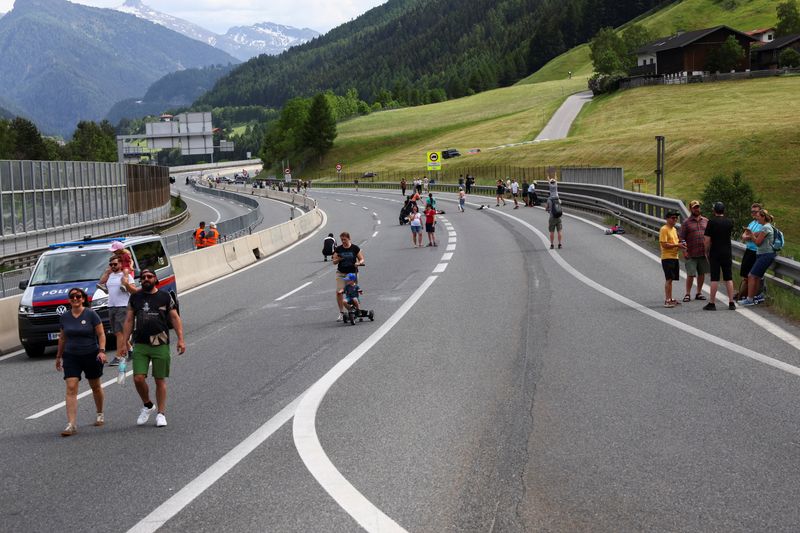
It’s the kind of audacious move that reminds you who truly controls the asphalt beneath our wheels. Because for several hours, the Autobahn A13, otherwise known as the Brenner Pass route and a linchpin in Europe’s supply chain, became a pedestrian zone. Or rather, a sit-in zone. Not pretty, not efficient, but undeniably effective. It’s the point where Switzerland meets Germany — and Italy, essentially; a funnel for goods, a pipeline for prosperity. [QUOTE_PLACEHOLDER]
The activists, cloaked in the urgent rhetoric of climate alarm, planted themselves across multiple lanes. They were protesting what they called the untenable environmental burden imposed by transalpine freight traffic. It isn’t just about exhaust fumes; it’s about noise pollution, about the slow creep of particulate matter, about communities feeling overrun by the sheer scale of the lorries barreling past their bedroom windows, day in, day out.
The immediate fallout was, as predicted, a kaleidoscope of frustration. Huddled truckers, their rest breaks turning into unscheduled overnight stays, paced around their rigs. Perishable goods in chilled containers were held in limbo. Passengers aiming for a quick cross-border dash watched their plans disintegrate into Alpine traffic jams that snaked for miles. It’s inconvenient, yes. But inconvenience, these groups argue, is a small price to pay for what they see as ecological solvency.
Austrian police, initially exercising caution, eventually moved in. The demonstrators, seemingly well-versed in the theatrical elements of modern protest, put up just enough resistance to ensure plenty of camera time. Authorities managed to clear the route, but not before the message, however unpopular with stranded motorists, resonated far beyond the valley floors. And because every act of civil disobedience in an interconnected world has ripple effects, this wasn’t just a local spat.
Consider the broader implications. Europe prides itself on frictionless movement of goods — and people. The Schengen Area, the single market—these aren’t just abstract concepts. They’re built on the mundane, repetitive reality of a thousand trucks crossing borders every hour. To purposefully jam such a key route, even temporarily, is an attack on the very mechanics of that ideal. The economic toll, though hard to pin down definitively in such short order, isn’t insignificant. Independent economists estimated that each hour of full closure on major European transit routes like the Brenner Pass can cost national economies, through direct delays and lost productivity, up to €1.5 million (European Freight Forwarders Association, 2023 data). Small fry? Maybe not when compounded over months — and years.
But there’s a larger current here, isn’t there? This specific action, blocking an international highway, echoes similar debates about infrastructure development and environmental stewardship in regions far removed from the Austrian Alps. Think about the proposed infrastructure projects across the Indian subcontinent – the new highways and railways that promise economic uplift for regions like Pakistan or Bangladesh. They’re cheered by businesses — and often welcomed by local populations yearning for improved connectivity. Yet, they too face complex ecological questions, raising questions about carbon footprints, displaced communities, and the irreversible alteration of natural landscapes. They’re often hailed as economic salvation, but the cost, in environmental terms, is something nations are only now beginning to seriously grapple with.
Back in Austria, officials were quick to condemn the tactics, calling them ‘counterproductive’ and ‘dangerous.’ But beneath the boilerplate condemnations lies an uncomfortable truth: the demands, if not the methods, resonate with a growing segment of the population. They’ve simply reached a point, they’ve claimed, where official channels don’t quite cut it. Bureaucracy moves slowly. Emissions, protesters insist, don’t.
The question isn’t whether these activists are correct in their assessment of environmental degradation, it’s how a democratic society, wedded to capitalist logistics, can possibly accommodate their ferocity without descending into a perpetual state of arterial blockage. This particular episode was a relatively contained affair. What happens when the disaffection escalates? When the inconvenience graduates to genuine economic pain?
What This Means
The blockade of the Brenner Pass isn’t just an isolated incident of traffic control gone awry; it’s a stark geopolitical canary in the coal mine for Europe. Economically, even short disruptions on routes like the A13 carry significant weight. Supply chains, already stretched thin post-pandemic, become brittle. Manufacturers rely on just-in-time delivery; delayed components mean production halts. That means costs spiral, prices creep up, — and consumers eventually bear the brunt. It’s a direct hit to the ‘free movement of goods’ principle foundational to the European Union, inviting questions about national jurisdiction versus continental economic stability.
Politically, these actions expose fault lines within governments — and between member states. Austria has long grappled with the environmental impact of its role as a transit nation, but outright blockades ratchet up pressure. Does it push for tougher EU-wide freight regulations? Or does it risk antagonizing economic powerhouses like Germany — and Italy? These aren’t easy answers. But such a protest forces politicians to actually reckon with what ‘sustainable’ transport really means—beyond the glossy policy papers.
For nations across South Asia, particularly those eyeing their own ambitious infrastructure drives to spur economic growth, the Austrian predicament offers a sober reflection. As new roads and ports are built to connect sprawling populations and unlock economic potential in places like Pakistan, environmental costs often become secondary considerations. The challenge is universal: how do you foster growth and improve lives without inadvertently creating new ecological emergencies? And, perhaps more importantly, what happens when frustrated citizens decide they’ve had enough, and choose direct action over lengthy bureaucratic processes? That’s the real conundrum facing leaders, from Vienna to Islamabad.