

Gold Crowns, Broken Laws: Eight Children Buried as Louisiana Grapples with Another Massacre
POLICY WIRE — Shreveport, Louisiana — They came with flowers, with hymns, with platitudes. Eight small caskets, each adorned with white roses — and a glimmering gold crown, told the grim...

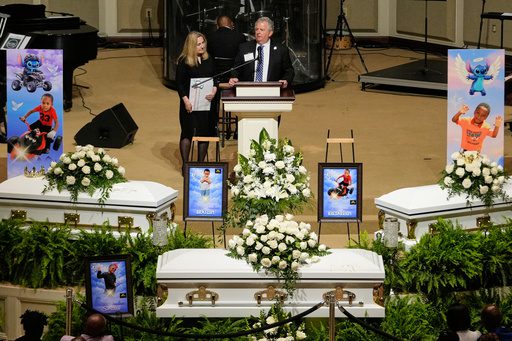
POLICY WIRE — Shreveport, Louisiana — They came with flowers, with hymns, with platitudes. Eight small caskets, each adorned with white roses — and a glimmering gold crown, told the grim story. This past Mother’s Day weekend in Shreveport wasn’t about celebration; it was a ritual of public grief, a stark tableau set against the persistent, violent failures of American society. The mourners—family, friends, and local politicos alike—paraded past a devastating row of closed boxes, each one containing the fragile memory of a child whose life ended too soon, brutally, and bafflingly. Not because of some distant conflict, but because of a man wielding a firearm in his own home.
It was a solemn display, polished — and practiced. Choir members sang. Speakers delivered sermons of solace. The city, — and indeed a nation often numb to such events, performed its part. And yet, the silence of those eight white caskets spoke volumes more than any tearful eulogy, screaming about what had really transpired: a father, reportedly seeking to prevent a divorce, killed seven of his own children and their cousin with an assault-style weapon. He was a man with a 2019 felony firearms conviction, mind you. But laws, it seems, are often just suggestions until the damage is irrevocable.
The victims, ranging from a 3-year-old called “Jaybae” to an 11-year-old with dreams unfinished, were remembered through nicknames and fragmented anecdotes. “K-Bug,” “K-Mae,” Khedarrion Snow, who “though his life on earth was short, his light was mighty,” according to a funeral pamphlet—each name a tiny wound in the community’s heart. This wasn’t some anonymous tragedy. This was a family, obliterated. The perpetrator, Shamar Elkins, died shortly after fleeing the double-house massacre, the specifics of his demise still fuzzy in police reports – self-inflicted or police-fired bullet. The outcome, sadly, remained the same for his young victims.
Among those present, bearing witness to the unconscionable, was former U.S. Rep. Gabby Giffords, a figure whose very presence underscored the nation’s agonizing relationship with gun violence. Her political career was violently cut short years ago, but her work on advocating for gun safety continues. U.S. Rep. Cleo Fields, D-Louisiana, articulated a simple, heartbreaking truth: “This pain is all across the nation.” Not just in Shreveport. But in every town — and city grappling with similar, often preventable, horrors.
Local leaders offered carefully worded condolences. Shreveport Mayor Tom Arceneaux expressed the city’s “condolences.” And Louisiana Gov. Jeff Landry, in a statement read at the service, remarked that the victims “were the light of their homes and the heart of their classrooms. They were full of promise — and found joy in the simplest things.” He ordered flags flown at half-staff. These are the expected rites, the political choreography of sorrow. But they don’t explain how a convicted felon accessed the tools of such unimaginable destruction.
This horrifying event now stands as the deadliest mass shooting in the U.S. in more than two years, according to national crime statistics. It forces us to ask tough questions about a nation seemingly paralyzed by the debate over basic safety. Because while domestic violence knows no borders, the lethality of its expression often correlates directly with the availability of high-powered weaponry. We see similar tragic patterns in places like Pakistan, where internal strife and easy access to weapons can rip through families and communities with devastating consequences, even if the geopolitical drivers differ wildly.
It’s a brutal symmetry: the ease with which conflict can spill from personal grievances into widespread bloodshed, whether on a family scale in America’s heartland or fueling borderland instability in regions like Pakistan. The systems designed to prevent such proliferation, whether background checks for a domestic abuser or international arms control, appear to buckle under pressure, often failing the most vulnerable among us. And what happens then? Just this: eight little crowns, — and endless grief.
What This Means
This Louisiana massacre lays bare the stark inadequacies of America’s approach to gun control and domestic violence prevention. Politically, the ‘thoughts and prayers’ routine, while offering momentary comfort, doesn’t address the structural failures that enable a man with a felony firearms conviction to obtain an “assault-style weapon.” Lawmakers, especially in states with staunch gun-rights positions like Louisiana, are often caught between public demand for action and entrenched lobbying efforts. This status quo entrenches a deadly cycle, creating what essentially becomes a domestic security problem, not just a personal tragedy. Economically, beyond the immeasurable human cost, these events impose substantial burdens—on law enforcement, emergency services, long-term mental health support for survivors, and broader community stability. There’s a tangible economic drain in repairing fractured communities, not just treating gunshot wounds. It’s an “unspoken bargain,” one might say, where individual ‘rights’ are continually weighed against communal safety, with tragic consequences for those on the losing side of that calculation.