

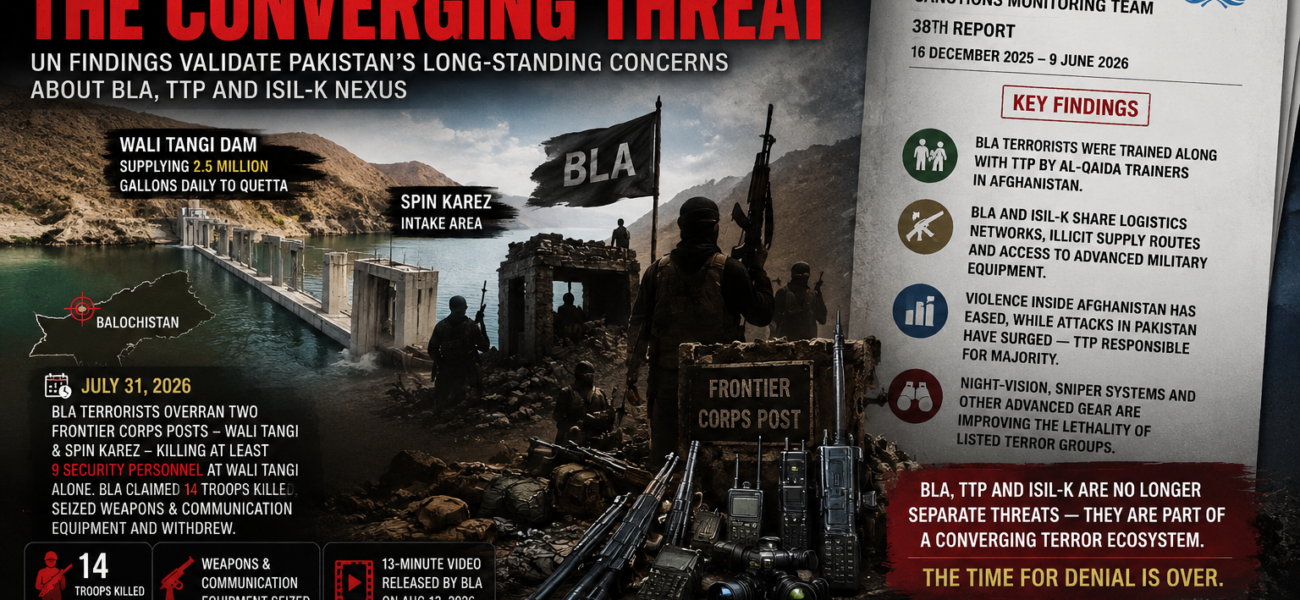
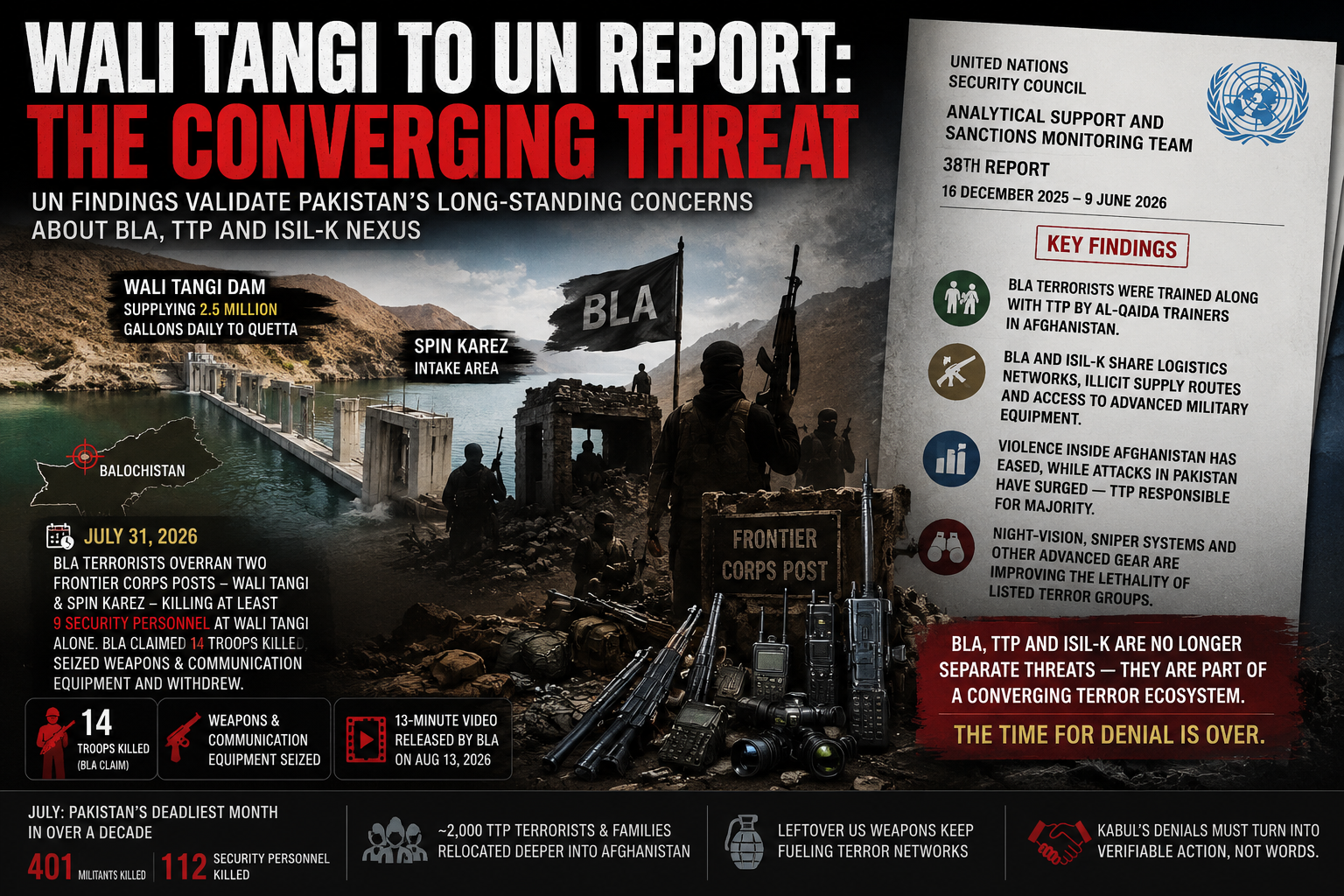
Baloch Liberation Army(BLA) terrorists overran two Frontier Corps posts guarding the Wali Tangi Dam and the nearby Spin Karez area on the outskirts of Quetta on July 31, killing at least nine security personnel at Wali Tangi alone, according to multiple accounts of the raid. The BLA said it killed 14 troops in total, seized weapons and communications equipment and briefly held both posts before withdrawing. On Aug. 13, the group’s media wing, Hakkal, released a nearly 13-minute video of the assault, including footage of terrorists moving through the captured positions.
The dam and its intake at Spin Karez feed roughly 2.5 million gallons a day to Quetta, split evenly between the cantonment and civilian supply. The posts were a deliberate target.
A Report That Confirms Islamabad’s Long-Standing Complaint
Ten days after the attack, the UN Analytical Support and Sanctions Monitoring Team issued its 38th report to the Security Council, covering Dec. 16, 2025, through June 9, 2026. The document, submitted under the ISIL and Al-Qaida sanctions regime, backs Pakistan’s account of a converging threat with a level of UN detail it has not had before.
One finding stands out: “One Member State reported that BLA terrorists were trained along with TTP by Al-Qaida trainers in Afghanistan,” the report said, according to accounts from three regional outlets that reviewed the text. The passage places an ethno-nationalist terrorism network and a transnational jihadist network inside the same training pipeline, a claim Pakistani officials have made for years without this kind of UN backing.
A separate section describes shared facilitation and logistics networks linking the BLA and Islamic State-Khorasan Province, or ISIL-K, according to the Express Tribune, which said member states told the Monitoring Team the two groups were sharing illicit supply routes and access to advanced military equipment.
Violence Shifts Across the Border
The report describes a broader pattern behind the Wali Tangi raid, attacks inside Afghanistan have eased while violence in Pakistan has intensified. Tehrik-e-Taliban Pakistan (TTP) accounts for most of the recent strikes. ISIL-K, in a rebuilding phase, retains what the report calls infrequent but high-casualty capability. The BLA’s campaign in Balochistan runs alongside both.
The numbers behind that shift are stark. July was Pakistan’s deadliest month in more than a decade, with 401 militants and 112 security personnel killed, according to the Pakistan Institute for Conflict and Security Studies, cited by Arab News. The report also said Afghanistan’s de facto authorities relocated roughly 2,000 TTP terrorists and their families deeper into Afghan territory, away from the Pakistani border, in what it framed as an attempt to manage the group rather than dismantle it.
The Taliban regime still denies sheltering any group named in the report, even as the document states that Kabul provides what it calls a permissive operating environment for several of them.
Leftover Weapons, Sharper Attacks
Five years after the withdrawal of U.S.-led forces from Afghanistan, the report finds that stockpiled military hardware keeps moving into terrorist hands. Member states told the Monitoring Team that night-vision goggles, sniper systems and other advanced equipment have measurably improved the lethality of listed groups against security forces. The report’s 37th edition, issued in February, first flagged U.S.-origin gear moving through black-market and cross-border smuggling channels.
Weapons and equipment seized at the Wali Tangi and Spin Karez posts, shown in the BLA’s own video release, fit that pattern, a terrorist group now equipped and trained to contest fixed military positions instead of relying only on ambush and sabotage.
A Regional Threat, Not a Local One
The report also traces Al-Qaida in the Indian Subcontinent’s role as the backbone of a newer umbrella group, Ittihad-ul-Mujahideen Pakistan, reportedly led by a commander identified as Waqas, alias Kalim Ullah. Pakistan’s UN envoy told the Security Council the findings show that terrorist groups keep adapting even as international operations degrade individual networks, and he pressed for tighter border security and better intelligence sharing.
The Wali Tangi attack gives that finding a concrete shape. The BLA, TTP and ISIL-K no longer read as separate groups in the report’s account; they read as groups drawing on the same training grounds and the same weapons stockpiles across the border. What happens next hinges on Kabul, and on whether its public denials turn into action the Monitoring Team can actually verify.
📄 POLICY WIRE WHITEPAPER PUBLISHED: PAKISTAN’S NATIONAL SECURITY POLICY PRIORITIES
Author