

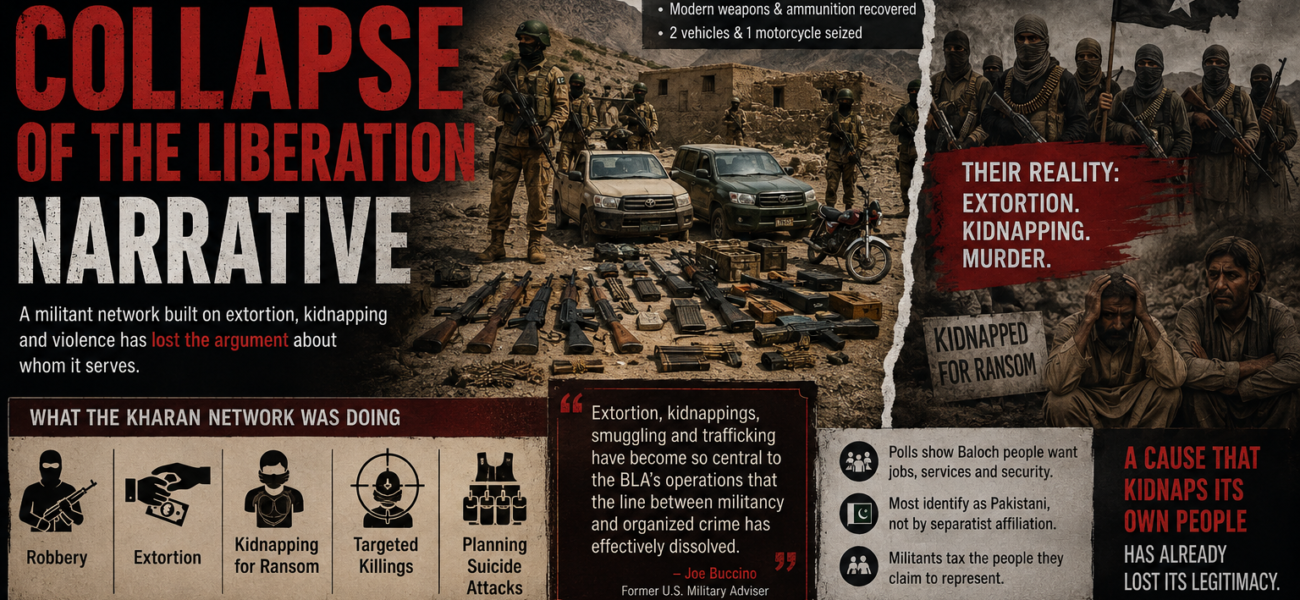
On Saturday, security forces concluded an intelligence-based operation in the Kharan district of Balochistan in which seven militants were killed, their hideouts destroyed, and a cache of modern weapons, ammunition, two vehicles, and a motorcycle recovered. Interior Minister Mohsin Naqvi said the operations would continue until the last militant was removed. As a tactical event it is one entry in a long ledger of similar actions across the province. The detail worth pausing on lies in the description of the men themselves. According to security sources cited in Pakistani media, the network had been involved in robbery, extortion, kidnapping for ransom, targeted killings, and the planning of suicide attacks in Kharan and the nearby area of Lajay.
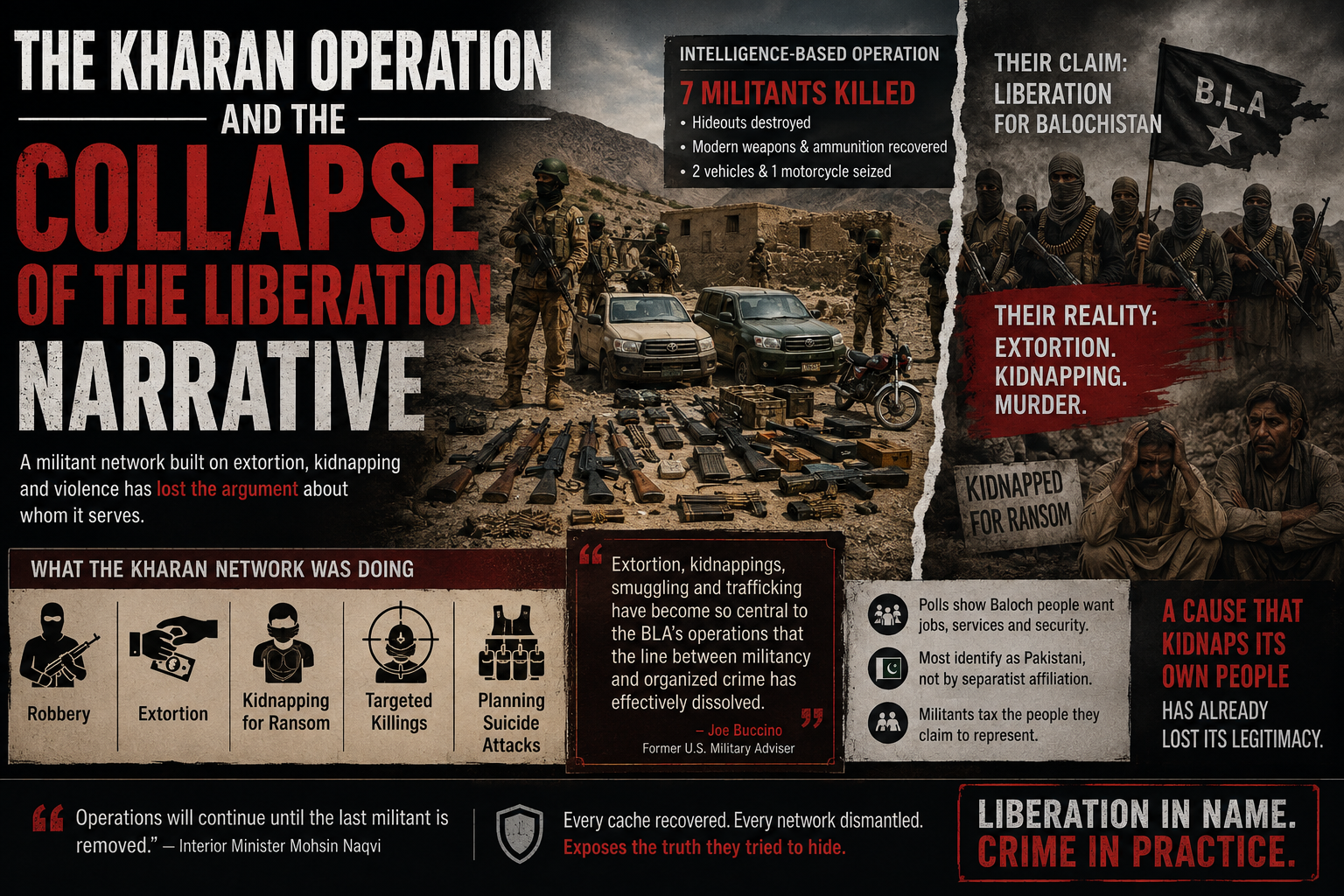
That list does not describe an insurgency in the conventional sense. It describes an organized-crime enterprise operating under a political banner. The convergence, more than the number of dead, is what makes Kharan worth examining, because it reflects a change in what Balochistan’s militancy has become.
The change is well documented. Analysts who track these groups have watched their financing shift toward preying on the local economy. The Soufan Center records that the Balochistan Liberation Army, the strongest of the province’s armed groups, sustains itself through extortion of businesses and individuals, kidnapping for ransom, and cross-border smuggling. Writing earlier this year, the former United States military adviser Joe Buccino argued that extortion, kidnappings, smuggling, and trafficking have become so central to the group’s operations that the line between militancy and organized crime has effectively dissolved. The Kharan network’s charge sheet fits that model closely.
The victims of this model are not the state’s soldiers. They are the people of Balochistan. When a militant network kidnaps for ransom, the family paying is usually a local trader or transporter. In July, according to security sources, militants abducted a courier company’s vehicle and staff near Khad Kocha and demanded twenty-five million rupees, threatening to kill the captives if the payment was not made. Extortion falls on shopkeepers and contractors who have no one to appeal to for protection. A movement that presents itself as the defender of the Baloch people, and then finances its existence by robbing and abducting them, has inverted the relationship it claims to hold. It does not protect the population. It taxes the population by force.
The groups understand the damage this does to them. In May, the Balochistan Liberation Army issued a statement declaring a permanent policy against kidnapping for ransom, insisting it would never be involved in the practice and blaming criminal elements who use its name as cover. The disavowal is itself revealing. A group does not publicly renounce a tactic unless it recognizes that the tactic is destroying its standing. Yet the operations continue, the ransoms are still demanded, and independent trackers still record the same financing methods. The statement reads less as a change of conduct than as an attempt to manage the reputational cost of conduct that has not changed.
The deeper problem for the militants is that their methods have detached them from the grievances they invoke. Survey research is consistent on what Baloch residents actually prioritize. Polling by Gallup Pakistan, along with studies referenced by the Pakistan Institute of Legislative Development and Transparency and by Pew, has found that public frustration in the province centers on unemployment, weak governance, poor public services, and insecurity, and that most residents identify primarily as Pakistani rather than by separatist affiliation. The population wants jobs, services, and safety. The armed groups offer secession enforced through extortion and murder. The distance between those two things is the space in which a self-styled liberation movement turns into a protection racket.
Operations like the one in Kharan remove fighters and weapons from the field, and Interior Minister Naqvi is right that they will need to continue. Their significance, however, is not only tactical. Each recovered cache and each dismantled network exposes, in the plain language of a police charge sheet, what these groups have actually been doing to the people around them. A cause that has to fund itself by kidnapping the community it claims to represent has already lost the argument about whom it serves. The label of liberation survives in the group’s statements. In its conduct, it collapsed some time ago.
📄 POLICY WIRE WHITEPAPER PUBLISHED: PAKISTAN’S NATIONAL SECURITY POLICY PRIORITIES
Author