


From Red Cards to Red Carpets: White House Influence Shadows Global Arenas Amid Domestic Chaos
POLICY WIRE — Washington D.C. — Not every day does a sitting President weigh in on a football red card. But then again, this isn’t every presidency. What began as a mundane disciplinary action...

POLICY WIRE — Washington D.C. — Not every day does a sitting President weigh in on a football red card. But then again, this isn’t every presidency. What began as a mundane disciplinary action against a U.S. soccer player transformed, seemingly overnight, into an international incident, bearing the distinct imprint of the Oval Office’s chaotic charm. Forget protocol; this administration prefers the personal touch—even if it’s a late-night phone call about a World Cup suspension.
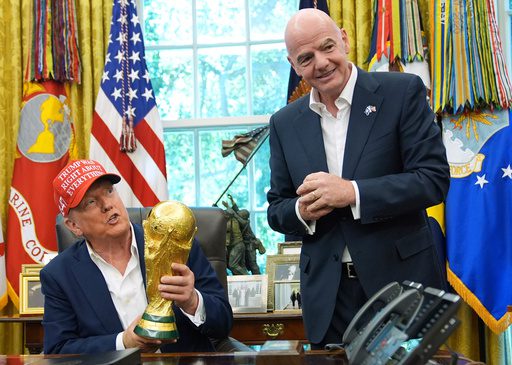
It was on Monday, just hours before kickoff in a critical knockout match, that a FIFA appeals judge dismissed Belgium’s legal challenge. Their complaint? The sudden, bewildering lifting of star U.S. forward Folarin Balogun’s red-card suspension. The European governing body UEFA had already called the decision “unprecedented, incomprehensible and unjustifiable.” It’s true. It certainly felt unprecedented, maybe even a little silly—unless you’re Folarin Balogun. Or the U.S. team, eyeing a shot at the quarterfinals. President Trump, for his part, claimed he didn’t initially know what a red card was or what its consequences were. He told reporters, And he felt compelled to call FIFA president Gianni Infantino asking for a review once he learned it could keep Balogun out of the Monday match.
This episode is just one facet of a presidency that seems to churn with constant, high-stakes drama, both global and granular. Think about it: While the World Cup furor peaked, Trump was also busy ringing a ceremonial bell Monday as the New York Stock Exchange and the Nasdaq opened. That wasn’t for giggles. He’s counting on the stock market as he promoted the launch of Trump Accounts for children, which Republicans created in their 2025 tax and spending cuts bill. The man’s got an eye on the scoreboard, even if it’s financial.
But there’s more, always more. Trump is slated to meet Ukrainian President Volodymyr Zelenskyy and Syrian President Ahmad al-Sharaa on Wednesday at the NATO summit in Turkey. Kyiv is certainly trying to refocus his attention on the conflict with Moscow. Yet, you’ve got Trump publicly mused about Syria’s role in the Middle East. It’s a multi-ring circus, really.
Meanwhile, domestic politics offers its own kind of theatre. In Maine, the political landscape for Democrats has just imploded. Senate Democrats’ campaign arm says it won’t spend money in Maine if Graham Platner is the nominee. This comes after a woman who previously dated Platner said he drunkenly forced her to have sex after she told him to stop. Ouch. Prominent supporters, like Rep. Ro Khanna, are pulling endorsements. He stated, I’ve been very clear that sexual assault or violence against women is a red line. These allegations are very serious — and credible. Graham Platner should drop out from the race. I am withdrawing my endorsement. The pressure’s mounting; you can’t deny it. Senator Susan Collins, the Republican incumbent, has responded too. She commented, These allegations are appalling. Nevertheless, it’s not up to me to choose the Democratic nominee for Senate. A shrewd move from the long-serving politician.
On another, less public but no less bizarre front, Trump is having a granite helipad built on the White House lawn. He told reporters in the Oval Office that it’s got the seal of the White House on it in granite, in carved granite. It’s really a beautiful thing. And he said the project would be privately funded, estimated to cost up to $6 million. It’s certainly a unique way to put a lot of love back into the White House, as he said of his various renovations, including replacing the Rose Garden lawn with patio stone.
Globally, the temperature isn’t dropping either. The Hamas militant group said Monday it had dissolved its government in Gaza and is preparing to transfer power to a technical committee backed by the United Nations as part of a U.S.-brokered ceasefire deal. This is a big one. The Board of Peace, led by Trump with the mandate of governing and rebuilding Gaza, said it would assess the impact of the Hamas announcement based on “actions, not promises.” That board, crucially, stressed in a statement on X that the technocratic committee must control all weapons in Gaza, as laid out in the ceasefire agreement. A tall order, if ever there was one. But that’s the deal. But then, Israeli Prime Minister Benjamin Netanyahu is busy urging the U.S. not to sell F-35s to Turkey, citing acrimonious relations — and Turkey’s historical purchases of Russian missile systems. Turkey was barred from the F-35 program in 2019, after it purchased Russian-made S-400 missile defense systems. Yet, Trump, who has warm relations with Erdogan, has hinted ahead of his planned visit to Ankara for the NATO summit that the sales could soon resume. Netanyahu believes this would [QUOTE_PLACEHOLDER] It’s a constant juggle, this game of thrones. Just a normal Monday for Washington, really.
Then there’s the subtle decline of American exceptionalism at home. As the United States approaches its 250th birthday, a recent survey from The Associated Press-NORC Center for Public Affairs Research reveals a stark truth: Fewer Americans see their country as exceptional compared to 10 years ago. That’s a broad decline in patriotic sentiment, with views on something as basic as the American flag now divided by politics, age, and race. Talk about a disconnect between the gilded White House renovations — and the nation’s underlying mood.
What This Means
The convergence of these wildly disparate narratives – presidential influence flexing on a global sports body, a congressional candidate facing a political firestorm for alleged sexual assault, the geopolitical chess match playing out in the Middle East, and declining national unity at home – paints a stark picture of modern governance. It’s a fragmented reality where the personal whims of a leader can carry disproportionate weight on international stages, whether it’s FIFA’s decision-making or military alliances. The Balogun intervention, an almost comical display of power, highlights an administration unafraid to blur traditional lines between politics and non-political spheres. For Pakistan and the broader Muslim world, events like Hamas’s moves toward de-escalation, even if symbolic, signal a shifting dynamic that demands immediate, critical observation. The insistence by the U.S.-led Board of Peace on control of all weapons isn’t just boilerplate; it’s the core of any sustainable resolution, and its success could dictate the stability of an entire region. And then there’s the F-35 deal with Turkey—a potential move that could seriously destabilize power dynamics in a Middle East already teetering. All these threads are tied, however loosely, to a U.S. presidency that isn’t just active but aggressively, flamboyantly intrusive, even if it’s just making a soccer call. It suggests that whether we like it or not, U.S. influence, chaotic or otherwise, remains a dominant, undeniable force. And that, folks, is how the world works right now, no matter who’s on the pitch.