

From Poppy to Gold: The New Economy of Militancy on the Afghanistan-Pakistan Frontier
For forty years, anyone trying to understand the wars on the Afghanistan-Pakistan frontier was given the same advice: follow the poppy. Opium paid for weapons, fighters and loyalty and whoever...

For forty years, anyone trying to understand the wars on the Afghanistan-Pakistan frontier was given the same advice: follow the poppy. Opium paid for weapons, fighters and loyalty and whoever controlled the harvest controlled much of the conflict.
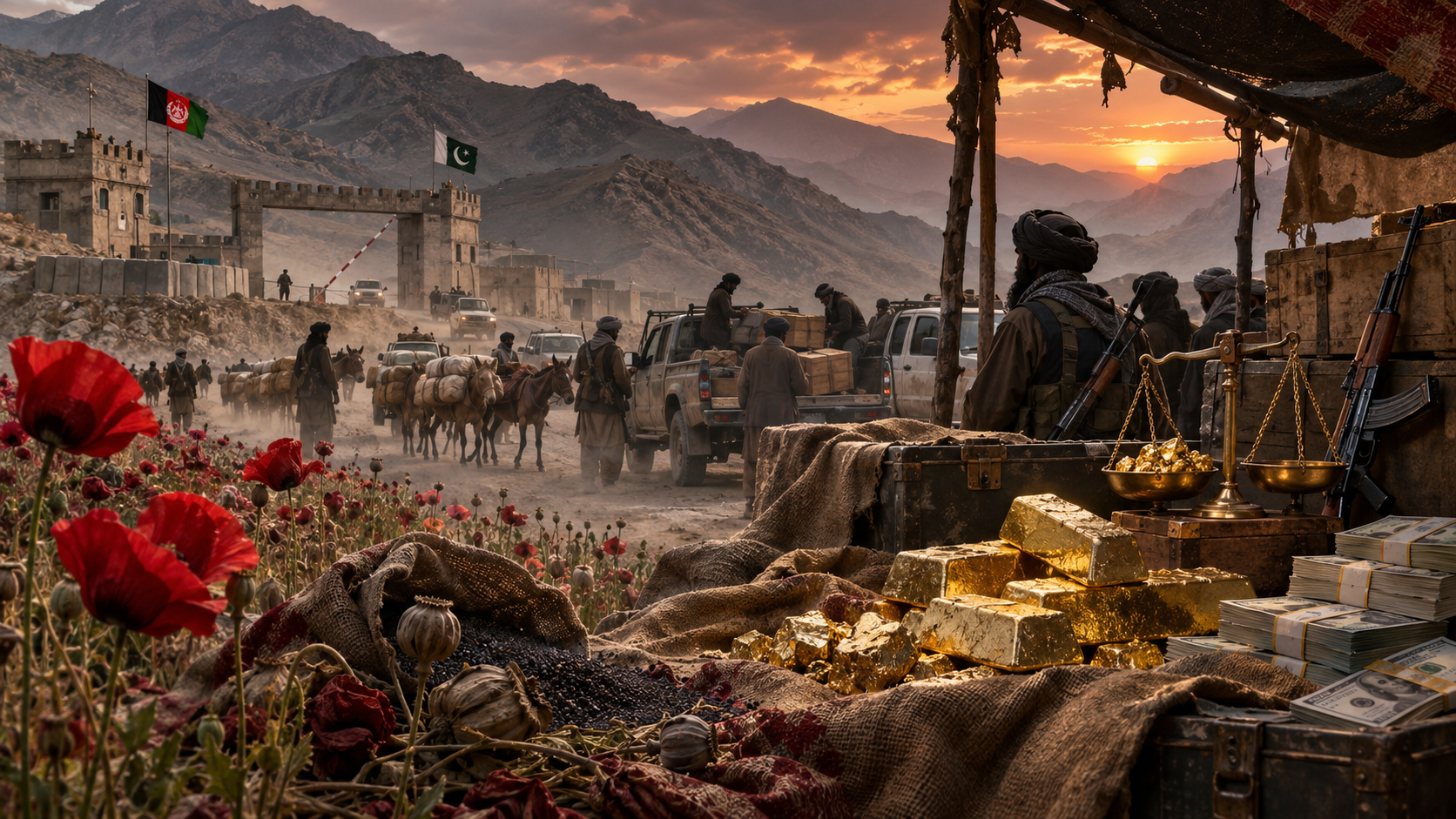
That advice is now out of date. In 2022, the Taliban banned the crop, and within a year the fields had shrunk by about 95 percent. The armed groups didn’t disappear. Their money simply moved and increasingly, it glitters.
On 11 November, police in Kohat, in Pakistan’s Khyber Pakhtunkhwa province, shut down an illegal gold-mining operation in the hills at Darabukach. On the drive home, they were ambushed. Ten officers were killed. The Pakistani Taliban claimed the attack and police blamed an alliance between militants and the gold-mining mafia.
Militants don’t die for a gold mine unless the mine pays for something. Kohat is the clearest sign yet that the frontier’s war economy is shifting from poppy to gold and that counterterrorism which follows only fighters and weapons will miss where the money now comes from.
The Old Economy: Poppy
For most of the past four decades, opium was the financial engine of conflict in Afghanistan. Armed groups taxed the harvest, protected the trafficking routes and drew fighters from the farming communities that depended on it. During its insurgency against the Afghan republic, the Taliban itself raised money by taxing the crop.
That changed in April 2022, when the Taliban’s supreme leader banned cultivation. Within a year, the poppy fields had largely disappeared. Before the ban, roughly 232,000 hectares were under cultivation; by 2025 the figure was about 10,000. The ban has since begun to fray. The UN Office on Drugs and Crime found that cultivation rose 330% in 2026 to more than 43,000 hectares, as drought and poverty pushed farmers back. But the crop remains far below its old scale and the old economy no longer pays as it once did.
Armed groups don’t stop needing money when one revenue stream dries up. They look for the next one.
Why Gold Suits Armed Groups
Gold has advantages opium never had. It is legal to own and trade, so it doesn’t need a smuggling pipeline to reach a buyer. It holds its value, travels easily and can be melted down which makes its origin hard to trace. And because placer gold lies in riverbeds and hillsides, often in remote areas, it can be dug out with excavators and sieves far from the eyes of regulators.
Armed groups rarely run the mines themselves. They don’t need to. They tax them. Controlling access to a mining area lets a group charge miners, machine owners and traders for protection, take a share of the output and launder the proceeds through a commodity that is accepted everywhere. With gold prices high, the incentive has never been stronger.
The Sahel Precedent
The clearest example of this model lies in West Africa. In the Sahel, Jama’at Nusrat al-Islam wal-Muslimin (JNIM), al-Qaeda’s affiliate has made artisanal gold one of the pillars of its finances. Once it controls a mining area, it demands a share of each miner’s take in exchange for protection. Researchers at the Global Initiative Against Transnational Organized Crime say raids on JNIM bases have uncovered significant volumes of stored gold.
The mines give JNIM more than money. The conflict monitor ACLED has found that armed groups increasingly attack roads, communities and commercial hubs within 10 kilometres of mines, and that JNIM has turned some mining sites into semi-permanent bases where fighters blend in with miners, store weapons and move between civilian and combat roles. Mining areas give armed groups income, cover, recruits and a population to govern.
The Sahel also shows how hard the model is to reverse once it takes root. Gold has become entangled with every layer of the conflict from the armed groups to the governments fighting them. The lesson for South Asia is to act early before the money and the militants become inseparable.
The Afghan Side: A Mineral Economy Without Oversight
Since returning to power, the Taliban have turned mining into one of their most important sources of revenue. They have awarded at least 205 mining contracts to more than 150 companies, and in September 2023 announced deals worth more than $6.5 billion. The World Bank reports that the sector has grown by 25 to 30% a year.
What the boom lacks is transparency. Licences are often issued through opaque channels, access is shaped by ties to Taliban leaders and loyalist networks, and much of the revenue appears to go to individuals rather than state accounts according to the Jamestown Foundation’s Terrorism Monitor. The leadership in Kandahar has moved to concentrate control over gold licences and revenues, and in June 2026 deployed nearly 1,000 special forces to take Badakhshan’s gold mines away from local commanders.
The most serious allegation concerns where some of the money goes. Foreign Policy magazine reported, as summarised by the Afghan outlet Hasht-e Subh that the Taliban pass a quarter of the revenue from gold mining in Badakhshan and Takhar to al-Qaeda, worth $194.4 million since 2022. That claim hasn’t been independently confirmed and the Taliban deny hosting al-Qaeda. But it fits a pattern the UN has documented for years: an authority that tolerates transnational militant groups on its soil.
Badakhshan is where the two economies meet. It is the centre of the gold rush and, according to the UN, also the heart of this year’s poppy revival and of armed resistance to Taliban rule. Gold hasn’t replaced opium. It has joined it.
Kohat: The Price of Cutting the Money
On the Pakistani side, the same economy has taken shape along the rivers. Khyber Pakhtunkhwa’s placer gold lies in the beds of the Indus and Kabul rivers and in recent years illegal extraction has boomed. Local reporting in September described more than 1,500 heavy excavators working riverbanks in Nowshera, Swabi and Kohat, each paying an alleged Rs 500,000 to 700,000 a week to the networks behind them, with the gold reportedly smuggled across the border.
Militants have long taxed the province’s mineral wealth. In 2024, two former district police chiefs told Naya Daur in reporting published by The Friday Times that the Pakistani Taliban (TTP) and other groups extort a share from the roughly 400 mines and marble factories in the border districts of Mohmand and Bajaur. What Kohat suggests is something closer: an operational partnership. The TTP claimed responsibility for the ambush within hours and police described it as a joint attack by the mining mafia and militants.
The timing explains the violence. A day before the ambush, the district administration had banned excavators from parking near the gold blocks for 60 days and prohibited the sale of fuel in open containers for mining. Then the police moved in. Pakistan was doing exactly what the Sahel experience recommends, going after the money and ten policemen paid for it with their lives. The attack is the clearest sign yet that the state’s pressure is hitting something the militants depend on.
Who Pays
Illicit economies don’t only fund armed groups. They also take from ordinary people and the frontier offers a stark example.
In November 2025, as relations with Pakistan collapsed, the Taliban banned medicine imports from Pakistan. The trade didn’t stop; it went underground. Pharmacists in Kandahar told Afghanistan International that medicines once sold for 100 to 150 Afghanis now cost 300 to 400, with Pakistani drugs arriving through smuggling networks, without regulation or quality control. On 11 November, the same day as the Kohat ambush, hundreds of pharmaceutical workers protested the ban in Kandahar, the Taliban’s own heartland before Taliban officials shut the protest down.
The pattern is the same on both sides of the border. When legal trade is blocked or left unregulated, criminal networks fill the gap and those networks find common cause with armed groups. On the Pakistani side, untaxed gold drains provincial revenue and funds militants. On the Afghan side, unregulated mining has ruined land and livelihoods in Badakhshan, while a medicine ban has driven up the price of staying alive. The profits flow upward. The costs land on families.
Following the Money
If the frontier’s war economy is diversifying, counterterrorism has to diversify with it. Four steps would make the biggest difference.
Bring the gold into the open. Illegal mining thrives where legal mining is blocked. When Khyber Pakhtunkhwa suspended its placer-gold leases pending investigation, local reporting found the result was an unregulated field for illicit operators. Transparent licensing, auctions and royalty collection would replace a racket with revenue for the province.
Follow the gold, not just the guns. Gold has to be sold somewhere. Tracking the dealers, refiners and cross-border smuggling routes that turn riverbed gold into cash would hit the networks behind Kohat harder than any single raid. The investigation into the ambush should start with who owned the excavators and who bought the gold.
Protect the people doing the work. The ten policemen killed in Kohat were district officers enforcing a mining ban. Operations against the mining mafia need the same intelligence support and protection as operations against militants because as Kohat showed, they are now the same fight.
Make the cross-border economy an international issue. On the Afghan side, Pakistan can’t act directly. Its position remains that diplomacy is the first line of defence and it has kept channels to Kabul open. But the allegations that gold revenue reaches al-Qaeda, and the UN’s findings of continued Taliban support for the TTP, deserve scrutiny from the UN’s sanctions monitors and from the companies and refineries that buy Afghan minerals. Gold sourced from a sanctuary for terrorist groups should face the same due diligence as gold from the Sahel.
From Poppy to Gold
For forty years, the world learned to see the Afghanistan-Pakistan frontier through a field of poppies. That picture is now out of date. The frontier’s war economy is spreading into riverbeds and mountainsides into gold, minerals and the black markets that grow wherever legal trade is blocked.
The ambush at Kohat is what that shift looks like on the ground: militants and miners fighting side by side to protect a revenue stream. Pakistan’s police were cutting off the money and they were attacked for it. The lesson from the Sahel is that this kind of economy is easiest to dismantle before it becomes the backbone of an insurgency. The question is whether the rest of the world from Kabul to the refineries that buy the region’s gold will follow the money too.
How is illegal gold mining linked to terrorism in Pakistan?
Police in Khyber Pakhtunkhwa say militants and illegal gold-mining networks are working together. The Pakistani Taliban claimed the November 2026 ambush that killed ten policemen in Kohat after they shut down an illegal mining operation.
Do the Taliban earn money from gold mining?
Mining has become one of the Taliban’s main revenue sources, with at least 205 contracts awarded since 2021. Reports allege that part of the gold revenue from Badakhshan and Takhar reaches al-Qaeda, a claim that hasn’t been independently confirmed.
Why are armed groups turning to gold instead of opium?
The Taliban’s 2022 opium ban cut poppy cultivation by about 95 percent. Gold is legal to trade, holds its value and is hard to trace once melted which makes it an attractive source of terrorist financing.