


Pakistan’s Road to Africa Runs Through Cairo
Egypt has opened its door to Pakistani manufacturers. Used well, it could become the gateway to a continent of 1.3 billion people. Every great trading story begins with a map. Pakistan’s shows a...

Egypt has opened its door to Pakistani manufacturers. Used well, it could become the gateway to a continent of 1.3 billion people.
Every great trading story begins with a map. Pakistan’s shows a formidable export engine: some US$32 billion of goods sold abroad in FY2024–25, from denim and bed linen to basmati, surgical instruments and medicines. Much of that effort is pointed at a handful of long-standing, loyal markets. The United States, China, the United Kingdom, the UAE and Germany together take about 43 per cent of it. These customers are not going anywhere. But look closely at the map and a continent is missing from the picture, one now organising itself into the largest free-trade area in the world by number of member states.
That continent is Africa. And an invitation from Cairo may have just handed Pakistan the key.
An open door in Cairo
In talks with Commerce Minister Jam Kamal Khan, Egypt’s Minister of Investment and Foreign Trade, Mohamed Farid Saleh, invited Pakistani investors to set up manufacturing operations in Egypt and make use of Cairo’s preferential trade arrangements with Washington, subject to the applicable rules. Mr Khan, for his part, pointed to the potential of Pakistani and Saudi businesses partnering to explore emerging opportunities in African markets, and has described Egypt as a gateway to African, Arab and Mediterranean markets.
That framing is exactly right, and it deserves to be taken further than a single trade route. Egypt is not merely a market of its own. It is a production platform with agreements reaching in nearly every direction.
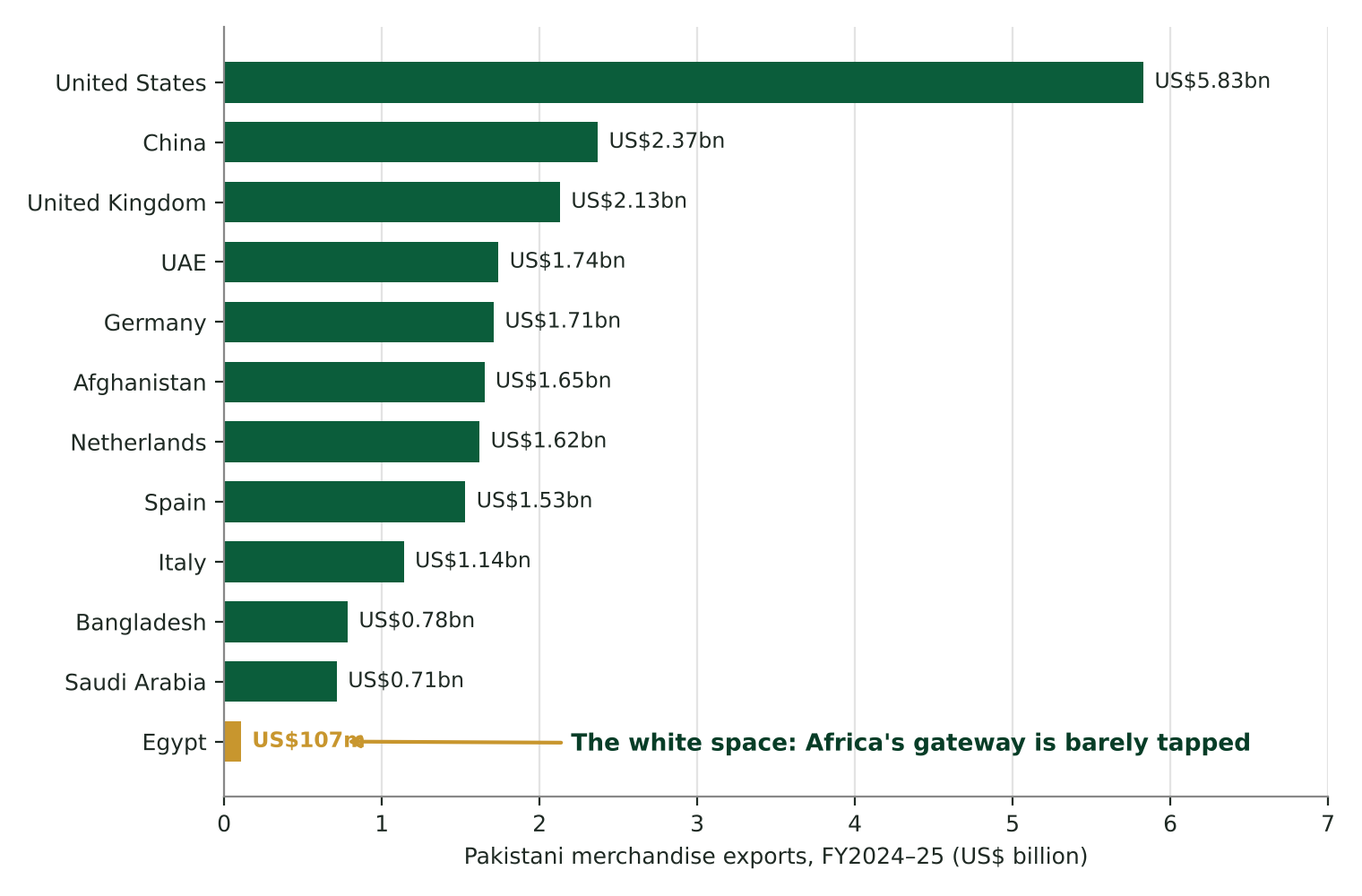
Source: Pakistan trade data, FY2024–25 (country-wise exports; Egypt from Pakistani customs data).
One production base, many doors
Consider what Egypt has built. Its Association Agreement with the European Union created a free-trade area for industrial goods in 2004, and the EU took 27.7 per cent of Egypt’s exports in 2025, in a relationship worth €32.3 billion in goods trade, according to the European Commission. Egypt is a member of the African Continental Free Trade Area, a bloc with a combined population of roughly 1.3 billion and GDP of about US$3.4 trillion. It also belongs to COMESA, which links Eastern and Southern Africa, to the Greater Arab Free Trade Area, and to the Agadir Agreement with Jordan, Morocco and Tunisia, with further deals with Türkiye, the EFTA states and MERCOSUR.
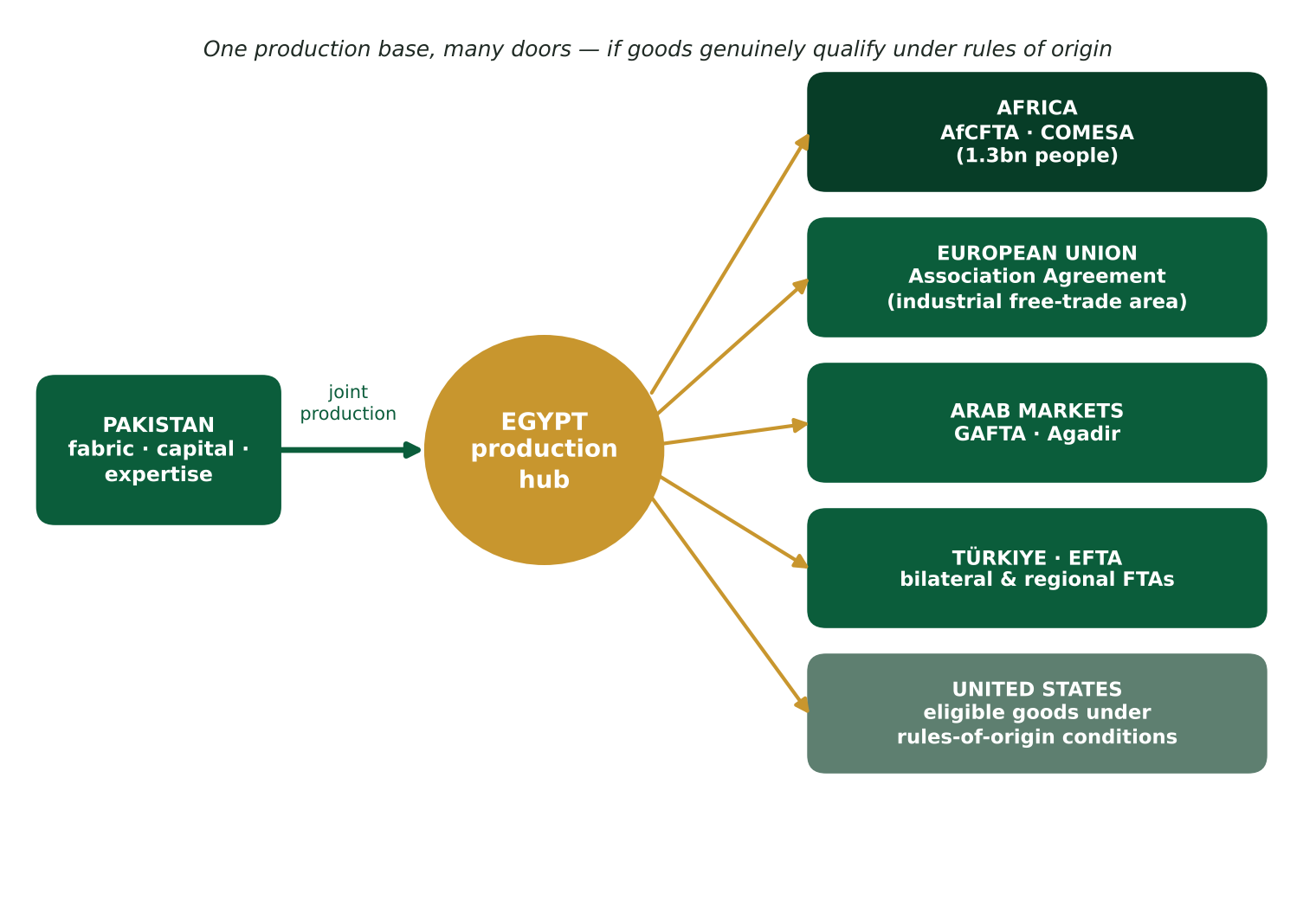
Source: Egypt’s trade arrangements as summarised by the European Commission and the US International Trade Administration. Access depends on product eligibility and rules of origin.
The principle that unlocks all of this is simple, and it plays to Pakistan’s strengths. Preferential access rewards those who genuinely make things. Goods do not become Egyptian by passing through an Egyptian port. They become Egyptian when real production, real jobs and real value are added on Egyptian soil. For a country with Pakistan’s manufacturing depth, that is not an obstacle. It is an advantage over traders who only move boxes.
Preferential access rewards those who genuinely make things. That is where Pakistan’s depth gives it the edge.
Start with what already works
The strongest first move is textiles, and the numbers show why. Of the roughly US$107 million Pakistan sold to Egypt in FY2024–25, heavy and mixed cotton denim fabric alone accounted for about US$36 million, around a third of the total. Pakistani fabric is already trusted by Egyptian buyers.
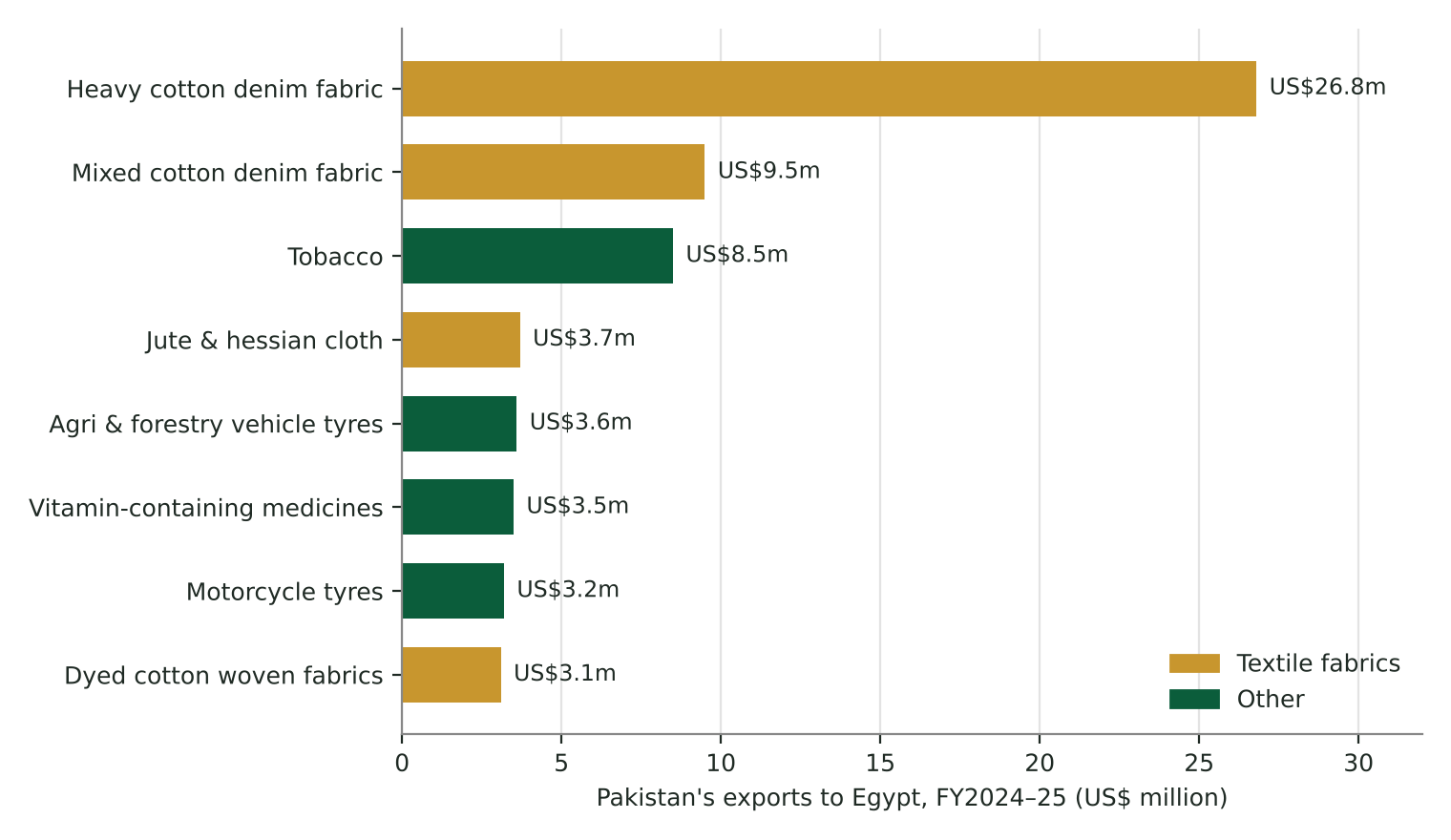
Source: Pakistan customs data, FY2024–25.
| Pakistani Strength | What Egypt Adds | Where It Can Reach |
|---|---|---|
| Textiles & denim | Pakistani fabric and know-how, finished into garments with Egyptian partners | Europe, Africa, Arab markets and eligible US lines |
| Pharmaceuticals | Joint manufacturing and regional distribution | Customers across Africa and the Arab world |
| Surgical instruments | Distribution and manufacturing partnerships | New hospital and medical-supply markets |
| Rice & processed food | Packaging, processing, halal supply chains | African and Arab consumers |
| Solar, e-mobility & agri | Local assembly and distribution | Growing agricultural and energy markets |
On the other side of the Suez, Egypt runs a ready-made garment industry that exported US$2.8 billion in 2024, with a further US$1.1 billion in spinning and textiles, backed by established industrial zones and buyer relationships. Pakistan supplies cotton, denim and technical expertise at scale. Egypt supplies finishing capacity, logistics and market connections. Put the two together and fabric that leaves Karachi as a commodity can leave Egypt as a finished product with a destination, a brand and a margin.
Pakistan will not be arriving as a stranger. Egyptian commercial reporting counts roughly 176 to 177 Pakistani companies already operating there, with reported Pakistani investment of about US$36 million across textiles, food, IT and telecommunications. The foundation exists. What is missing is scale.
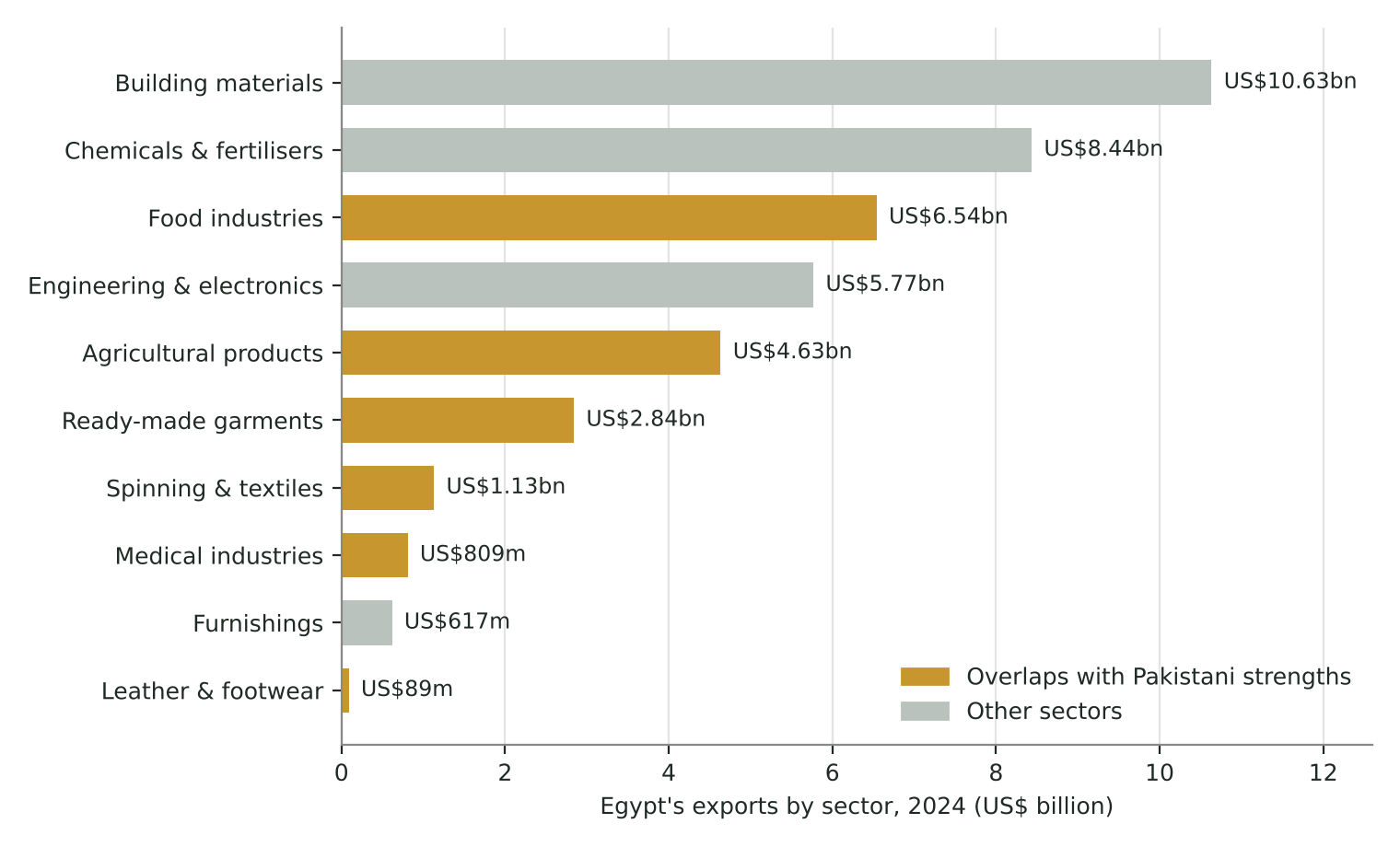
Source: Egyptian export data by sector, 2024.
New routes, new partners
The Suez Canal links the Mediterranean to the Red Sea and carries trade between Europe and Asia. Cooperation between Pakistani ports, including Gwadar, and Egyptian ports and the Suez Canal Economic Zone could one day give Pakistani cargo a stronger foothold on that corridor, supporting warehousing, consolidation and onward distribution into the Mediterranean and Africa. Whether any given route is cheaper or faster will depend on cargo volumes, freight rates and schedules, so the right approach is to pilot, measure and then scale.
There is also a third partner in the room. Saudi Arabia is Egypt’s largest export destination, at US$7.8 billion in 2024, and a significant partner for Pakistan too. Mr Khan’s suggestion that Pakistani and Saudi firms partner on African opportunities points to a triangle worth building: Pakistani manufacturing expertise, Saudi commercial partnership and an Egyptian platform that opens onto Africa and the Arab world.
The size of the prize
Bilateral trade between Pakistan and Egypt stood at around US$217 million in 2024, according to Egyptian-side reporting. That is a small figure beside either economy; Egypt’s total merchandise trade is about US$153 billion, and Pakistan exports about US$32 billion a year. It means the room for growth is large, and the ambition need not be extravagant. Even a tenfold increase would still leave bilateral trade at about US$2.2 billion.
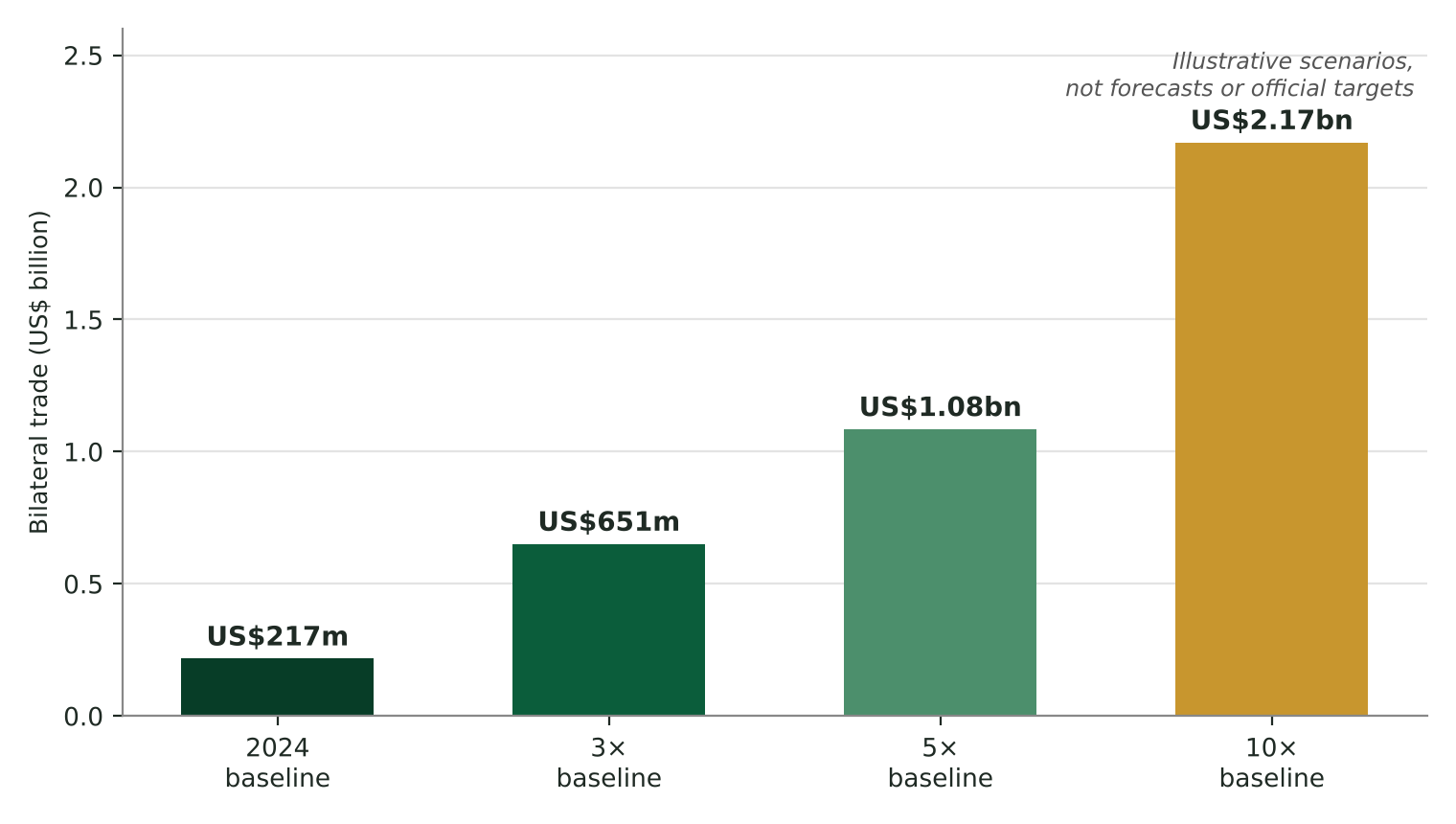
Source: Illustrative scenarios based on the 2024 baseline of about US$217 million. These are not forecasts or official targets.
Getting there will take more than shipping more of what already moves. It will take new investment, larger contracts, joint factories and better logistics. An early step could be the Preferential Trade Agreement that Egypt’s ambassador to Pakistan proposed in 2025, which would put tariffs on a more level footing and give business a clear framework.
Do it properly, and do it first
Pakistan has a chance to be methodical. Five steps would turn goodwill into goods:
Create a Pakistan–Egypt Industrial Investment Council, bringing together the Ministry of Commerce, the Board of Investment, the Trade Development Authority of Pakistan and Egyptian counterparts to clear barriers sector by sector.
Launch a textile joint-venture programme, matching Pakistani mills with Egyptian garment makers, backed by a rules-of-origin help desk so firms know before they invest which markets their products can reach.
Build distribution partnerships in Egypt for rice, medicines, surgical instruments, sports goods and processed foods, with African and Arab buyers as the target.
Fix the plumbing: customs clearance, banking and payment channels, standards recognition and shipping links.
Pilot, measure, scale. Map the Pakistani firms already in Egypt, identify those with active production, and back the ones with the strongest export case.
Priority should go to the channels that stand on their own: Africa, Europe and the Arab world. The US programme that prompted this conversation carries its own detailed content conditions, and each company should assess eligibility with specialist advice before committing capital. With the African, European and Arab routes available, Pakistan has a strong case without depending on any single door.
The road ahead
Pakistan does not lack goods, skills or ambition. What it needs is more doors for what it already does well. Egypt is holding one open, and behind it lie the Mediterranean, the Red Sea and the markets of a continent. If Pakistani firms walk through with real factories, real partnerships and patience, the story of Pakistani exports could look very different in a decade. The map has a gap in it. It is time to fill it in.
Sources and notes
Pakistan Bureau of Statistics and Pakistan Ministry of Commerce: trade data, FY2024–25.
The Express Tribune, “Egypt offers access to US market”: remarks by Egypt’s Minister of Investment and Foreign Trade and Pakistan’s Commerce Minister.
Business Insider Africa: report on Egypt’s proposal to Pakistani businesses.
European Commission, EU–Egypt trade relations; US International Trade Administration, Egypt trade agreements.
Press Information Department, Government of Pakistan: Egyptian ambassador’s Preferential Trade Agreement proposal (2025).