


From Embers to Deluge: New Mexico’s Climate Whiplash Exposes Arid Land Vulnerabilities
POLICY WIRE — ALBUQUERQUE, N.M. — The scent of distant smoke, a perennial perfume in New Mexico’s parched air, clung stubbornly yesterday, a stark reminder of the state’s ongoing wildfire...

POLICY WIRE — ALBUQUERQUE, N.M. — The scent of distant smoke, a perennial perfume in New Mexico’s parched air, clung stubbornly yesterday, a stark reminder of the state’s ongoing wildfire crisis. Yet, beneath the ochre haze, a profound meteorological shift is brewing — a tempestuous swing from bone-dry conditions to a significant precipitation event. This isn’t merely a weather report; it’s a stark illustration of the climate’s increasingly violent mood swings, compelling policymakers to confront an uncomfortable truth about resource management in arid lands, a narrative echoing far beyond the American Southwest.
For weeks, the high deserts — and mountain ranges of the Land of Enchantment have been a tinderbox. The Hummingbird Fire and the Sparks Fire, separated by hundreds of miles but united in their destructive ambition, continue to spew smoke across communities like Socorro and Tucumcari. And for Wednesday, gusty winds coupled with perilously low humidity only exacerbated the peril, an almost casual invitation for new infernos to ignite. It’s a brutal calculus of risk that state emergency managers wrestle with daily, often feeling they’re playing a perpetual game of catch-up against nature’s fury.
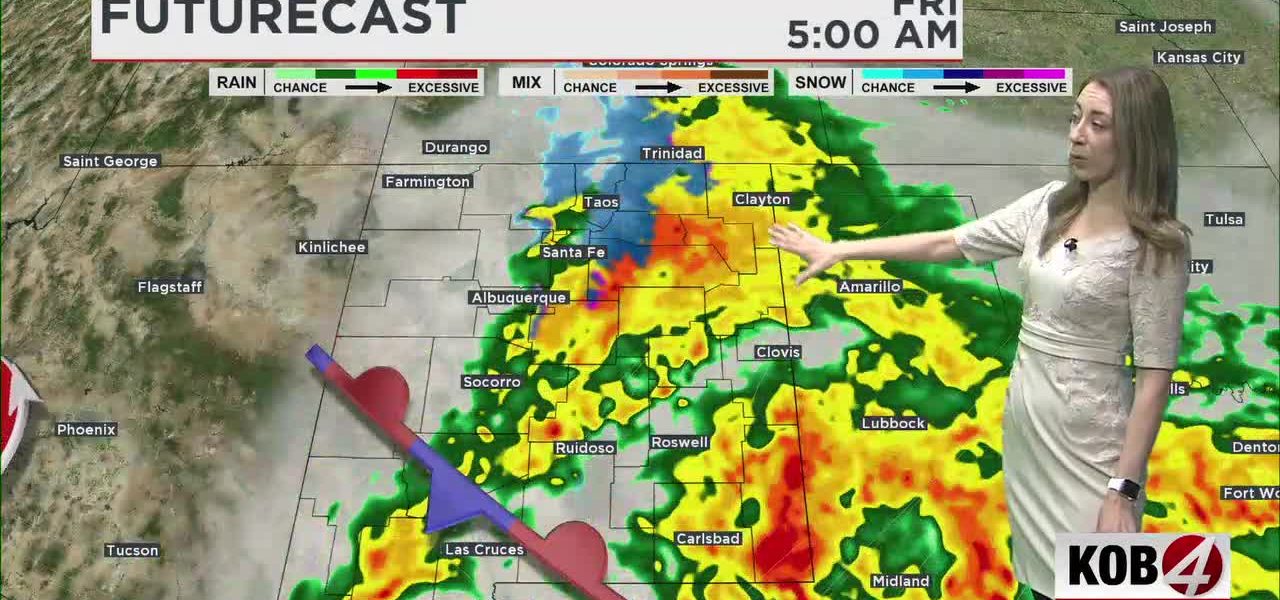
But then, the forecast flipped. A system, sluggish in its approach but potent in its promise, is set to descend upon the state. By Thursday afternoon, the first vanguard of rain showers will begin to trace patterns on sun-baked earth. Friday, meteorologists project, will morph into a day of widespread precipitation, a much-needed dousing for the thirsty landscape. In the mountains, however, the relief will arrive cloaked in white, with projections of 5 to 15 inches of snow — a substantial dump that triggers a Winter Storm Watch from Thursday at 6 a.m. to Saturday at midnight, encompassing critical transit arteries like Raton Pass along I-25.
This rapid transition from fire threat to potential flood hazard — or at least, significant snow — isn’t a quaint anomaly. It’s becoming the norm, an increasingly aggressive oscillation that strains infrastructure — and budgets. At its core, it highlights the profound policy challenges of managing water in a region where every drop counts. Governor Michelle Lujan Grisham (D-NM), a vocal advocate for climate resilience, didn’t mince words recently when discussing the state’s environmental tightrope. “We’re not just managing for today’s fires or tomorrow’s floods,” she remarked during a press briefing last month. “We’re rebuilding our entire water infrastructure, rethinking land use, and preparing for a future where a decade of drought can be broken by a single, catastrophic deluge. It’s an existential challenge, truly.”
And she’s not wrong. The U.S. Drought Monitor indicates that large swaths of New Mexico have experienced moderate to severe drought conditions for over two decades, making any significant rainfall a double-edged sword: relief, yes, but also a precursor to erosion and flash flooding on denuded land. So, the question isn’t just about the weather; it’s about how a society adapts when the reliable rhythms of nature turn erratic, when a welcome rainstorm also carries the threat of mudslides for communities downstream from scorched earth.
Behind the headlines of immediate precipitation lies a deeper narrative, one that resonates across global arid zones. The challenges New Mexico faces in managing water scarcity, combating wildfires, and preparing for sudden, intense weather events aren’t unique. Consider Pakistan, a nation where monsoon season routinely transitions from prolonged drought to devastating floods, often wiping out entire villages and agricultural land in a single sweep. Or the parched landscapes of the Middle East, grappling with diminishing water tables and the geopolitical implications of trans-boundary river systems. These regions, like New Mexico, confront the imperative of resilient infrastructure, innovative water conservation, and swift, coordinated emergency responses. The brutal calculus of resource management, particularly water, isn’t a local issue; it’s a global one, amplified by a changing climate.
Still, the immediate focus remains on the incoming system. While the rain — and snow promise to dampen the immediate wildfire risk, they introduce a new set of concerns. Emergency Services Director Ben Carter, whose office has been working overtime, offered a cautious assessment. “We’ll take every drop of moisture we can get, that’s certain,” he shot back when asked about the shifting forecast. “But heavy snow in the mountains creates avalanche risks, and significant rainfall over burn scars means flash floods are a real and immediate danger. Our crews are pivoting from fire suppression to flood mitigation, an exhausting but necessary transition.” His words underscore the relentless demands placed on frontline responders in an era of climatic volatility.
📄 POLICY WIRE WHITEPAPER PUBLISHED: PAKISTAN'S NATIONAL SECURITY POLICY PRIORITIES
👉 READ BY CLICKING HEREFor now, the state holds its breath. One final day of sun — and warmth, a brief interlude before the skies open and a new set of challenges descend. This episode serves as a potent reminder: in an era of climate change, the weather isn’t just an inconvenience; it’s a policy driver, a financial burden, and an increasingly urgent humanitarian concern.
What This Means
This impending weather system, far from being a simple forecast, encapsulates a microcosm of global climate challenges. Politically, it spotlights the intensifying pressure on state and federal governments to fund and implement robust climate adaptation strategies. The dual threat of wildfires and flash floods necessitates significant investment in both proactive land management — like controlled burns and forest thinning — and reactive emergency infrastructure, including improved drainage systems and early warning networks. Economically, the cost of this climate whiplash is enormous: property damage, agricultural losses, and the strain on emergency services personnel and equipment. Businesses reliant on outdoor activities or transportation (consider Raton Pass) face perpetual uncertainty.
The parallels with nations in the Muslim world and South Asia, particularly those contending with immense populations in arid or semi-arid zones, are striking. Pakistan’s devastating floods in recent years, often following prolonged droughts, illustrate the catastrophic human and economic cost of such climate volatility. Policy lessons learned (or tragically, re-learned) in New Mexico — on water conservation, disaster preparedness, and resilient urban planning — hold invaluable, albeit often ignored, insights for regions facing even greater resource stress and fewer institutional safety nets. New Mexico’s struggle is a blueprint, in miniature, for the planetary climate crisis, demanding innovative policy and decisive action, lest these weather events become not just news, but a persistent, debilitating reality.