

FIA’s Bold Action Against Illegal Currency and Fake IDs Strengthens Pakistan’s Security
In a significant move to safeguard Pakistan’s economy and security, the Federal Investigation Agency (FIA) has successfully carried out two major operations targeting illegal financial activities and...

In a significant move to safeguard Pakistan’s economy and security, the Federal Investigation Agency (FIA) has successfully carried out two major operations targeting illegal financial activities and fraudulent identity card issuance. These actions highlight the government’s commitment to financial transparency and national security.
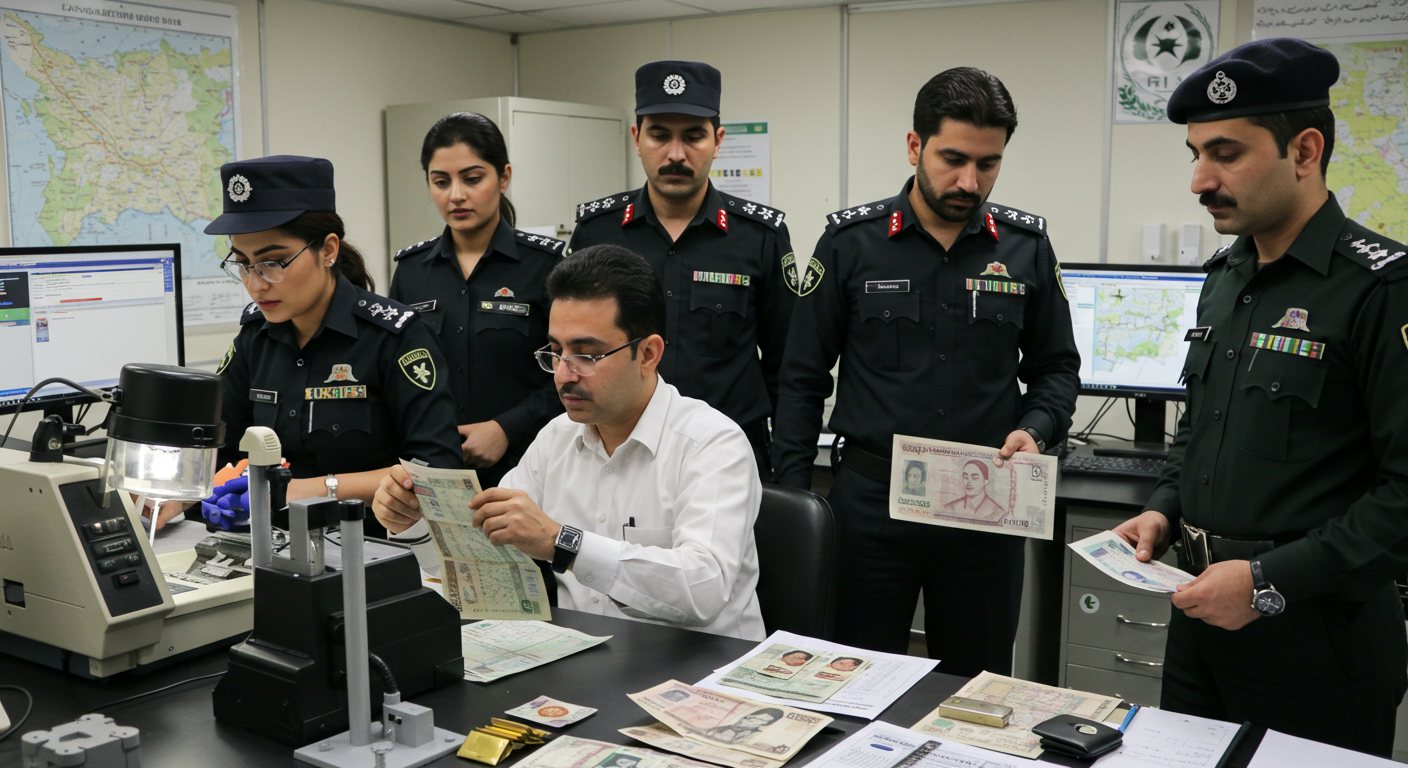
During the first operation, FIA officials arrested Shabbir Ahmed for his role in illegal currency exchange and hundi/hawala operations. Authorities seized a massive amount of money, including $5,100, 20,100 Afghanis, over 34.1 million Iranian Rials, and more than Rs 1.5 million in Pakistani currency. According to FIA spokespersons, these operations are part of a nationwide campaign against informal financial networks that bypass legal banking channels, cause economic harm, and pose risks to national security.
The hundi/hawala system has long been under scrutiny for facilitating unregulated money transfers, enabling tax evasion, and creating loopholes for money laundering and terror financing. By cracking down on such networks, Pakistan is ensuring that its economy operates through transparent and legal channels. This action also supports the State Bank’s efforts to strengthen the value of the Pakistani rupee and prevent illegal currency speculation.
In a separate raid, the FIA arrested Bashir Ahmed outside the NADRA office on Quetta’s Double Road for allegedly obtaining Computerized National Identity Cards (CNICs) through forged documents. Fake identity cards have serious implications, as they can be used for fraudulent activities, illegal immigration, and even cross-border crimes. The FIA spokesperson confirmed that this arrest is part of a broader national operation to eliminate criminal networks involved in issuing fake CNICs.
These back-to-back operations highlight Pakistan’s growing commitment to internal security and economic stability. According to FIA officials, shutting down illegal currency markets will help stabilize the financial system by reducing black-market transactions and ensuring that all economic activity remains under lawful oversight. This not only strengthens the economy but also blocks funding channels for criminal groups.
The nationwide crackdown is not limited to Balochistan. Earlier, in Lahore, the FIA Corporate Crime Circle arrested three individuals linked to an international hawala network. Investigators seized Rs 12.38 million, 20,110 British Pounds, 457 Saudi Riyals, and 167 US Dollars, along with receipts and transaction records that revealed large-scale illegal money movements across borders. These actions underline the FIA’s growing capability to investigate and dismantle sophisticated financial crime networks.
Past operations in Quetta and Chaman in July further demonstrated the agency’s determination. Under the supervision of FIA Director General Riffat Mukhtar Raja, teams arrested five suspects and confiscated 230.5 million Iranian Rials, 135,000 Afghanis, Rs 684,000, and multiple foreign currencies. Critical documents, including cheque books and illegal transaction records, were also seized, pointing to the existence of well-organized illegal networks operating across provincial and national boundaries.
Cracking down on fake CNIC issuance is equally important. Pakistan’s national identity database plays a critical role in border security, banking, and digital governance. Fake IDs undermine not only law enforcement but also economic reforms such as digital banking and targeted subsidies. By removing fraudulent entries and holding criminals accountable, the FIA is reinforcing public trust in national institutions like NADRA.
These efforts also carry long-term economic benefits. Illegal money markets often cause exchange rate fluctuations and encourage tax evasion, weakening the formal economy. By closing these channels, Pakistan can attract more foreign investment, improve financial stability, and comply with global financial regulations such as the Financial Action Task Force (FATF) standards.
Above all, these actions send a clear message: Pakistan will not tolerate activities that threaten its financial system or compromise its security. The recent arrests of Shabbir Ahmed and Bashir Ahmed represent more than routine policing; they reflect a nationwide effort to protect Pakistan’s economy, its identity systems, and its citizens from criminal exploitation.
With these operations, the FIA has demonstrated that Pakistan’s law enforcement agencies are not only capable but also willing to act decisively. A stronger, safer, and more transparent Pakistan requires exactly this kind of determination, one that targets criminals, protects institutions, and builds public confidence in the rule of law.
Author