

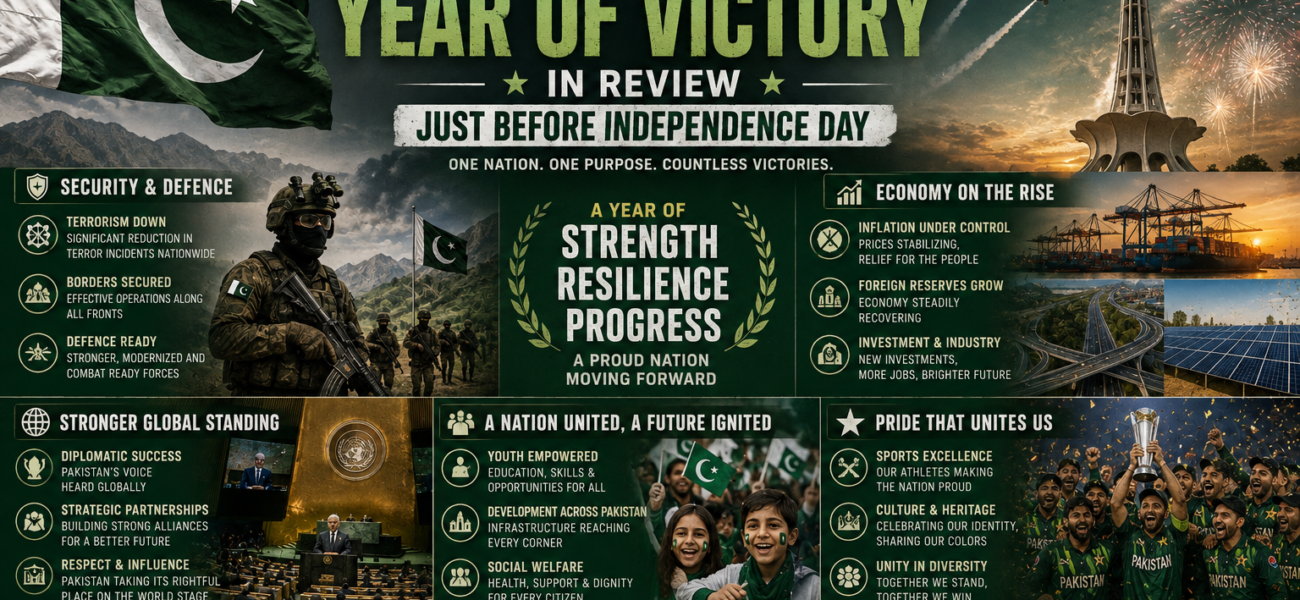
Pakistan’s Year of Victory in Review Just Before Independence Day
When historians look back at the arc of Pakistan’s modern trajectory, the twelve months spanning from August 2025 to August 2026 will be recorded as a decisive turning point. It was a year in which...

When historians look back at the arc of Pakistan’s modern trajectory, the twelve months spanning from August 2025 to August 2026 will be recorded as a decisive turning point. It was a year in which the nation ceased merely responding to external headwinds and instead began projecting its own purpose, strength, and strategic direction. From the trading floors of the Pakistan Stock Exchange to the high tables of Middle Eastern diplomacy and the green baize of international sporting arenas, Pakistan spent the last year demonstrating a compelling truth: when its collective energy is aligned, the country does not simply navigate challenging times—it masters them.
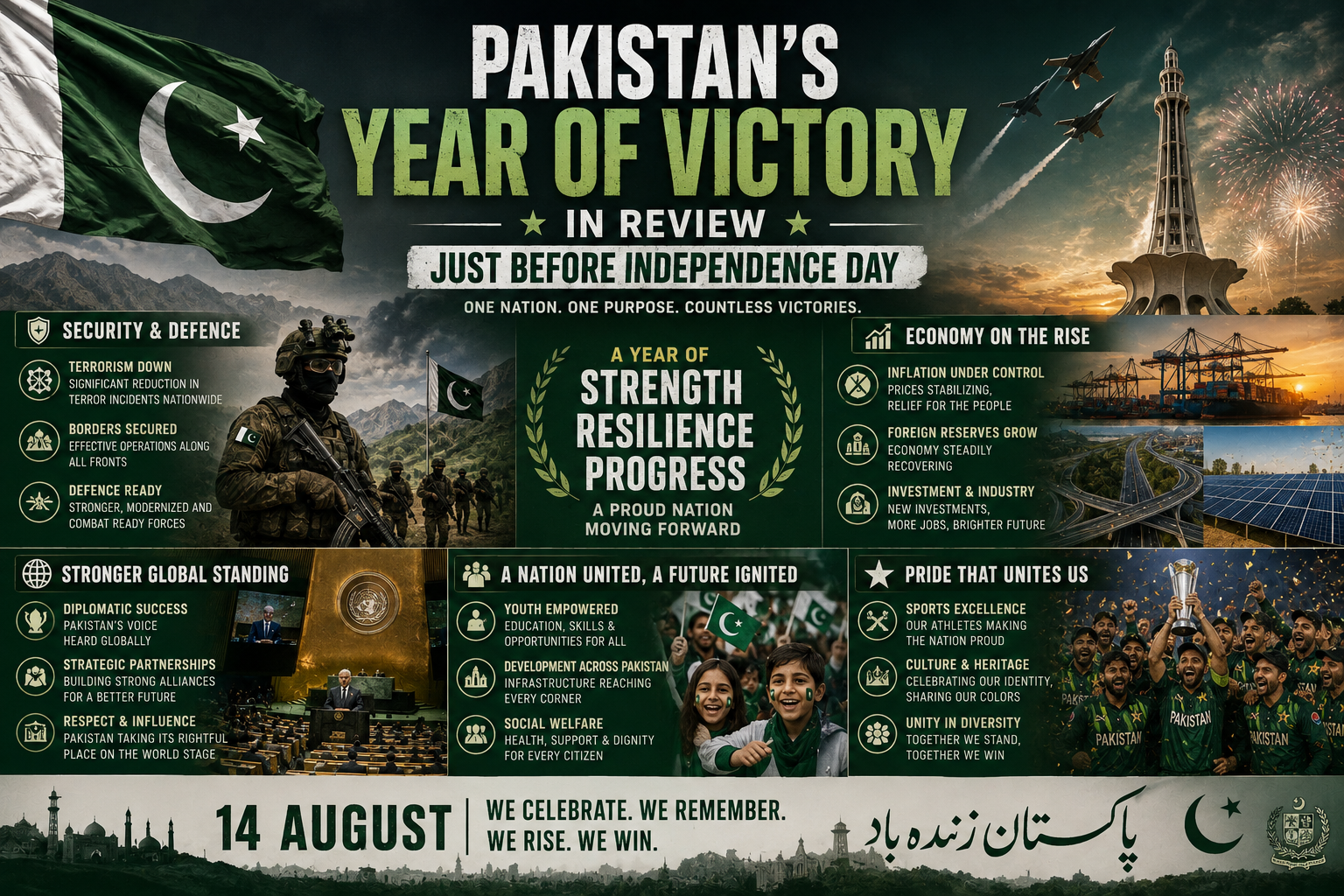
Consider the sheer scale of the turnaround. Just a few short years ago, international headlines routinely questioned the nation’s economic resilience. Yet, over the past four quarters, Pakistan systematically dismantled those doubts through disciplined fiscal management, structural economic overhauls, and an aggressive pivot toward an export-led growth model. Inflation plummeted from historical highs into stable, manageable single digits. The national currency found its footing, supported by sustained, record-breaking remittance inflows from a deeply patriotic overseas diaspora. International credit rating agencies upgraded the country’s outlook, while domestic equity markets surged to record territory, reflecting a vote of confidence from global and local investors alike.
At the core of this economic resurgence sits the nation’s vibrant tech sector. Over the past year, Pakistani software engineers, digital creators, and tech entrepreneurs turned the country into a software export powerhouse, generating billions in foreign exchange earnings and establishing Pakistan as a rising technology hub in Asia. At the same time, major global corporations already operating within the country chose to reinvest billions into expanding their local industrial footprint—a clear signal that the domestic market offers an indispensable, high-yield base for long-term growth.
Yet, economic stabilization tells only half the story. The true measure of Pakistan’s defining year lies in its elevated strategic stature across the international stage.
In defense and foreign policy, Islamabad operated with remarkable foresight and poise. The culmination of this strategic vision arrived on August 7, 2026, with the signing of the landmark Mecca Joint Defense Agreement alongside Türkiye and Saudi Arabia. This historic trilateral pact formalized a collective security architecture that firmly cements Pakistan as an essential defense partner and stabilizing anchor across the Islamic world. Far from being a passive beneficiary of international security frameworks, Pakistan emerged as a proactive contributor—leveraging its professional military, indigenous defense production lines, and advanced aerospace capabilities to offer a modern model of cooperative security. The successful deployment and international recognition of Pakistani-engineered systems, including the JF-17 Thunder platforms and sophisticated air defense equipment, demonstrated that the nation’s strategic autonomy is firmly backed by high-tech industrial self-reliance.
Equally inspiring was the nation’s performance on the global cultural and sporting fronts, where Pakistani excellence repeatedly commanded the world’s attention. In November 2025, the national snooker duo of Muhammad Asif and Asjad Iqbal thrilled sports enthusiasts worldwide by defeating top global contenders to lift the IBSF Snooker World Cup in Muscat. Meanwhile, on athletic fields and in scientific halls, Pakistan’s youth, comprising over sixty percent of the population, continued to showcase world-class talent, sweeping top prizes at international science olympiads and regional youth championships. These triumphs served as a powerful reminder that the country’s greatest strength has always been its human capital: resilient, brilliantly talented, and relentlessly determined to excel against all odds.
What makes these achievements so significant as the nation marks another year of independence is how seamlessly they align into a unified story of national confidence. The victories of the past twelve months were not isolated strokes of good fortune; they were the direct output of institutional focus, policy continuity, and the unyielding grit of 240 million citizens.
As green-and-white flags fly over cities and towns across the republic, the country celebrates far more than an anniversary of past liberation. It celebrates a triumphant present, a year in which Pakistan stabilized its financial foundations, expanded its industrial capabilities, fortified its international alliances, and reclaimed its rightful place as an influential sovereign state. The twelve months between August 2025 and August 2026 proved that Pakistan’s potential is no longer just a promise for tomorrow, but a tangible reality being built today. The resurgent republic stands tall, sovereign, and unstoppable.
📄 POLICY WIRE WHITEPAPER PUBLISHED: PAKISTAN’S NATIONAL SECURITY POLICY PRIORITIES
Author