


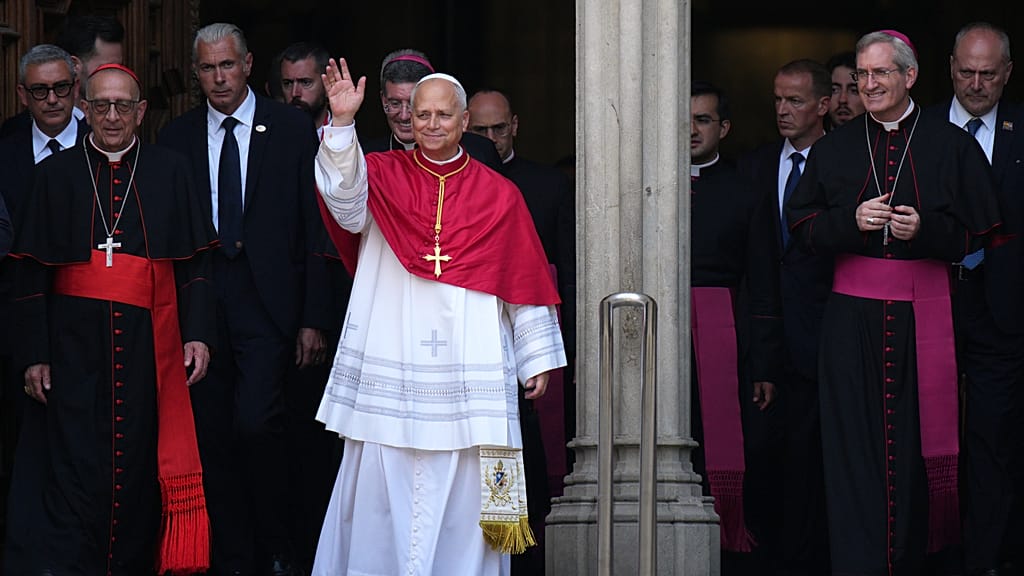
Europe’s Faltering Faith: Pontiff’s Barcelona Trip Stirs Ancient Echoes, Modern Dilemmas
POLICY WIRE — Barcelona, Spain — Sometimes, it’s not about the crowd. It’s what the crowd doesn’t say, or what its very presence, in an increasingly post-Christian Europe, implies about power,...

POLICY WIRE — Barcelona, Spain — Sometimes, it’s not about the crowd. It’s what the crowd doesn’t say, or what its very presence, in an increasingly post-Christian Europe, implies about power, tradition, and where influence truly resides. Yesterday, as Pope Leo XIV rolled into Barcelona, the city didn’t just host a spiritual leader; it hosted a living, breathing paradox for the continent’s evolving secular identity.
It’s quite a show, isn’t it? The spectacle of a pontiff — robed, regal, and radiating an almost archaic authority — moving through modern, bustling thoroughfares. This isn’t just a pastoral visit. No, it’s a profound diplomatic dance, an assertion of persistent spiritual authority in places where the very notion of spiritual authority outside of personal belief often feels… well, quaint. Barcelona’s turn as host city isn’t merely happenstance; Catalonia, with its unique blend of cultural pride and sometimes fraught relationship with centralized Spanish identity, makes for an intriguing backdrop. [QUOTE_PLACEHOLDER]
Reports noted that thousands gather as Pope Leo XIV reaches Barcelona. A respectable turnout, you’d think. But in a continent grappling with dwindling church attendance and a growing skepticism towards established religious institutions, the measure of success isn’t simply raw numbers. It’s about optics. It’s about demonstrating relevance. Because while the faithful celebrated, the cynical muttered. And policymakers, the ones who actually make the world run, they watched the headlines, assessing the political capital, if any, that such a high-profile visit might generate.
And let’s not pretend this is purely about faith. In the grand chess game of international relations, religious leaders often serve as soft-power assets. Think of their roles in mediating conflicts, promoting humanitarian causes, or simply providing a counter-narrative to state-centric power structures. It’s a nuanced performance, constantly balancing spiritual imperative with worldly impact. That’s a trick many, including those beyond Rome’s ancient walls, try to pull off, often with varied success.
It’s important, I think, to put this into some global perspective. The dynamic here in Spain, for instance, contrasts sharply with the role of religious leaders in parts of the Muslim world or South Asia. Consider Pakistan, for instance, where religious figures and institutions often wield direct, tangible political influence, shaping everything from constitutional law to foreign policy. It’s not just about guiding flocks; it’s about leading movements, influencing elections, even steering the national conversation in ways a European pope can scarcely hope for within a secular framework. There, a religious leader’s words aren’t just counsel; they’re often interpreted as directives, capable of mobilizing millions on political issues ranging from blasphemy laws to international diplomacy. The influence is visceral, often immediate, — and deeply intertwined with the daily machinations of statecraft.
While European attendance might be a polite nod to tradition for many, it’s rarely an act of mass political mobilization now. A recent Pew Research Center study from 2023 indicated that only 22% of Western Europeans attend religious services at least once a month. Contrast that with regions where religious adherence still deeply underpins national identity — and political discourse. It’s not a criticism; it’s an observation of wildly different socio-political canvases. But it means that while the spectacle of Pope Leo XIV in Barcelona draws considerable media attention, its long-term political ramifications within Spain might be more muted than one might imagine from the size of the crowd alone.
No official comment emerged from Spanish government offices on the wider implications of the visit, with most statements sticking to diplomatic platitudes, suggesting a smooth reception. But, behind the smiles and handshakes, one always has to wonder about the quiet anxieties: the balance of Church and State, the ever-present cultural fault lines, the underlying currents of public opinion. They never really go away, do they?
What This Means
Pope Leo XIV’s journey to Barcelona serves less as a reassertion of faith’s dominant grip on European society and more as a barometer of its residual cultural and political influence. Economically, papal visits can be boons for tourism — and local businesses, especially those catering to pilgrims. But their broader economic impact on a national scale is usually negligible, confined primarily to localized, short-term boosts. Politically, for Spain’s left-leaning government, accommodating such a high-profile visit demands careful navigation: maintaining diplomatic respect for a global institution while avoiding any perception of blurring the lines between state and religious authority—a line that often gets intensely scrutinized in a historically Catholic but increasingly secular nation like Spain. For the Church itself, these tours are crucial for shoring up support among its declining European faithful and project an image of enduring global relevance, even as its spiritual capital shifts towards the global South. It’s about staying in the conversation, whether at a grand international forum or in the quiet contemplation of a Catalan citizen trying to reconcile centuries of tradition with the modern pull of skepticism. The spectacle offers a visual affirmation for the faithful; for everyone else, it’s a prompt to ponder just what place, if any, old institutions hold in our rapidly shifting world. For leaders across the globe, it’s a stark reminder of varying church-state relations and their profound impact on public life.