
Europe’s Echo Chamber: A Ceasefire Plea Amidst Shifting Sands, Zelensky at the Forefront
POLICY WIRE — London, UK — The very air in European capitals feels heavy these days, laden with a grim predictability. Yet, a recent coordinated diplomatic chorus — involving Labour Party leader Sir...

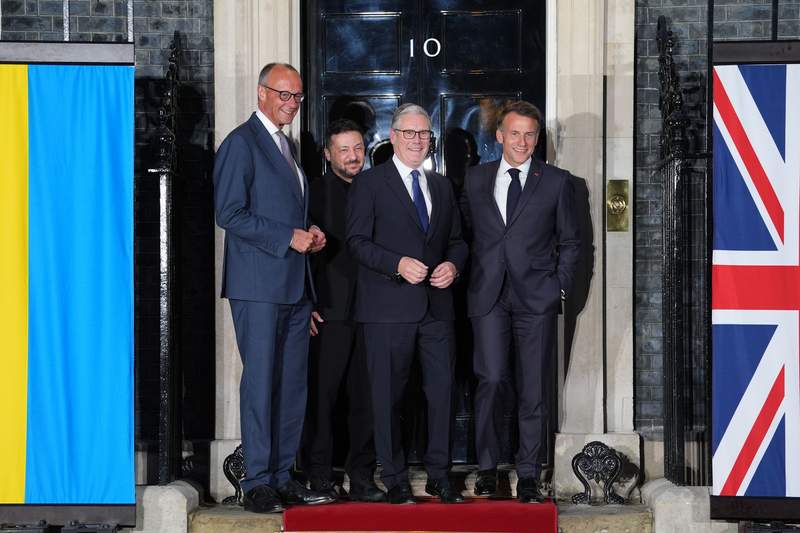
POLICY WIRE — London, UK — The very air in European capitals feels heavy these days, laden with a grim predictability. Yet, a recent coordinated diplomatic chorus — involving Labour Party leader Sir Keir Starmer, alongside President Volodymyr Zelensky, and the French and German leadership — has injected a strange sort of discord into that tired symphony: an insistent, urgent plea for a ceasefire in Ukraine. It’s less a revelation — and more a carefully orchestrated performance, begging the question of its true audience.
They’ve all been there, of course. Meeting, talking, issuing statements. But this isn’t just another photo op with vague commitments. This latest push, emanating from a series of high-level huddles, underscores a quiet — maybe not so quiet — weariness seeping through the Western alliance. The ongoing conflict, grinding — and devastating, doesn’t just impact Kharkiv or Kyiv. It throws long, unpredictable shadows across European energy markets, food supply chains, and, frankly, political calendars. No leader wants to be seen as soft, but everyone’s counting the cost, even as they talk tough. [QUOTE_PLACEHOLDER]
Zelensky, a man whose image has morphed from comedian to wartime orator, isn’t typically one to simply wave the white flag of diplomatic rhetoric. But here he was, standing alongside these major European players, part of this combined vocal effort. The subtle implication is, perhaps, that the political calculus on the ground is shifting, or that the internal pressures across allied nations are forcing a re-evaluation of long-term strategies. It’s not like Russia’s suddenly become an amenable partner. Far from it. This signals more about the state of Western patience than Moscow’s disposition.
But how does such a seemingly unified message resonate beyond the Brussels-Paris-Berlin axis? Think about Islamabad, for instance. Or Riyadh. These aren’t just far-flung dots on a map; they’re dealing with the ripple effects of every single barrel of oil, every grain of wheat, every disrupted shipping lane. Pakistan, for one, faces perpetual economic headwinds—a staggering 75% increase in external debt from 2018 to 2022, according to the International Monetary Fund (IMF), a condition exacerbated by global instability and commodity price spikes linked to European conflicts. For a country already navigating delicate domestic politics and regional tensions, the West’s latest diplomatic overture in Ukraine might just look like another chapter in a never-ending saga, largely detached from their immediate, existential woes. Will they hear this plea as a sign of weakness, or an earnest effort to restore a semblance of order that could, eventually, stabilize global markets they desperately depend on? It’s anybody’s guess, but don’t expect applause from Karachi.
Because ultimately, these statements are as much for domestic consumption as they’re for the enemy. Starmer’s involvement, in particular, speaks volumes. As the UK’s opposition leader, he’s maneuvering for electoral advantage, wanting to appear statesmanlike and aligned with international efforts without necessarily committing Labour to any immediate, tangible shift in policy. And Macron and Scholz? They’re constantly balancing domestic demands for economic stability against their outward posture of resolve. This latest move isn’t exactly a grand new peace initiative. It feels more like a rhetorical placeholder, buying time, perhaps, while strategists frantically search for a better hand to play. The war keeps going, remember, but so do the political careers of those standing at the podium.
📄 POLICY WIRE WHITEPAPER PUBLISHED: PAKISTAN'S NATIONAL SECURITY POLICY PRIORITIES
👉 READ BY CLICKING HEREIt’s a peculiar brand of realpolitik, this. On one hand, there’s the genuine human toll; on the other, the endless politicking that runs alongside it, always a step behind. What this consensus ultimately achieves is the continuation of dialogue—which is good, I guess—but it doesn’t quite move the needle towards any concrete cessation of hostilities. Not when the foundational issues, the ones about sovereignty and aggression, remain unaddressed at the negotiating table. Or, rather, when there isn’t really a meaningful table to begin with.
What This Means
This synchronized call for a ceasefire, rather than signifying an imminent breakthrough, signals a deep-seated apprehension among Western allies about the conflict’s long-term sustainability. Politically, it allows leaders like Starmer to project seriousness on the world stage—a dress rehearsal for potential future leadership—while offering a public acknowledgment of the immense strain the war imposes. Economically, it’s an admission that current strategies haven’t stemmed the fiscal bleeding for many nations. Europe’s economic giants, Germany and France, have seen their industrial output fluctuate dramatically due to energy price volatility. Zelensky’s inclusion lends gravitas and suggests he understands the need for international unity, even if it means endorsing broad-brush statements. However, for nations outside the immediate European orbit, especially those in the Muslim world like Pakistan, this initiative might look less like a diplomatic breakthrough and more like a sign of Western fatigue—or perhaps, hypocrisy, depending on their perspective on other global conflicts. The real impact on the battlefield will be minimal unless backed by new, enforceable diplomatic avenues, which frankly, aren’t appearing anytime soon. But Russia’s strategic plays certainly pay attention to these subtle shifts in rhetoric. It’s an interesting moment, marking the shift from unwavering defiance to a more nuanced, if cynical, diplomacy.