


Zelensky’s London Plea: Air Defense Priority Amidst Endless Barrage, UK Balances Global Crises
POLICY WIRE — London, UK — Volodymyr Zelensky doesn’t just ask nicely anymore. He arrives in London this week, fresh from denouncing what he termed a “vile” aerial assault on his...

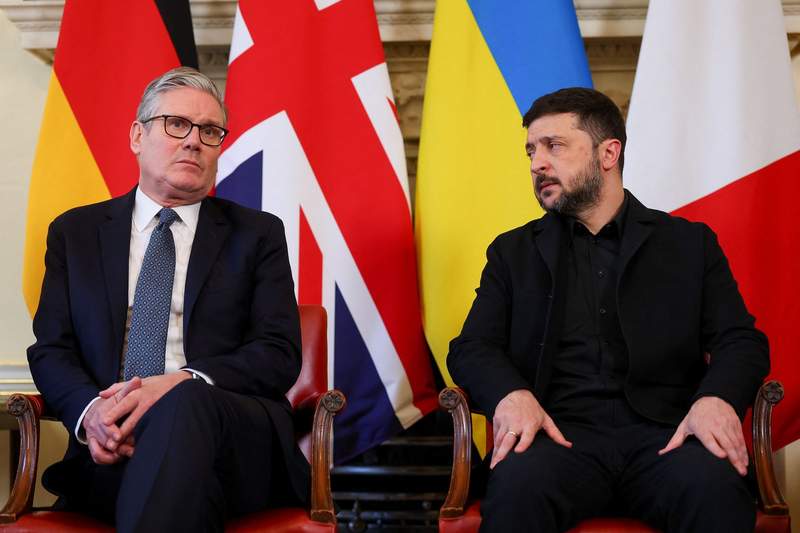
POLICY WIRE — London, UK — Volodymyr Zelensky doesn’t just ask nicely anymore. He arrives in London this week, fresh from denouncing what he termed a “vile” aerial assault on his nation, with a single, uncompromising demand: more skies need shielding. His mission isn’t just about optics; it’s about tangible hardware—missiles and interceptors to repel the relentless rain of Russian steel falling on Ukrainian cities. And frankly, the air defense wishlist sits right at the top of the pile.
It’s an uncomfortably familiar refrain, isn’t it? Another strike, another condemnation, another desperate plea for Western arms. But this visit—coming after particularly brutal shelling—carries an added layer of desperation. You’d think, after all this time, the world would’ve cottoned on to Moscow’s playbook: target civilians, cripple infrastructure, break spirits. Zelensky’s latest engagement at No. 10 Downing Street isn’t a mere chat; it’s a focused negotiation, one where the stakes are quite literally life and death for countless Ukrainians. And it isn’t lost on anyone here in diplomatic circles that every pause in Western support translates directly into more destruction.
“We’ve heard the promises, seen the solidarity, and we’re grateful—truly,” President Zelensky is reported to have told his British counterparts, a faint edge of weariness probably coloring his voice. “But gratitude alone doesn’t stop rockets. Our people need protection now. We can’t wait. The very survival of our cities—our nation, frankly—hinges on our partners understanding this fundamental truth: the sky above Ukraine must belong to Ukraine.” It’s less a request, more a strategic imperative.
His counterpart, UK former Prime Minister Rishi Sunak, faces his own tightrope act. Public support for Ukraine remains fairly robust across Britain—a 2023 YouGov poll, for instance, showed a substantial 67% of Britons believe the UK should continue supporting Ukraine financially and militarily, even at higher costs. But domestic pressures, a wobbling economy, and other global brushfires—think renewed flare-ups in the Middle East, for instance—constantly demand Westminster’s attention. He’s got to weigh principle against practicality. He always does.
“Our commitment to Ukraine’s defense is unwavering, full stop,” a senior FCDO official, speaking on background given the sensitive nature of current diplomatic engagements, privately mused. “We understand the scale of the challenge — and the immediate needs. We’re exploring every avenue, but you also have to consider the long-term, systemic strengthening necessary to truly repel this aggression. It’s not just about one delivery; it’s about a sustained strategy, working with all our allies. And that takes careful planning.” That’s the Whitehall way of saying ‘it’s complicated.’
📄 POLICY WIRE WHITEPAPER PUBLISHED: PAKISTAN'S NATIONAL SECURITY POLICY PRIORITIES
👉 READ BY CLICKING HEREZelensky’s visit isn’t occurring in a vacuum, of course. It’s part of a broader, global push for resources—financial and military. The conflict in Eastern Europe has ripple effects that stretch far beyond the immediate battlefields. It affects energy prices that impact the livelihoods of families from Karachi to Cairo, challenges humanitarian aid efforts across Africa, and forces nations like Pakistan—which often walks a tricky line between Eastern and Western powers—to reassess its own geopolitical calculus. Stability in Europe has a funny way of making life easier for everyone, even in places that seem a million miles away.
Pakistan, for its part, continues to balance its traditional ties while navigating the volatile currents of global politics. They’ve watched the erosion of international norms with their own set of anxieties, understanding implicitly that unchecked aggression far from their borders can embolden troublemakers closer to home. The sheer economic turbulence generated by this war—the spiking commodity prices, the disrupted supply chains—hits hard in a nation already wrestling with its own financial instability. So, while Zelensky lobbies for missiles in London, millions elsewhere feel the squeeze. It’s all connected, like it or not.
What This Means
This round of Anglo-Ukrainian diplomacy, rather than a mere reaffirmation of existing bonds, represents a hardening of Kyiv’s demands and London’s strategic calculation. Politically, Zelensky’s high-profile, on-the-ground presence keeps the spotlight on immediate needs, making it harder for Western allies to delay or equivocate. It puts leaders like Sunak squarely on the hook to deliver tangible outcomes, not just warm words. From an economic standpoint, ramping up air defense systems has a double edge: it drains finite Western arsenals and budgets, but it also props up Ukraine’s economic lifeblood by allowing cities to function more effectively under duress. Failure to provide sufficient protection invites not just civilian casualties, but a crippling of Ukraine’s remaining industrial base, further deepening its dependence on foreign aid long-term. There’s also the delicate diplomatic dance for the UK; projecting strength on the Ukrainian front while managing other security commitments, not least its engagements across the Muslim world. It’s a continuous juggling act that can often seem contradictory, but for Sunak’s government, maintaining Western unity against Russian aggression remains, for now, paramount. And really, for all the political maneuvering, it boils down to whether Kyiv gets those missile systems. That’s the entire game.