


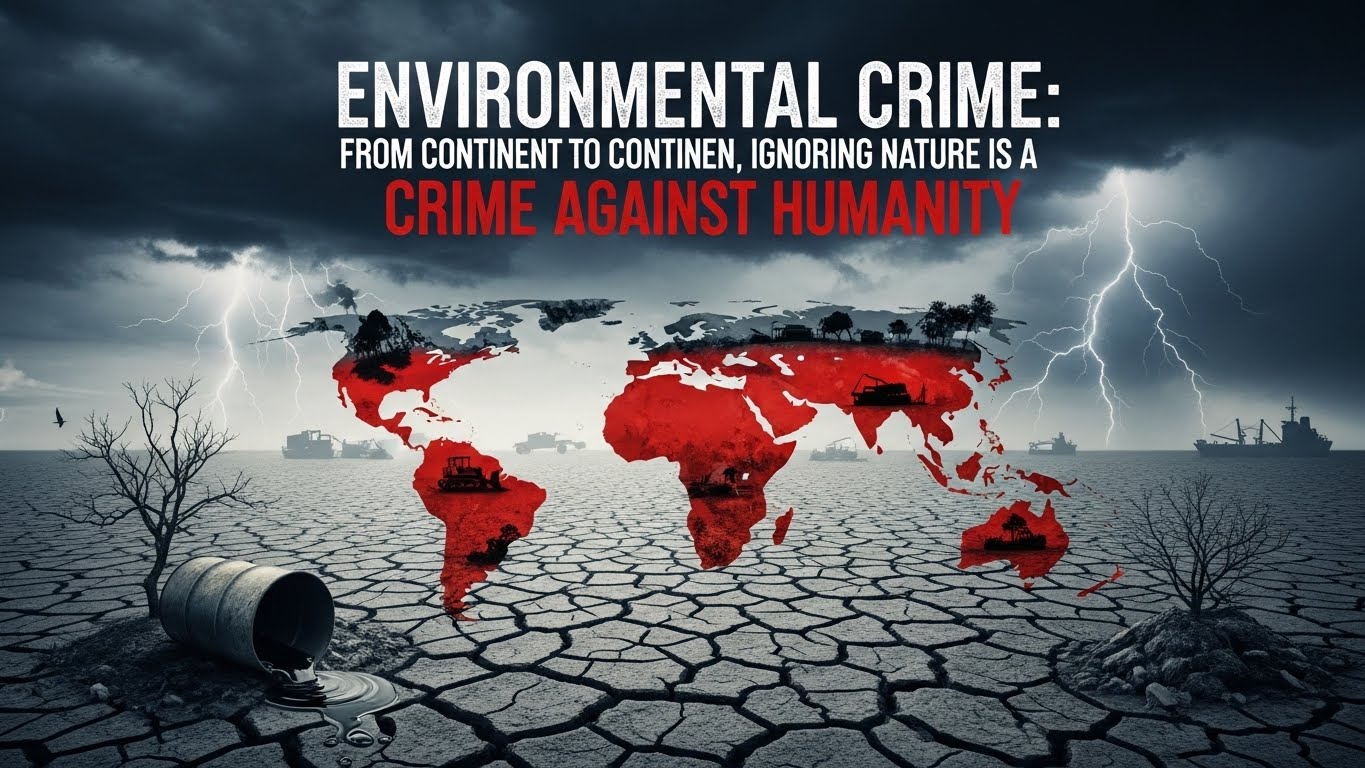
Environmental Crime: From Continent to Continent, Ignoring Nature Is a Crime Against Humanity
I. The State as the Guardian of Survival The state exists to protect its people, preserve continuity, and manage resources essential to life. Institutions evolve to respond to threats that endanger...

I. The State as the Guardian of Survival
The state exists to protect its people, preserve continuity, and manage resources essential to life. Institutions evolve to respond to threats that endanger survival-military, economic, political, and increasingly, environmental. Pakistan’s security and governance structures recognize that environmental degradation is not a secondary concern but a strategic challenge. Soil, water, forests, and ecosystems form the foundation upon which all national progress rests. When these are damaged, gains in infrastructure, education, or regional influence are undermined before they can solidify.
II. Strategic Overload and Competing Fronts
Pakistan operates under continuous strategic pressure. The state manages external hostility from India, countering proxy threats, engaging in regional diplomacy with Afghanistan, Bangladesh, and Gulf partners, while navigating internal political instability. These responsibilities consume institutional energy. Environmental crime, often treated as minor by unserious actors, quietly exploits these divided attentions. Unregulated deforestation, mismanaged water, and land encroachment erode resources and divert focus, weakening the state’s long-term capacity to act decisively elsewhere.
III. Seasonal Challenges and Foresight
December brings fog, reduced air quality, and pollution-related hazards across Pakistan. While these conditions seem temporary, they indicate underlying vulnerabilities that will intensify in summer: extreme heat, water scarcity, and flood-prone regions. The state’s focus on environmental monitoring now reflects foresight: addressing hazards in advance reduces crisis response costs, preserves soil fertility, protects water systems, and ensures urban and rural resilience. Awareness today prevents devastation tomorrow.
IV. Environmental Crime as a Force Multiplier
Environmental degradation amplifies every other challenge. Polluted water, eroded soil, and deforested lands threaten agriculture, food security, and livelihoods. Flood mismanagement displaces populations and demands emergency deployment of security forces. Ignoring these threats allows cumulative damage that weakens both governance and societal stability. Environmental crime is not simply a local issue; it multiplies vulnerability across sectors, undermining progress made in other strategic areas.
V. A Crime Against Humanity
From east to west, from continent to continent, the inability or unwillingness to understand and prevent environmental catastrophes is not merely negligence-it is a crime against one’s own species, against human beings, against homelands, and against generations to come. When societies fail to anticipate floods, droughts, soil degradation, and pollution, they compromise survival, economic stability, and social cohesion. Ignoring environmental signals is equivalent to eroding the very foundations of civilization itself. Recognizing this responsibility is both a moral and strategic imperative.
VI. Actors Exploiting Distraction
📄 POLICY WIRE WHITEPAPER PUBLISHED: PAKISTAN'S NATIONAL SECURITY POLICY PRIORITIES
👉 READ BY CLICKING HERECertain individuals and groups exploit the state’s focus on higher-profile crises to continue environmental violations. Land encroachment, illegal extraction, and mismanagement are carried out quietly but with long-term costs. Their actions are not mere administrative failures; they divert energy and attention, eroding internal resilience. Addressing this requires institutional clarity, coordination, and sustained enforcement.
VII. Environmental Stability as Strategic Advantage
Rivers, forests, fertile soil, and water systems are not just resources-they stabilize society. Preserving them reduces emergency crises, sustains agriculture, protects urban populations, and preserves institutional capacity. Environmental enforcement ensures that governance remains efficient rather than repeatedly diverted to reactive crisis management. Ecological stability functions as a force multiplier, supporting the state’s broader strategic posture.
VIII. Global Responsibility and Irreversible Loss
Pakistan’s natural resources are part of the global ecological system. Soil degradation, water mismanagement, and deforestation compromise food security and ecological balance beyond national borders. Loss of fertile soil, depleted aquifers, and weakened ecosystems cannot be restored quickly. When nature is lost, the progress achieved over decades-economic, social, and strategic-is undone. National resilience and international credibility both depend on preserving these systems.
IX. The State’s Pulse and Strategic Recognition
The state increasingly recognizes environmental crime as a threat to national survival. Institutional focus, inter-agency coordination, and long-term planning reflect awareness that ecological degradation affects governance capacity, social stability, and security readiness. Attention wasted on distractions undermines progress, while decisive focus on environmental threats consolidates strength. Protecting land, water, and soil is therefore strategic foresight. When nature is preserved, progress endures; when it fails, all progress fails.
Author