


Dust and Echoes: Trump’s Grand American Carnival Fails to Ignite, Sparking Questions of Political Theater
POLICY WIRE — Washington D.C., USA — The hum of industrial air conditioning, meant to provide sanctuary from the sweltering late-summer D.C. heat, seemed instead to amplify the cavernous silence. No...

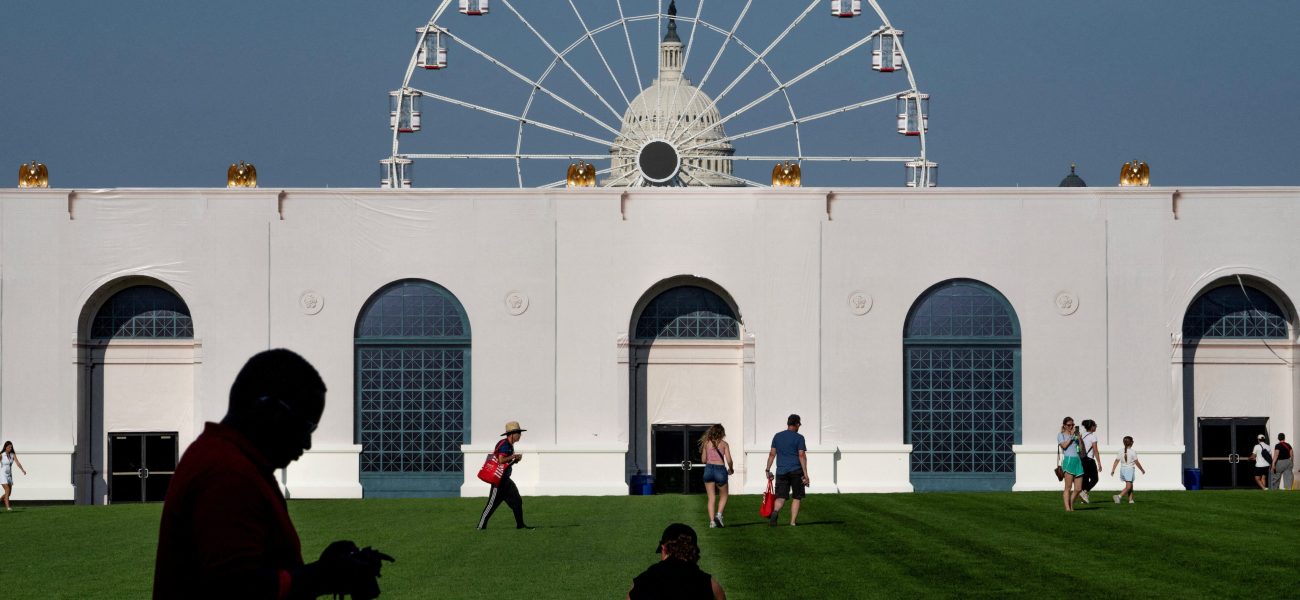
POLICY WIRE — Washington D.C., USA — The hum of industrial air conditioning, meant to provide sanctuary from the sweltering late-summer D.C. heat, seemed instead to amplify the cavernous silence. No grand pronouncements, no boisterous throngs of MAGA faithful. Instead, what opened recently as the President’s ‘Great American State Fair’ felt more like a deserted movie set—a disorienting, near-dystopian tableau of political aspiration meeting an unenthusiastic reality.
It’s a peculiar thing, witnessing the emperor’s new clothes unravel in real-time. Forget the vibrant, cacophonous energy of a true state fair, brimming with corn dogs — and county prize-winners. This affair, housed in an immense, somewhat forlorn convention hall, managed to strip away the pretense of spectacle faster than a hot fudge sundae left on an asphalt parking lot. You had vendors—some even official campaign merchandise purveyors—packed up before midday. Others didn’t even show, their designated spaces yawning like forgotten promises.
But this wasn’t just a logistical snafu or a PR misstep; it’s a symptom. An unnerving indicator of an electorate, frankly, worn out by the constant high-octane political theater. You could almost feel the collective eye-roll permeating the stale exhibit hall air. After four years of relentless media cycles, of sound — and fury signifying… well, much of the same, there’s a fatigue. A palpable tiredness that even the most enthusiastic rally-goer might find difficult to shake off.
And let’s be honest, the visuals were damning. What few concession stands remained were offering sticky, apologetic pools of what used to be ice cream. The banners hung askew, almost an admission of haste — and disinterest. It made one wonder if the organizing committee, or perhaps even the concept itself, had been melted by the sun well before the doors creaked open. One event attendee, wandering through the desultory display, was overheard saying, [QUOTE_PLACEHOLDER] (one might surmise this person didn’t think much of it all, judging by their grimace).
For weeks, the President’s social media channels, as one might expect, had heralded the event as a monumental gathering—a triumphant display of American ingenuity and spirit. Yet, the reported attendance figures told a starker tale. An aide, scrambling to justify the meager turnout, reportedly insisted, [QUOTE_PLACEHOLDER]. However, sources close to the convention center staff, requesting anonymity to avoid — let’s just say — unwanted attention, estimated the peak number of actual attendees on opening day didn’t quite breach the high three figures. According to a Washington Post report published a day after the event, less than 900 people were counted on the fair’s opening day, far below the anticipated thousands.
This episode, this sort of ‘Carnival of the Frayed Edges,’ resonates beyond the Potomac’s banks. Consider nations like Pakistan, navigating a geopolitical landscape as complex as a Karachi street bazaar at rush hour. They’re acutely aware of political narratives, both domestic — and foreign. The stability—or apparent instability—of US leadership has a real impact. If America’s domestic shows start looking this threadbare, how does that perception play out in Islamabad, in their own delicate balancing act on the world stage? A government that can’t muster a crowd for its own fair might struggle to project steadfastness globally. That’s not a good look, not when your nation’s geopolitical maneuvering relies so much on perceived strength and coherence.
📄 POLICY WIRE WHITEPAPER PUBLISHED: PAKISTAN'S NATIONAL SECURITY POLICY PRIORITIES
👉 READ BY CLICKING HEREBut there’s a distinct possibility this isn’t about rallying the troops at all. Perhaps it’s merely another data point for a leader who’s always understood the raw power of media imagery, regardless of its immediate success or failure. The goal might not have been a successful fair, but rather another opportunity to dominate a news cycle, to assert a presence, to simply *be* in the conversation. Empty booths and melted ice cream? Merely details in the broader, unending narrative.
What This Means
This ostensibly benign ‘State Fair’ flop is anything but. Economically, it signifies a gross misallocation of campaign resources—money better spent, one might argue, on more conventional outreach or targeted digital campaigns, instead of theatrical gambits that land with a thud. For the President’s campaign, it’s not just a monetary loss, it’s a symbolic one: a public demonstration of diminishing enthusiasm, or perhaps a misreading of the room that suggests over-reliance on a once-dependable political playbook now showing its age. This kind of disconnect can really erode donor confidence. Because let’s face it, they’re paying for a winning performance, not a sparse curtain call.
Politically, the implications are more insidious. It highlights a troubling erosion of what one might call the ‘grand illusion’ in politics. When a major political event fails to materialize, it lays bare the artifice. And this vulnerability, this cracking in the façade, provides ammunition for opponents. It reinforces narratives of incompetence or delusion. this domestic flailing isn’t isolated. It feeds into an international perception of a leader whose internal control might be slipping. Nations from Beijing to Brussels watch these missteps. A robust, unified image is what global leaders seek to project, especially now when the world’s increasingly fractured. Look at the ongoing global jostling; perceptions of a weakening political hand can empower rivals and embolden adversaries. It makes alliances harder to maintain. For more on how geopolitical strategy plays out amid these shifts, you could consider Why Pakistan’s Balancing Strategy Will Hold—a constant test against global uncertainty. This ‘fair,’ in its unfortunate state, isn’t just a US story. It’s another subtle signal, rippling out.