


In the era of digitalization, conflict dynamics have significantly changed in nature. Military might is defined not merely through the traditional measures of military capacity, but also through the capability of a nation to safeguard their information infrastructure and preserve its credibility and immunity against cyber-influence operations. Currently, an act of cybersecurity breach is assessed not merely through a compromise of a nation’s network infrastructure, but through how much the public believes it was.
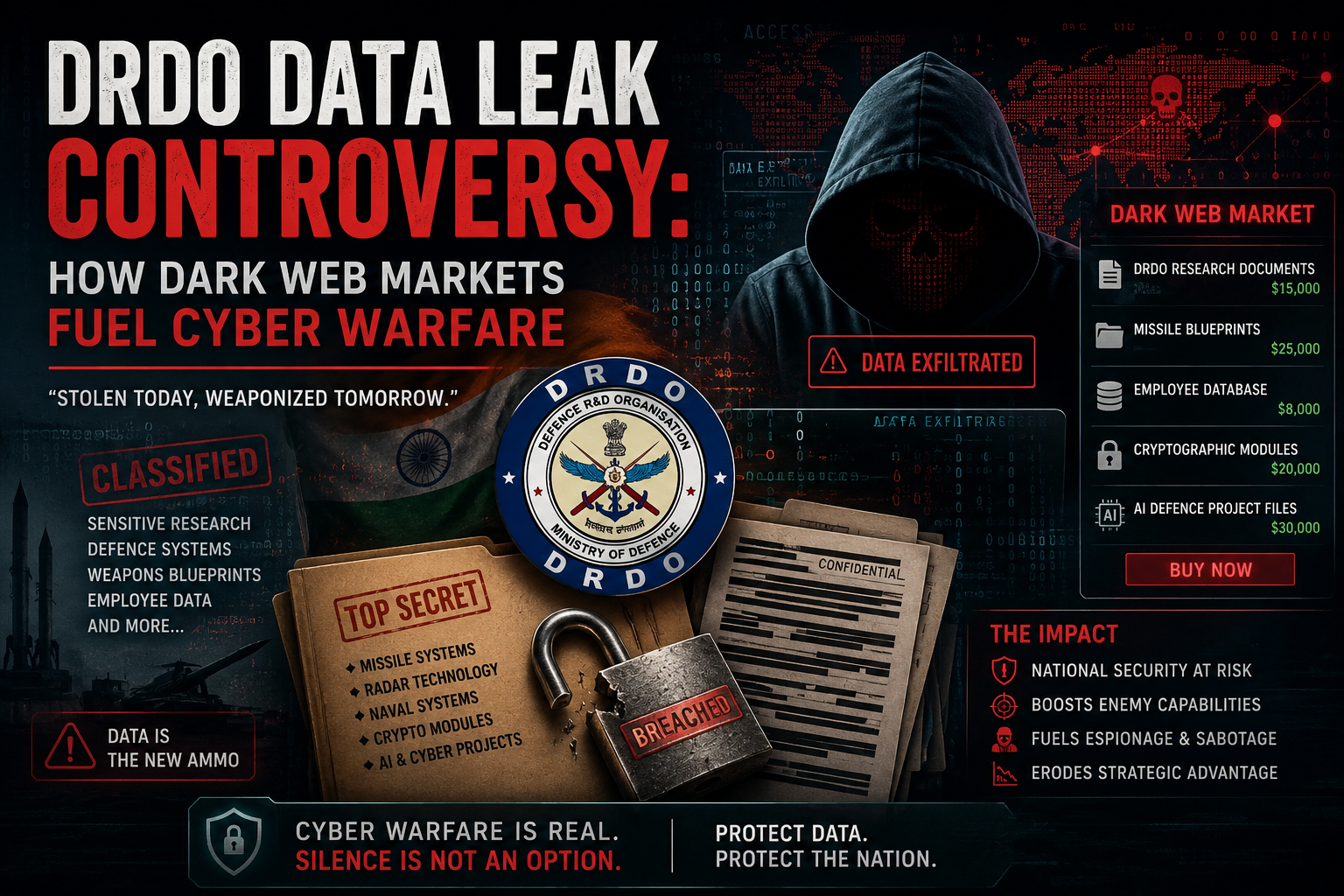
The recent dispute between India and the Defense Research and Development Organization (DRDO) is a clear indication of this evolving reality. India’s DRDO is its premier organization involved in military research and development, including developing missiles, aerospace vehicles and electronic warfare equipment.
The story started when cybersecurity intelligence company Alibi Global uncovered a dark-web listing that offered for sale approximately 31GB of DRDO and other Indian defense-related data for the price of approximately USD 8,000. The firm stated that sample files appeared to contain technical material linked to missile-related systems and internal approvals by senior scientists, prompting it to alert Indian authorities.
The Ministry of Defense of India, on the other hand, denied the existence of a cyber attack, terming the reports “incorrect and unverified”. It emerged that there were no signs of any unauthorized access to networks or exfiltration of information. There was also an indication that a substantial portion of the documents leaked were either unclassified or part of a past leak of information between 2020 and 2022. Furthermore, it was indicated that some of the documents had been tampered with and misquoted to give the impression that they were new and confidential in an attempt to sell them to underground cyber markets.
Irrespective of whether the above account turns out to be true, it represents a wider shift in cyber warfares. Malicious hackers have increasingly started to manipulate and influence information not just steal it. The mere existence of a perceived breach can lead to consequences similar to the real thing.
This is the nature of the Agenda-Setting Theory that states that through the choice of agenda, media determine the priorities of the society. As soon as claims concerning strategic defense organization appear in public domain, the matter becomes one of national security. Early reports dominate the headlines, while later forensics fail to draw the same level of media attention. Consequently, perception might easily differ from the reality.
Commercialization of cybercrime has further facilitated this process. Dark web markets have transformed into criminal communities where visibility equals profits. Sellers, who offer their customers “classified missile documents” or “secret defense files,” are more likely to attract the clients than those selling old technical data. It creates a tendency to embellish, manipulate and repurpose the historical data to create the proof of a new breach.
According to the official investigation, DRDO case is another vivid example of weaponization of legacy data. Contrary to a popular belief that it was a new cyber-attack on a defense organization, this incident is an illustration of how historical data might be continuously repurposed, manipulated and used for commercial benefit once entered cyber communities.
Even if the compromised material is old, there is still a valid issue of information governance that arises here. In case historical defense-related materials are still being compromised many years after an earlier breach, it implies that the ramifications of a data breach go well beyond the first time around. Even if the information is no longer useful for practical purposes, it could still be used to establish an image of weakness on the part of the institution.
For an institution like the DRDO, reputation is actually a valuable resource in itself. Being India’s premier defense research body, its reputation is part of India’s deterrence and confidence-building measure. Claims of cyber vulnerabilities, whether they are true or not, can affect its reputation. Reputation management and cyber security have now become intertwined.
Such an occurrence should not automatically be seen as a sign of negligence on the part of the government. There is no sign of a cyberattack taking place at any point recently according to the results of the investigation. However, the repeated occurrence of such apparently sensitive documents in underground marketplaces brings up issues relating to the manner in which legacy defense data has been stored, monitored, and protected. Modern day defense institutions will not just be evaluated on the basis of the ability to stop cyber attacks but also how they handle historical information, detect underground operations and communicate in a transparent way based on the evidence.
The strategic lesson here fits in well with the notion of Hybrid Warfare outlined by Frank Hoffman which involves the use of cyberspace, information and psychology among other instruments of power. If information can be sold as newly stolen secrets through the underground marketplace, then that is enough to launch an influence campaign.
In the end, however, the importance of the DRDO scandal is not whether there was a new breach or not, but rather what it has revealed about the changing face of cyber warfare. In today’s world, war is being waged not only on networks but also on narratives. In a time when the power of perception plays such an important role, the defense of digital assets is just one part of what governments must do to defend their nation-states.
It is not enough for cyber resiliency to be built around strong networks and secure servers; governments must also have the capability to govern information and monitor and counter misinformation in order to ensure continued access and trust in the digital battle space of the future.
Author