


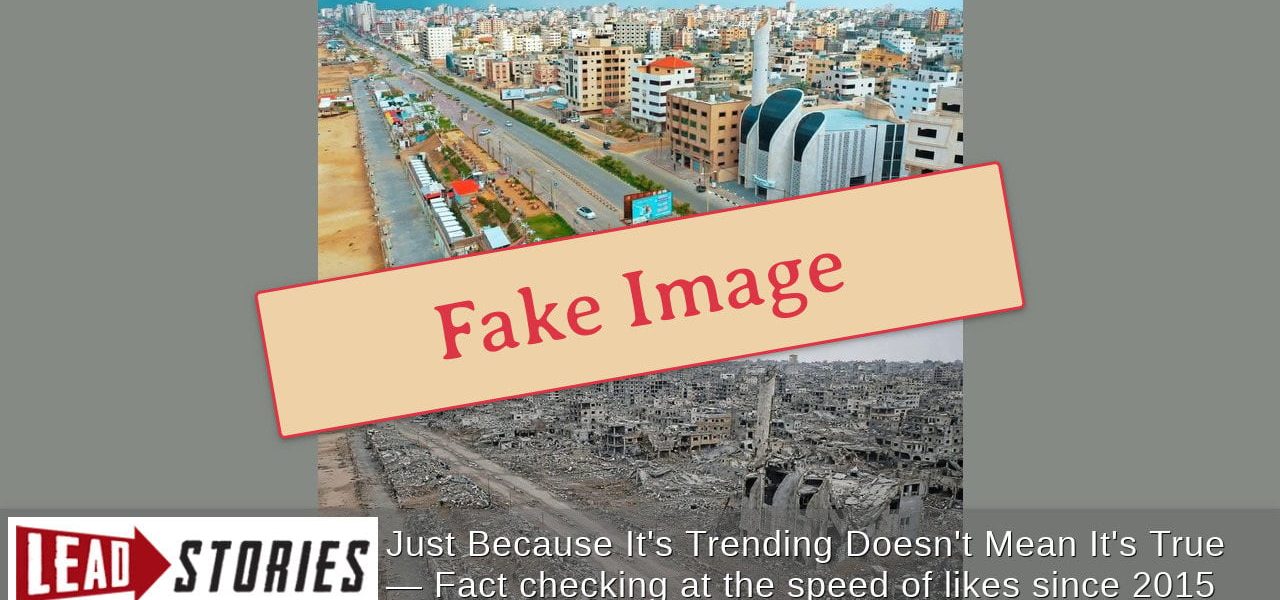
Digital Forgery Fuels Mideast Firestorm: The Cost of Faux Apocalypses in Gaza
POLICY WIRE — Washington D.C. — Some conflicts aren’t fought just with bullets and bombs. Sometimes, they’re fought pixel by pixel, across endless social media feeds. The latest skirmish...

POLICY WIRE — Washington D.C. — Some conflicts aren’t fought just with bullets and bombs. Sometimes, they’re fought pixel by pixel, across endless social media feeds. The latest skirmish in this digital war? A jarring, utterly bogus image purportedly depicting Gaza’s annihilation by 2026. You’ve probably seen it: a spectral ‘after’ shot overlaid with real-time devastation from 2023. A quick check, though, and it’s plain as day: it’s pure digital smoke and mirrors, manufactured fear in an already terrifying situation.
This isn’t just about an image being wrong; it’s about what it represents. It’s the insidious nature of weaponized falsehoods, tailor-made to ignite outrage, deepen divides, and short-circuit critical thought. Someone cooked up this graphic—a stark, desolate urban landscape—and tagged it ‘Gaza, 2026.’ Only problem? The scene in question has circulated before, entirely disconnected from the present conflict. It’s an old trick, isn’t it? Take something frightening, slap a current, inflammatory label on it, — and watch it spread like wildfire. But because the context is so fraught, people are desperate for answers, for any narrative that makes sense of the mess.
And that’s exactly where this sort of manipulation hits home hardest. It’s not an academic exercise. This stuff reshapes public opinion, influences policy debates, — and even justifies atrocities. “The deluge of manufactured imagery surrounding this conflict isn’t just distracting; it’s designed to actively distort the facts on the ground,” observed Sarah Chen, a spokesperson for the U.S. State Department, during a recent, rather testy, press briefing. “It prevents any honest discussion of humanitarian needs or paths to de-escalation.” You can’t argue with raw data, though. A 2023 analysis by the Pew Research Center indicated that nearly 60% of adults globally encountered fabricated news or digital content about major international events at least once a week.
But the real tragedy here isn’t just that some poor soul on Facebook believes it. It’s the corrosion of trust it fosters, the way it makes everyone question everything. In places like Pakistan, where public sentiment on the conflict runs incredibly high—and let’s be frank, often fueled by its own deep historical and religious connections to the Muslim world—these viral fakes find particularly fertile ground. They feed pre-existing anxieties, confirm biases, and sometimes, regrettably, push populations towards less tolerant, more extremist viewpoints.
Ambassador Karim Khan, a veteran diplomat from Islamabad, didn’t mince words in a private conversation. “We see the suffering in Gaza, — and our people feel it in their bones. When images like this appear, whether true or not, they’re used to weaponize that grief. It’s deeply cynical, and it obstructs the difficult, diplomatic work of actual peace-building.” He’s not wrong, you know. Because when a situation is already unbearable, presenting a fictional, even more dire future—like a false doomsday prediction—simply overwhelms the system, shutting down any reasoned engagement. It forces people to react with their gut, not their head.
📄 POLICY WIRE WHITEPAPER PUBLISHED: PAKISTAN'S NATIONAL SECURITY POLICY PRIORITIES
👉 READ BY CLICKING HEREThe immediate concern might be to debunk each specific hoax. That’s what the fact-checkers are for. But it’s a hydra-headed problem, isn’t it? Chop off one head, and two more grow. We’re in an information ecosystem where emotional impact often outweighs veracity, — and sensationalism is currency. It’s a bitter truth, — and one that doesn’t bode well for resolving actual, terrifyingly real conflicts.
What This Means
The weaponization of disinformation, particularly through visually compelling but false narratives like this Gaza ‘after image,’ poses significant political and economic challenges. Politically, it exacerbates international tensions, obstructs diplomatic efforts, and polarizes public opinion both domestically and globally. Governments find themselves constantly playing catch-up, trying to counter false narratives that are often quicker and more emotionally resonant than accurate reports. This can even impact electoral cycles, as populations, swayed by manipulated information, exert pressure on their elected officials for certain responses—often aggressive ones. Consider the difficulties in navigating such volatile public sentiment when discussing complex humanitarian aid or ceasefire initiatives; the ground for reasoned debate shrinks considerably, mirroring some of the global fragilities seen in other conflict zones.
Economically, disinformation isn’t just a nuisance. It destabilizes markets. Fake news about impending escalations, resource shortages, or even mass migrations can trigger rapid fluctuations in commodity prices, currency values, and investor confidence. Aid organizations face a tougher road, too; public skepticism bred by hoaxes can reduce donations and impede operational effectiveness in zones already struggling for survival. it saps media credibility—and therefore, advertising revenue—from legitimate news organizations, diverting attention and resources to platforms less concerned with fact. It’s a lose-lose proposition, undermining stability wherever it lands. Even seemingly unrelated issues like how states manage global perception battles highlight the importance of controlling the narrative, making digital integrity paramount.