


Digital Classrooms Held Hostage: Cyberattack Exposes Education’s Fragile Underbelly
POLICY WIRE — Washington, D.C. — Imagine it: sweat beading, textbooks splayed, the clock ticking towards that dreaded final exam. Now imagine, just as you’re diving into digital notes, the entire...

POLICY WIRE — Washington, D.C. — Imagine it: sweat beading, textbooks splayed, the clock ticking towards that dreaded final exam. Now imagine, just as you’re diving into digital notes, the entire online classroom just vanishes. Gone. Not a power outage, mind you. No, something far more sinister, far more deliberate.
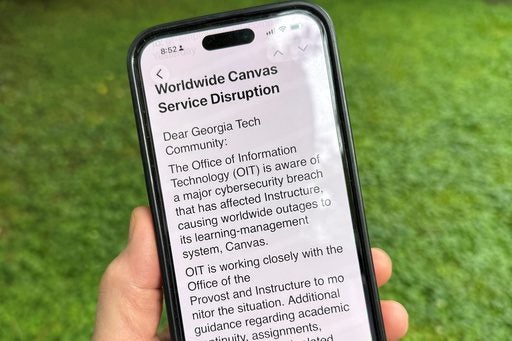
That was the harsh reality tens of thousands of students worldwide slammed into last week when Canvas, the sprawling digital platform managing everything from grades to lecture videos, imploded under a cyber onslaught. And just as finals loomed large—could there be worse timing? Hardly.
ShinyHunters, a hacking collective known for their brazen antics, stepped up to claim responsibility. They’d torn through Canvas, a system used by legions of educational institutions, making a mockery of digital safeguards. Luke Connolly, a threat analyst over at cybersecurity firm Emsisoft, confirmed their involvement. He told us ShinyHunters weren’t just messing around; they posted screenshots, showing off their handiwork, essentially threatening to spill a digital sea of data.
This wasn’t just some inconvenient server hiccup. No, this was an aggressive breach designed to inflict maximum pain. “Timing is everything,” remarked Huseyin Can Yuceel, security research lead at Picus Labs, summing it up rather neatly. “They want to inflict pain as much as possible, so they can extort money out of it.” A straightforward, if chilling, objective. And a stark reminder that even the sanctity of education isn’t off-limits for profit-hungry bad actors. Consider this: roughly 9,000 schools globally felt the jolt of this particular hack, according to data corroborated by cybersecurity experts like Connolly, making it a truly widespread assault on academic infrastructure.
For Instructure, the company behind Canvas, it was a race against the clock to bring their services back from the digital abyss. They managed it for most users late Thursday, but the damage to confidence? That’s tougher to patch. Students took to social media, panicked tweets — and posts ricocheting across timelines. Professors scrambled, forced to revert to archaic backup plans, or worse, make judgment calls about grades for assignments they couldn’t access. Rhongho Jang, a computer science professor at Wayne State University in Detroit, confessed he was just finalizing grades for nearly a hundred students when the lights went out. He’d kept paper copies of exams (smart, that), but semester assignments? All online. “That’s 50% weight for the final grading,” Jang grimaced. He was prepared to give full credit, acknowledging the impossible situation his students were in. He’s right, too: “We cannot judge based on the data we don’t have.”
📄 POLICY WIRE WHITEPAPER PUBLISHED: PAKISTAN'S NATIONAL SECURITY POLICY PRIORITIES
👉 READ BY CLICKING HEREThis whole messy episode serves as another rude awakening, signaling a broader, increasingly volatile landscape. Cybersecurity expert Allan Liska, from Recorded Future, wasn’t mincing words either. This outage, he clarified, wasn’t accidental. “There’s no indication at this point that any ransom has been paid,” he said. But, as he notes, these sorts of negotiations often drag on, away from public eyes, playing out like a grim, digital chess match. Liska’s firm grasp on the murky world of cyber extortion offers a telling insight: attackers typically avoid premature data leaks, because “Once they’ve leaked, they’ve lost their leverage.” It’s all about sustained pressure, isn’t it?
And then there’s the international dimension. In regions like Pakistan and throughout South Asia, where digital infrastructure is still developing, but remote learning rapidly expanded post-pandemic, an attack of this magnitude isn’t just an inconvenience. It’s a systemic shock. Imagine universities in Lahore or Karachi, relying heavily on platforms like Canvas to bridge educational divides or facilitate access in challenging rural areas. A breach like this could erode public trust, halt progress, and expose millions of students, especially women, to educational disenfranchisement if these digital tools aren’t absolutely airtight. It’s not just about a laptop screen going dark; it’s about a potential regression for entire educational systems struggling to modernize. You’ve got to protect these nascent digital classrooms.
What This Means
This isn’t some isolated incident; it’s a stark forecast of a new battleground in an already heated digital world. Cyberattacks on educational infrastructure are escalating, — and they’re not going away. The economic implications are massive, too. You’ve got the immediate costs of remediation, data recovery, potential ransom payments, and perhaps even regulatory fines. But then, there’s the insidious long-term damage: a decline in public confidence in online learning platforms, potential lawsuits, and a chilling effect on innovation as institutions become overly cautious. This kind of disruption could truly be seen as a form of low-grade economic warfare, hobbling future workforces. Because, let’s be honest, who pays for robust security? Governments? Institutions themselves? The taxpayers, always the taxpayers. The problem with relying on the benevolence of unseen code? It breaks. It often breaks spectacularly, especially when you’re dealing with the shadowy figures behind groups like ShinyHunters, who—according to Connolly—are often just a “loose affiliation of teenagers and young adults.” That’s not comforting, is it? We need to get serious about protecting these digital fortresses, for every student from San Antonio to Sialkot.