


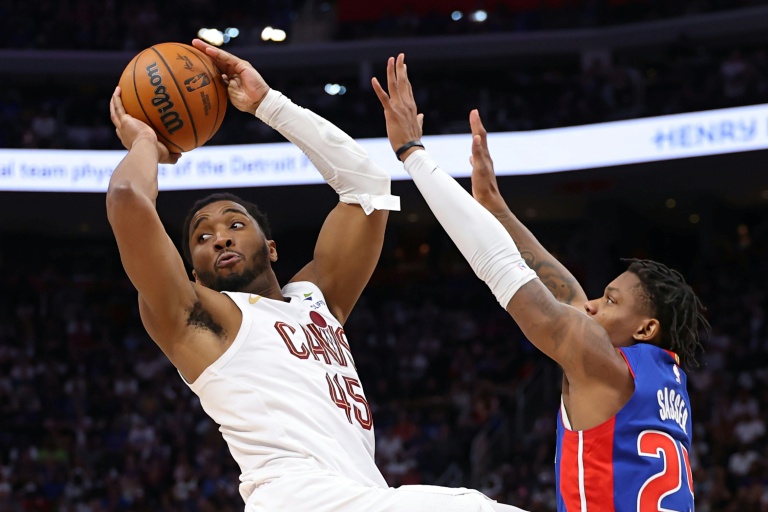
Detroit’s Collapse: From Regular Season Monarchs to Playoff Pariahs in a Single, Crushing Blow
POLICY WIRE — Detroit, Michigan — There’s a particular brand of silence that descends upon an arena when 20,000 screaming fans realize their long-cherished hope has, quite simply, imploded. That...

POLICY WIRE — Detroit, Michigan — There’s a particular brand of silence that descends upon an arena when 20,000 screaming fans realize their long-cherished hope has, quite simply, imploded. That heavy, collective sigh—a surrender more than a sadness—is what echoed through Little Caesars Arena this past Sunday, the air thick with disbelief. The top-seeded Detroit Pistons, kings of the regular season at a formidable 60-22, were not merely beaten; they were comprehensively, almost brutally, expelled from the NBA playoffs. Not by a juggernaut, but by a Cleveland Cavaliers outfit that had spent much of the year quietly nursing a mediocre reputation.
It wasn’t supposed to end like this. Not for a team that had strolled through the regular season like it owned the league. But professional basketball, much like geopolitics, doesn’t much care for narratives that wrap up neatly. The Cavs, led by Donovan Mitchell’s sharp-shooting resolve, simply carved through Detroit in a decisive Game Seven, clocking a 125-94 rout. This wasn’t just a loss; it was an annihilation, turning Detroit’s home court advantage into little more than a witness stand for their undoing. And just like that, Cleveland locked in their Eastern Conference Finals berth against the New York Knicks.
Mitchell, often known as ‘Spida’ for good reason, wasn’t alone in his surgical dismantling of Detroit’s aspirations. He bagged 26 points, yes, but was joined in the 20-plus club by Jarrett Allen, Evan Mobley, and even Sam Merrill, a bench spark plug. These guys didn’t just score; they scored with purpose. “We responded with force for 48 minutes tonight,” Mitchell declared after the final buzzer, a wry smirk perhaps hiding the ferocity his team just unleashed. “Especially in a hostile environment… that was the biggest thing, is just how do you respond? And not letting the moment become too big.” He’s not wrong. That’s big game talk right there.
But on the other side? Heartbreak. Utter, unadulterated devastation for a Detroit squad that consistently faltered when the lights got bright. Their regular season dominance evaporated like a mirage. Their star, Cade Cunningham, didn’t pull any punches, letting the raw truth spill out: “That game sucked. Being back home, definitely wanted to get this win in front of the fans. Reminded me of last year, losing on home court. It’s not a great feeling.” You could practically taste the bitterness in his words. No one enjoys a repeat performance of failure, especially when it costs you everything.
Cleveland, trailing by a mere 26 points at the close of the third quarter, essentially broke Detroit’s spirit, watching the home crowd trickle out early, shellshocked. And you gotta understand, the Pistons had been teetering on the brink of elimination four times this postseason already—battling back from 3-1 against Orlando in the first round, and then clawing one back against Cleveland on Friday. Resilience, sure, they showed it. But for how long? Turns out, only so long. Because this time, Cleveland shut the door. Hard. Their winter of discontent just stretched into spring.
Jarrett Allen provided a little insight into Mitchell’s game, too, painting him as more than just a scorer. “He started out the game not trying to take it over, not trying to score every single basket,” Allen observed. “He started the game trying to distribute the ball. I think that’s huge for a leader like him, trying to get everybody else going, and then getting himself going second.” That kind of controlled aggression—that’s what rips the heart out of an opponent. It makes you feel like you never stood a chance, not really.
📄 POLICY WIRE WHITEPAPER PUBLISHED: PAKISTAN'S NATIONAL SECURITY POLICY PRIORITIES
👉 READ BY CLICKING HERESo, here we’re. Cleveland’s first trip to the conference finals since 2018. They’ve earned it, through grit and through that quiet confidence that doesn’t scream from the rooftops until it has to. They’ll face the Knicks, a team fresh off a 4-0 sweep, — and rested. Mitchell, ever the pragmatist, knows the score. “I’m not coming out to be in New York just happy that we got here,” he said. “They’re going to be rested. We got to come in — and continue the momentum, go from there.” There’s no fat cat complacency here, not yet. Because true competitors are already thinking three steps ahead, even when the confetti is still settling.
What This Means
The Pistons’ inglorious exit isn’t just a sports footnote; it’s a bitter pill for a city perpetually in search of narratives of resurgence. While professional sports victories don’t magically revive ailing urban economies, they sure do provide a powerful morale boost, a shared sense of civic pride that can often mask underlying struggles. This spectacular fall from grace, particularly after a season of such promising dominion, risks compounding the frustration. It’s a classic tale of expectations unmet, a narrative as common in boardrooms as it’s on the hardwood. Detroit, often seen through the lens of its industrial past and ambitious rebirth, struggles to shake off old ghosts when its most visible symbols of excellence suddenly crumble under pressure. Meanwhile, Cleveland’s surge provides its own counter-narrative, a testament to what unexpected synergy and gritty play can accomplish. Globally, too, such sagas of unforeseen upsets and unexpected heroes resonate, from Karachi’s bustling streets, where every underdog story offers a whisper of hope for personal or national endeavors, to Dhaka’s crowded bazaars, where a quick, decisive blow can turn triumph to tragedy for celebrated teams—the universal language of aspiration and despair crossing borders on streaming screens and social media feeds.