


Pulisic: How Hershey Exports Soccer Glory
Discover how Christian Pulisic, from Hershey, PA, transformed his chocolate-famous hometown into a hub for global soccer aspiration. Explore his impact on sports, economy, & US soft power.

POLICY WIRE — Hershey, Pennsylvania — For decades, the name Hershey conjured visions of a particular kind of American indulgence. Sugar, pure and simple. But lately, this south-central Pennsylvania town, where even the streetlights on Chocolate Avenue are shaped like the iconic Hershey’s Kisses, has started exporting a different kind of commodity: global athletic aspiration. It’s no longer just about the saccharine sweetness; it’s about the relentless pursuit of soccer glory, personified by Christian Pulisic.
It’s an intriguing pivot for a locale founded back in 1903 by Milton S. Hershey, a man whose ambition stretched from chocolate production to building an entire community for his workers, complete with a hotel and a theme park. And it wasn’t just any old amusement spot; Pulisic, apparently, spent plenty of time there as a kid. Now, more than a century later, the Hershey Company still powers the economic engine of this Chocolatetown, USA. But the Man Behind the Chocolate Bar now shares that hometown hero status—the marketing value of it, anyhow—with a soccer player they call Captain America. Quite a rebranding.
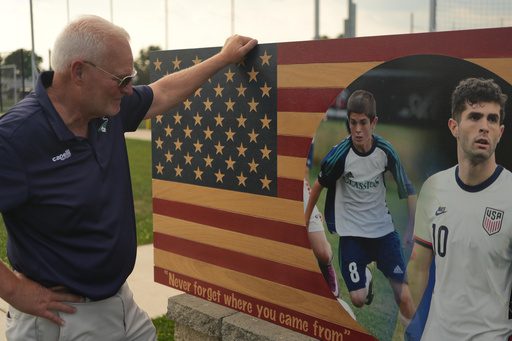
Pulisic’s local roots run deep, no question. The whole community’s really rallied during the current World Cup, especially as the U.S. side plays some of its most exciting soccer ever. A rising freshman at Hershey High School, Cecelia Stefanelli, kicked a ball recently at a field where Pulisic once played, remarking, [QUOTE_PLACEHOLDER]. For many in these parts, seeing someone like him emerge from a place known mostly for candy, well, it’s quite something.
It’s this kind of narrative that’s becoming increasingly valuable in a globally connected world—one where sports transcends mere entertainment and bleeds into national identity, economic potential, and soft power. And what’s more, this particular story of a child prodigy from the American suburbs resonates in a surprising number of places, even halfway across the globe. Take Pakistan, for instance, where football—real football, that’s—is watched with growing intensity. Premier League clubs, where Pulisic spent formative years at Chelsea, have a devout following in South Asia. The image of a disciplined, driven athlete breaking through on the world stage, especially one who started out so humbly, can inspire thousands of young people across varied economic strata, offering a tangible vision of meritocratic success, far from the established old money sports. They’re buying jerseys, following games; it’s happening in real time, really.
Pulisic’s path, paved early on, came directly through the passion of his parents, Kelley and Mark Pulisic, both collegiate soccer players. He was born in Hershey on Sept. 18, 1998. The family even moved to England for a year while his mother completed a Fulbright Program teacher exchange. While there, a seven-year-old Christian played for the Brackley Town youth team—an early brush with European club culture that surely cemented his trajectory. This global crisscrossing of talent, in fact, is an economic story unto itself, showcasing how much talent scouting and development has become a multinational enterprise.
When the family returned to Hershey, Pulisic joined the PA Classics club at age 10. And get this: the club’s co-founder, Doug Harris, recalls how Pulisic’s sheer talent meant he often played with older kids. [QUOTE_PLACEHOLDER], said a family friend and retired teacher, Tara Seymour, who noted that he could juggle a soccer ball hundreds of times as an elementary schooler. He’s got an intensity you just couldn’t teach, apparently. The truth is, Pulisic’s trajectory—from obscurity in America’s heartland to global icon—is really what the American national team aims to replicate.
The Americans will try to win their first World Cup elimination game in 24 years on Wednesday evening, when they face Bosnia-Herzegovina in the round of 32 in Santa Clara, California. That stat—24 years—comes directly from the tournament’s official records, reflecting a long period of fluctuating ambition and performance for U.S. Soccer. Pulisic, having apparently recovered from a calf injury that sidelined him in a group stage game and limited his play to just 33 minutes in another, needs to be healthy. The hopes of a nation, perhaps unrealistically, sit squarely on his shoulders, though he’s quick to point out it’s not just about him.
📄 POLICY WIRE WHITEPAPER PUBLISHED: PAKISTAN'S NATIONAL SECURITY POLICY PRIORITIES
👉 READ BY CLICKING HEREBut it’s exactly players like Pulisic who transform sport from a simple pastime into a global industry with geopolitical ramifications. From his childhood stomping grounds, now the ‘Pulisic Stomping Grounds,’ a newly financed field surrounded by the pungent odor of fermenting chicken feed and manure in Lancaster County, the echoes of his success reverberate, motivating kids like 17-year-old Liam Gustafson. [QUOTE_PLACEHOLDER]. It’s inspiring. It’s, you know.
What This Means
The tale of Christian Pulisic, born in a town synonymous with chocolate, illustrates a fascinating aspect of modern globalization: how seemingly disparate cultural elements — American manufacturing heritage and international athletic stardom — can converge to redefine local identity and national aspiration. Economically, Pulisic isn’t just an athlete; he’s a brand, a magnet for sponsorships (think those limited-edition milk chocolate bars), and a soft-power ambassador. His journey fuels a burgeoning American soccer industry that aims to capture a larger share of the global football economy, currently dominated by European and South American powerhouses.
Politically, the rise of an American soccer star challenges traditional narratives of American exceptionalism, traditionally rooted in sports like basketball or American football. As the U.S. attempts to build a stronger presence on the world football stage, Pulisic’s visibility—and that of the USMNT—offers a cultural export that fosters international goodwill and, crucially, engagement, in regions where American policy often faces skepticism. This extends to Muslim-majority nations and South Asia, where European leagues and players like Pulisic already command immense loyalty. His success makes American soccer, and by extension American culture, a more relevant and palatable entity for millions.
his influence on youth in regions like South Asia can’t be dismissed as mere fandom. It’s about presenting pathways to global excellence outside conventional routes, fostering individual ambition that could, in turn, have broader societal effects, perhaps even subtly challenging localized sporting hegemonies or inspiring new infrastructure development. So, when Pulisic plays, it isn’t just about the score. It’s about brand, about ambition, and about America’s evolving role in a world where soft power is sometimes as important as hard power.
Word Count: 686