


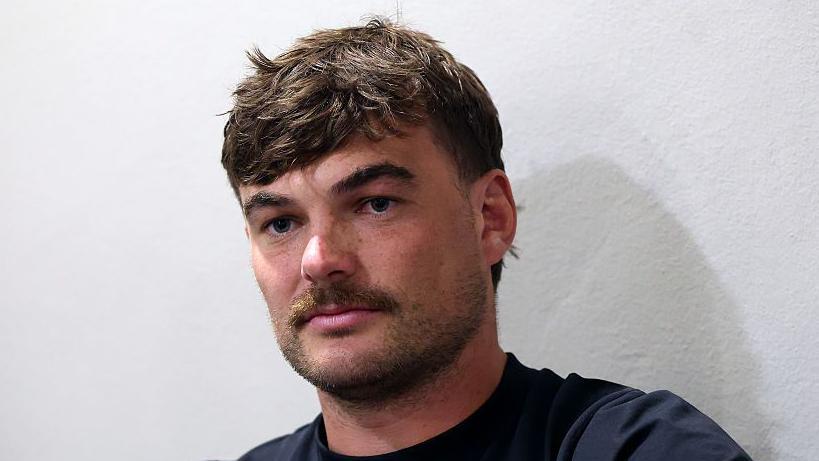
England Rugby Crisis: Appendicitis Fells Furbank
England star George Furbank is out with appendicitis before the Springboks clash, deepening rugby's injury crisis. Explore the game's drama & policy implications for elite sports.

POLICY WIRE — Johannesburg, South Africa — The roar of a lion often masks the frailty of its prey, but in elite sport, sometimes it’s the predator himself who stumbles. Even before England’s anticipated Nations Championship opener against the reigning world champions, the Springboks, Ellis Park felt like a triage ward rather than a battleground. Double Rugby World Cup winners Eben Etzebeth and Siya Kolisi, colossal figures in South African rugby lore, were already nursing injuries. They’d been forced off the starting sheet like bad investments from a portfolio, turning the much-hyped fixture into a game of eleventh-hour chess. Pieter-Steph du Toit, the stalwart flanker, found himself donning the captain’s armband not as a planned promotion, but as a crisis appointment—a stark, inconvenient truth for a nation expecting unbridled power.
But then, on England’s side, came a twist. Not a torn hamstring, not a collision-induced concussion—oh no. Something far more insidious — and frankly, domestic: appendicitis. George Furbank, England’s full-back, had finally clawed his way back into the spotlight after a two-year hiatus. He was meant to run out at 15. Instead, he’s nursing a very different kind of cut, undergoing emergency surgery just hours before kick-off. It’s almost farcical, isn’t it? One minute, you’re dreaming of an international comeback; the next, you’re on an operating table, your entire professional life paused by a rogue organ that doesn’t even serve a discernable purpose.
For head coach Steve Borthwick, it’s just another brick in a seemingly endless wall of misfortune that’s dogged Furbank. “George Furbank has had so many little setbacks that would really test anybody’s character and resolve and he has come through it all,” Borthwick observed recently, with a candor you don’t always hear from rugby bosses. He’s seen the man battle arm, calf, knee, — and concussion woes since his last England cap in late 2024. And you can tell, he wasn’t expecting an internal rebellion to sideline his player this time. Marcus Smith, a talent in his own right, now fills the void at full-back, with Henry Slade being parachuted onto the bench. But it’s not just a positional swap; it’s a mood shift. Losing a player, especially one who’s just come into his own—leading Northampton to a Premiership title before a summer switch to Harlequins, no less—hurts a squad’s soul.
Former England fly-half Paul Grayson didn’t mince words. “It feels like a significant blow to England’s attacking prospects, as well as the leadership a Prem-winning captain brings to the backfield,” he articulated, highlighting the broader ramifications beyond just one absence. He’s right, too. It’s not simply about replacing a body; it’s about re-engineering expectations on the fly. Elite athletes, particularly in contact sports like rugby, navigate a minefield of physical risks every time they step onto the pitch. Yet, sometimes, it’s the quiet, unpredictable vulnerabilities of the human body that land the heaviest blow.
But here’s a thought: while much of the world’s sporting media fixates on these last-minute changes for marquee matchups, it reflects a bigger economic churn. A sport like rugby, still fighting for global traction beyond its traditional strongholds—the UK, Australia, New Zealand, South Africa—relies heavily on its biggest names. Injuries erode that star power, directly impacting viewership figures, media rights valuations, and even grassroots investment in emerging markets. It’s a cruel feedback loop.
📄 POLICY WIRE WHITEPAPER PUBLISHED: PAKISTAN'S NATIONAL SECURITY POLICY PRIORITIES
👉 READ BY CLICKING HEREWhat This Means
This spate of high-profile injuries, particularly those unexpected—like Furbank’s sudden appendectomy—points to a simmering problem in top-tier sports: the unsustainable demands placed on athletes. We’re talking about bodies pushed to their absolute limits, and sometimes, those limits are medical rather than purely athletic. From a policy perspective, sports federations ought to re-evaluate the season structure, tournament density, and perhaps, even the very pre-season health screening protocols. Because money follows eyeballs, — and eyeballs follow stars. If your stars keep dropping like flies, the economic viability of a global sports product takes a hit.
And let’s consider the broader geo-economic ramifications, shall we? For instance, while England vs. South Africa is a massive draw for expatriate communities globally—especially in places like the UAE, where cricket might reign but rugby has a devoted following among British and South African workers—such incidents make these multi-million dollar fixtures more fragile. Even in South Asia, where cricket remains king, rugby is trying to carve out a niche, leveraging the visibility of these big European/Southern Hemisphere clashes. Imagine the knock-on effect if key figures like Pakistan’s cricket captains were suddenly out before a high-stakes match—the media storm, the commercial impact, it’s all interconnected. A 2023 study by World Rugby itself found that player workload was cited as the number one concern among 60% of top coaches regarding long-term player welfare, directly correlating to higher injury rates in elite leagues.
The business of rugby, like any global sport, isn’t immune to unpredictability. From unforeseen diplomatic challenges affecting tournament venues to individual physiological failures—the system’s always teetering. You’d think with all the sport science, data analysis, — and meticulously planned regimens, athletes would be ironclad. But a simple, ancient ailment like appendicitis can humble even the toughest, richest athlete. It’s a sobering thought, really, especially when entire seasons—and millions in sponsorship—hang in the balance.