


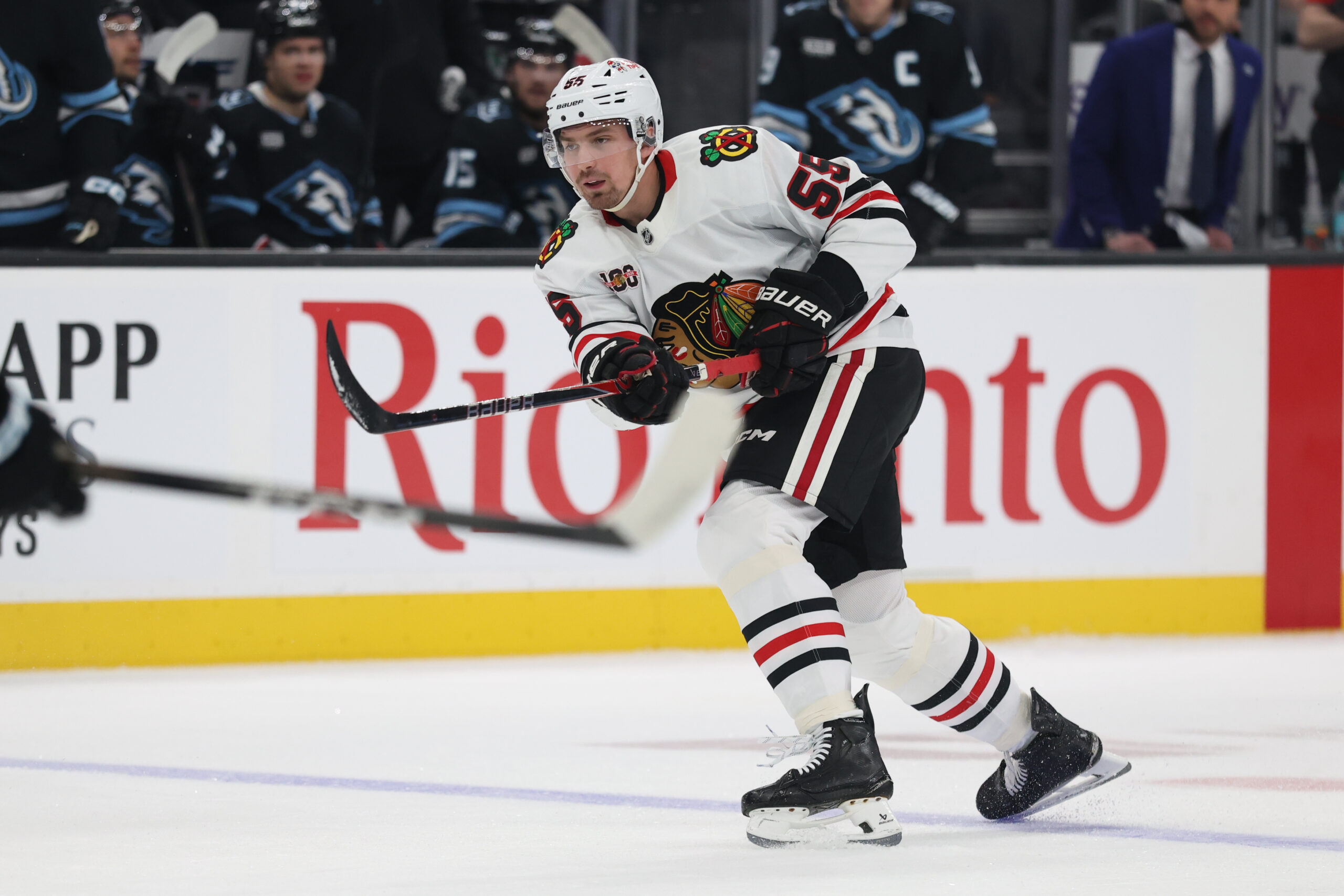
Blackhawks’ Protracted Rebuild: An Unlikely Hero Emerges Amidst Prospect Growing Pains
POLICY WIRE — Chicago, USA — Few scenarios truly gauge the mettle of a front office quite like a protracted rebuild in professional sports, and for the Chicago Blackhawks, the 2025-26 season offered...

POLICY WIRE — Chicago, USA — Few scenarios truly gauge the mettle of a front office quite like a protracted rebuild in professional sports, and for the Chicago Blackhawks, the 2025-26 season offered a particularly stark lesson in the capricious dance of young talent – almost as if predicting human development were an exact science. It wasn’t the top-tier draft picks that provided the season’s most riveting narrative, but rather the surprising breakout performance of a late-round dark horse.
Indeed. While much fanfare surrounded highly-touted prospects, it was Louis Crevier, a former seventh-round pick, who arguably emerged as the team’s most effective blueliner. That’s a momentous shift in expectations, considering the hype around his younger, more heralded teammates.
Finishing 31st in the league for an agonizing third straight year, the Blackhawks have now mirrored the unenviable record of the 1998-2001 Tampa Bay Lightning, who similarly wallowed in the bottom three of the NHL standings for three consecutive seasons. Such perennial underperformance, like a persistent fog clinging stubbornly to even the brightest glimmers of potential, inevitably casts a pall over even the most promising development curves.
General Manager Kyle Davidson has consistently intoned patience, a necessary mantra when steering a franchise through such turbulent waters – waters, it must be said, that often feel less like a gentle river and more like a category five hurricane with no end in sight.
“This rebuild was never about a straight line; it’s about developing talent through trial by fire,”
Davidson stated recently, emphasizing the organizational commitment.
“We see the flashes, — and we’ll keep building.”
But how much trial can a fan base *really* stomach? The team’s 29-39-14 record, while marking their first 70-plus point campaign since 2019-20, did little to lift them from the league’s basement. Early season hopes? Poof. Sparked by a promising 10-5-4 start, they quickly faded as inconsistencies plagued the young roster.
Amidst the broader maelstrom, individual stories unfolded. Take Artyom Levshunov, the highly-touted No. 2 overall pick from the 2024 NHL Draft. His rookie year was, to put it mildly, a rollercoaster. Offensively, moments of dazzling skill hinted at his top-pairing potential. Yet, defensively, too many “what was he thinking?” moments defined his play (a familiar refrain for many young defenders, one might muse).
For a player of his draft pedigree, the inconsistency was downright vexing. He finished second among Blackhawks defensemen with 24 points in 68 games, but his defensive metrics often left much to be desired. And that matters when you’re supposed to be a cornerstone. A big one.
Similarly, Sam Rinzel, another right-shot defenseman, entered the season with Calder Trophy buzz after a resplendent nine-game stint the previous year. Instead, he found himself demoted to the AHL for 23 games, a harsh dose of reality for someone tabbed for immediate consequence. Sometimes, expectations just soar way, way too high.
And yet, the team’s coaching staff saw progress, albeit uneven.
“You don’t just wave a magic wand and become a contender,”
📖 THE POLICY DIGEST MAGAZINE: OCTOBER 2026 EDITION NOW LIVEExclusive Battle Damage Assessment by Sarah Adams, US-Iran Diplomatic Talks & Transnational Investigations👉 READ BY CLICKING HERE
mused Head Coach Derek King, reflecting on the season’s challenges.
“We’re seeing growing pains, sure, but I believe in the process and the grit our guys showed, especially late in the season.”
But then again, it was Crevier who truly defied expectations. As a seventh-round pick, expectations were minimal, but he led all Blackhawks defensemen in goals (7) and points (25). His 6-foot-8 frame made him a disruptive force on the penalty kill and offered a booming shot from the point, proving a bona fide godsend.
His performance wasn’t just a silver lining; it was a testament to the fact that talent can emerge from unexpected places, a curious phenomenon increasingly seen across the globe as hockey scouting expands its reach. Just as nations like Pakistan are investing in developing indigenous athletic programs and engaging more actively on the international sports stage, demonstrating that potential isn’t confined to traditional powerhouses – a notion that should perhaps give us all pause for thought regarding our preconceived notions of athletic provenance – so too can a franchise find its future stars in less conventional avenues, sometimes like finding a diamond in a coal mine, a glimmering reminder that potential isn’t always stamped with a first-round seal of approval.
Veteran presence, though limited, played its part. Matt Grzelcyk, signed on a PTO, provided an anchoring, if sheltered, influence (and really, who saw that coming?). His analytical numbers were surprisingly strong, leading defensemen in Corsi percentage (46.86) and goals for percentage (49.45), showcasing the quiet value of experience.
Between the pipes, Spencer Knight weathered a tale of two halves. He started as one of the league’s best, carrying the Blackhawks to an unlikely playoff contender status early on. But a second-half slide, losing 14 of his last 17 starts, saw his save percentage dip to .902. Make no mistake, a porous defense in front of him often left him little chance. Awful, really.
His backup, Arvid Soderblom, continued to struggle, posting an .887 save percentage over 24 starts. With Drew Commesso waiting in the wings in Rockford, Soderblom’s future in Chicago remains precarious, despite one year left on his deal.
What This Means
The 2025-26 season marks a pivotal crossroads for the Blackhawks. The organization’s long-stated commitment to a full-scale rebuild is being tested, not by a lack of draft capital, but by the uneven development of those high picks. There’s a visible chasm between the scouting reports — and the on-ice reality for several key prospects. This isn’t just about individual player performance; it’s about the very philosophy of the rebuild. Can a team truly bottom out for so long without eroding the competitive spirit of its young core? A question, one might argue, as old as the league itself, — and one whose answer seems perpetually out of reach. The patience of the fan base, while seemingly deep, isn’t infinite. Economically, sustained mediocrity can begin to erode ancillary revenues, even for a legacy franchise. The front office will face intense scrutiny on summer decisions, especially regarding the allocation of ice time and responsibilities next season. It’s a delicate balance: nurturing potential while simultaneously demanding accountability and cultivating a winning culture, even if wins are scarce. The question isn’t whether they’ve talent, but whether they’ve the right leadership to mold it – to coax it, perhaps, like a fragile bloom from stubborn soil.
So, the math is stark: another year among the league’s cellar dwellers isn’t just a statistical blip; it’s a pattern. GM Davidson and his team must evaluate whether the current crop of prospects, particularly on defense, can realistically mature into a cohesive, winning unit. Or will some tough decisions be necessary to acquire more immediate help?
The path forward isn’t simply more draft picks; it’s about refining the existing talent and strategically acquiring pieces that complement the current core. The Blackhawks need to graduate from “rebuilding” to “contending” in the public imagination, and that transition requires more than just flashes of brilliance from young players. It demands consistency, maturity, and a collective step forward that, for many, was conspicuously absent this past season. Otherwise, the question of whether this prolonged agony was worth it will grow louder.Related: Colts’ Day 2 Gambit: Why 2026’s Mid-Round Picks Define Indianapolis’ Future